
Your phone, your breakfast, the air you’re breathing right now: all of it is matter. Matter is anything that has mass and takes up space, but it behaves in ways that are far stranger than that definition suggests. Here are the facts about matter that explain the world around you, from solid ice to glowing plasma. You’ll learn what matter is made of, how the states of matter work, and why the properties of matter decide whether something floats, melts, or burns.
Along the way, you’ll also meet some unexpected facts about matter, including dark matter and antimatter. Whether you’re a student, a parent, or just curious, everything is explained in plain English. Let’s start with the quick version.
Key Takeaways
The key facts about matter at a glance:
- Matter is anything with mass that takes up space, and it’s built from atoms and smaller particles.
- It exists mainly as a solid, liquid, gas, or plasma, and it changes state when temperature or pressure changes.
- Mass stays the same everywhere, but weight depends on gravity.
- Matter isn’t destroyed in ordinary reactions. It only rearranges.
- Ordinary matter makes up only about 5% of the universe. The rest is dark matter and dark energy.
Table of Contents
- Surprising Facts About Matter You Didn’t Know
- What Is Matter?
- What Is Matter Made Of?
- Properties of Matter
- The States of Matter Explained
- Fun Facts About the States of Matter
- How Matter Changes From One State to Another
- Matter vs. Mass vs. Energy
- Everyday Examples of Matter
- What Is Dark Matter?
- Why Is Matter Important?
- Common Misconceptions About Matter
- Simple Experiments to Learn About Matter
- Quick Quiz: Test Your Knowledge
- FAQs About Matter
- Conclusion
Surprising Facts About Matter You Didn’t Know

Start with these eight.
- Atoms are mostly empty space. If an atom were the size of a football stadium, its nucleus would be about the size of a grain of sand at the center.
- Most ordinary matter in the observable universe is plasma. That includes the stars and the thin, hot gas between galaxies.
- Ordinary matter is only about 5% of the universe. NASA estimates that dark matter makes up around 27% and dark energy about 68%.
- Ice floats. It’s about 8% less dense than liquid water, which is why lakes freeze from the top down and fish survive the winter.
- Diamond and pencil graphite are the same element. Both are pure carbon. Only the arrangement of the atoms is different.
- Scientists can cool atoms far below the temperature of outer space. Deep space sits at about 2.7 degrees above absolute zero (−455°F). The first Bose–Einstein condensates were millions of times colder.
- Oxygen makes up about 65% of your body’s mass. Carbon comes second at roughly 18%.
- Neutron star material is almost beyond imagination. A single teaspoon of it would weigh billions of tons.
What Is Matter?
Matter is anything that has mass and occupies space. If something passes both parts of this test, it’s matter:
- Does it contain “stuff” (mass)?
- Does it take up room (volume)?
A rock passes. So does the air in a balloon. A shadow doesn’t, and neither does a song.
People have been asking what matter is for a very long time. Thales of Miletus argued that everything comes from water. His follower Anaximenes of Miletus chose air instead. Later, René Descartes described the physical world in terms of matter and motion.
Modern physics goes deeper. According to Britannica, matter at its most basic level is built from elementary particles called quarks and leptons. Electrons are the best-known leptons.
Keep this simple test in mind as you read the rest of these facts about matter.
What Is Matter Made Of?
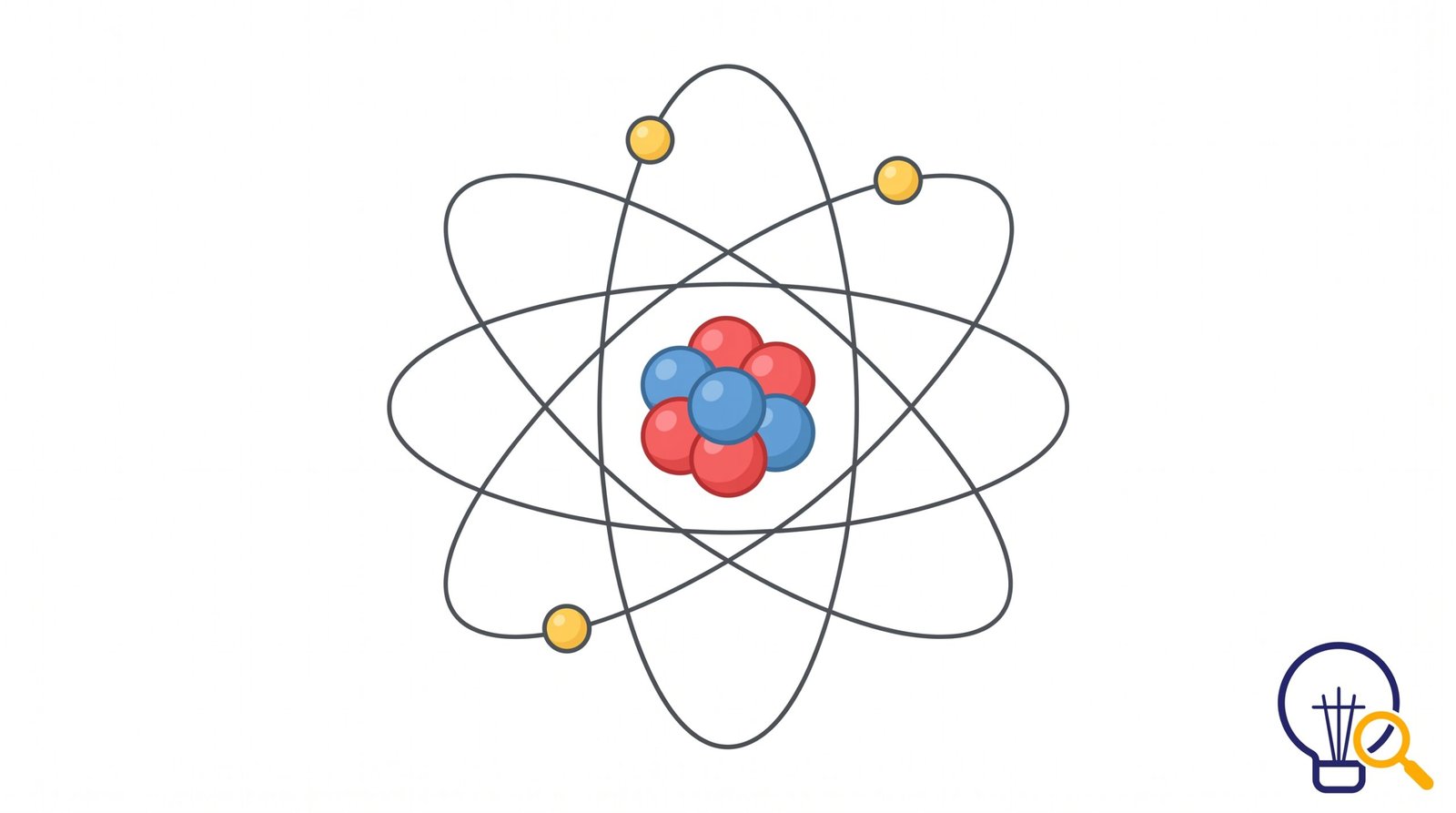
The composition of matter comes down to atoms and the particles inside them. Let’s go from the familiar to the tiny.
Atoms, Elements, and Molecules
Most of the matter around you is made of atoms. Each kind of atom is a chemical element, such as hydrogen, carbon, or iron. When atoms join together chemically, they form molecules. A water molecule, for example, is two hydrogen atoms bonded to one oxygen atom.
Scientists use this classification of matter:
- Pure substances: elements (oxygen) and compounds (water, table salt)
- Mixtures: two or more substances combined but not chemically bonded
- Homogeneous: looks the same throughout, like salt water
- Heterogeneous: visibly different parts, like sand in water
You can separate a mixture with physical methods such as filtering, sieving, or evaporation.
The particles of matter are never still. This idea, called the particle model, says heat makes particles move faster and spread out, while cold slows them down and draws them closer. Attractions between particles, known as intermolecular forces, decide how tightly they cling to each other.
Elements and the Periodic Table
The periodic table arranges all 118 known elements by the number of protons in their atoms. Dmitri Mendeleev published the first widely used version in 1869. Around 90 elements occur naturally on Earth, and scientists have made the rest in labs.
Atoms of these elements are the building blocks of the universe you can see and touch. One of the most amazing facts about matter is that hydrogen and helium alone make up about 98% of the ordinary matter in the universe by mass.
Our picture of the atom took shape in three big steps:
- Around 400 BCE: Democritus proposed that matter is made of tiny, indivisible particles he called atoms.
- Early 1800s: John Dalton showed that each element has its own kind of atom.
- 1911: Ernest Rutherford discovered that atoms have a tiny, dense nucleus.
Subatomic Particles Inside Matter
Atoms themselves have parts:
- Protons (positive) and neutrons (no charge) sit in the nucleus.
- Electrons (negative) move around the nucleus.
Protons and neutrons belong to a family called baryons, so everyday matter is often called baryonic matter. Particles that aren’t built from baryons, such as electrons and neutrinos, are non-baryonic.
A few details are worth knowing:
- Most of a proton’s mass doesn’t come from its quarks. The quarks account for only about 1%. The rest comes from the energy of the force binding them together.
- About 100 trillion neutrinos pass through your body every second. Almost none of them interact with you at all.
- The Pauli exclusion principle is largely why you don’t fall through the floor. It stops electrons from piling into the same state, which keeps atoms from squashing together.
From Big to Small: Matter’s Scale
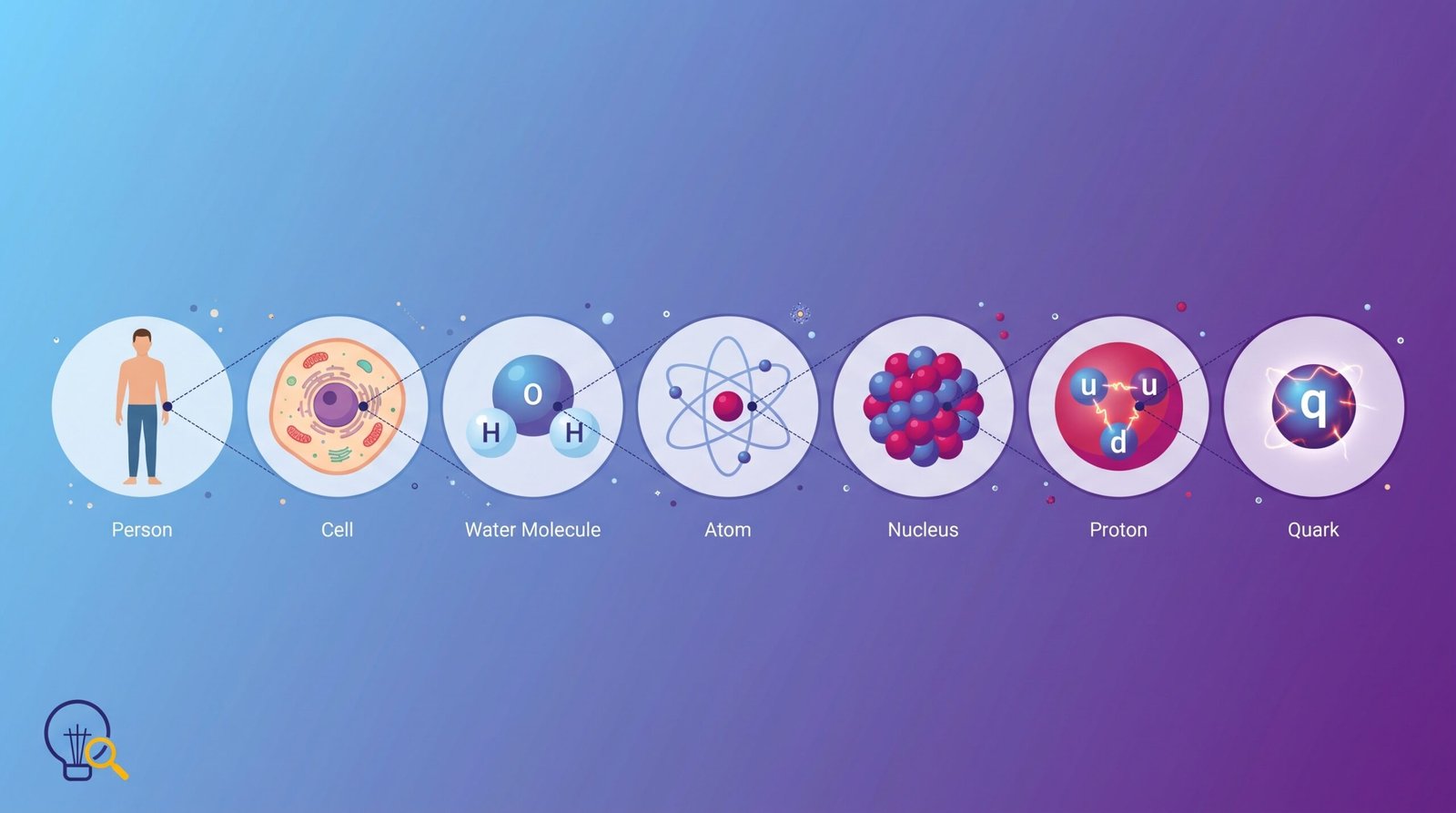
Here’s how a living thing breaks down, with approximate sizes:
- Organism (a person is about 5.5 feet tall)
- Organs and tissues
- Cells (typically 10 to 100 micrometers across)
- Molecules (a water molecule is about 0.3 nanometers)
- Atoms (about 0.1 nanometers)
- Nucleus (roughly 10,000 to 100,000 times smaller than the atom)
- Protons and neutrons (about one quadrillionth of a meter)
- Quarks (no size has been measured yet; they behave like points)
Properties of Matter
Properties are how scientists describe a substance and identify it. Many familiar behaviors, like why ice floats or why gold sinks, come down to one of them. Plenty of facts about matter trace back to density.
Physical Properties
Physical properties are the measurable properties you can observe without changing what the substance is. The main ones are:
- Mass and volume
- Density
- Melting and boiling points
- Color, texture, and hardness
You calculate density by dividing mass by volume.
Density = mass ÷ volume
Because pure substances have a fixed density, it works like a fingerprint. Say you have a metal block with a mass of 200 g and a volume of 25 cm³. Its density is 8 g/cm³, which is very close to iron (about 7.9 g/cm³). Gold, by comparison, is about 19.3 g/cm³, and water is 1 g/cm³.
Chemical Properties
Chemical properties describe how a substance reacts with others. You only see them when the substance turns into something new. Common examples include iron rusting, wood burning, and silver tarnishing.
| Physical property | Chemical property | |
| Changes the substance? | No | Yes |
| Examples | Density, color, melting point | Flammability, rusting, reactivity |
| How you observe it | Measure or look | Run a reaction |
The States of Matter Explained
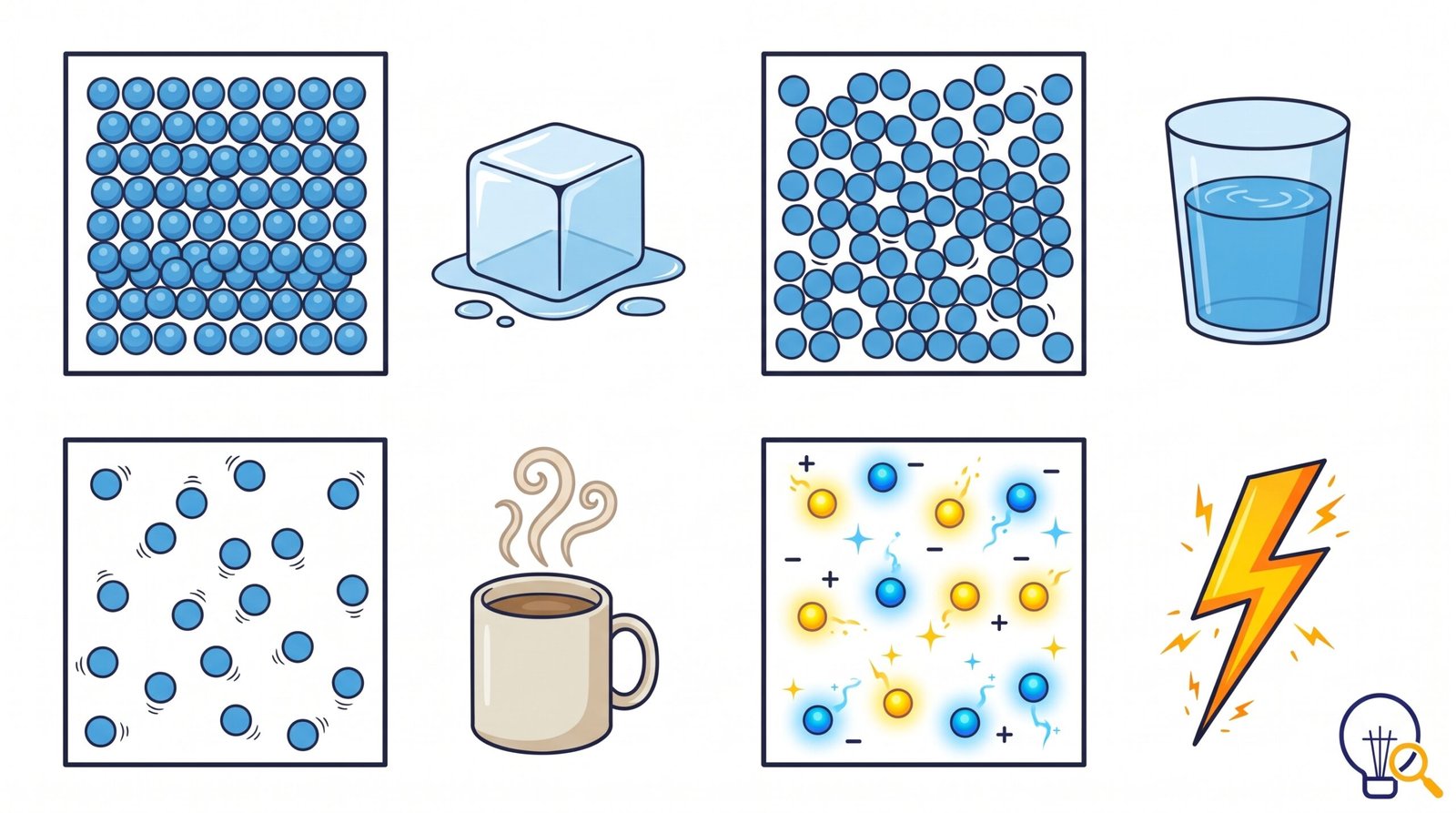
The states of matter are the heart of any science lesson. Each phase of matter has its own particle behavior.
| State | Shape | Volume | Particle behavior | Examples |
| Solid | Fixed | Fixed | Tightly packed, vibrating in place | Rock, wood, ice |
| Liquid | Takes container’s shape | Fixed | Close, sliding past each other | Water, oil, honey |
| Gas | Fills container | Not fixed | Far apart, moving freely | Air, helium, steam |
| Plasma | No fixed shape | Not fixed | Ionized, electrically charged | Neon signs, the Sun |
Liquids and gases are both called fluids, because they flow.
Solids
In a solid, particles are held in fixed positions and can only vibrate. This is why solids keep their shape and are very hard to compress. Many solids, like salt and ice, arrange their particles in neat repeating patterns called crystals.
Liquids
Liquid particles stay close but can slide past each other, so liquids flow and match their container. Cohesive force, the pull between similar particles, holds them together. How easily a liquid flows is its viscosity. Honey has high viscosity, and water has low viscosity.
Gases
Gas particles are far apart and barely attract each other, so a gas spreads out to fill any space. This gives gases high compressibility. Diffusion is easy to notice. When someone opens a bag of popcorn across the room, gas particles carry the smell to you.
Plasma
Plasma forms when a gas gets energetic enough to knock electrons off its atoms. This process is ionization, and it leaves a soup of charged particles that conducts electricity and responds to magnets.
You can spot plasma in:
- Lightning
- The northern and southern lights
- Neon signs and fluorescent bulbs
- A plasma globe on a science-store shelf
- The Sun and other stars
- Older plasma TVs
Bose–Einstein Condensate
In the mid-1920s, Satyendra Nath Bose and Albert Einstein predicted that a gas of bosons cooled close to absolute zero (−459.67°F, or −273.15°C) would behave in an odd way. The atoms would stop acting like separate particles and merge into a single quantum wave.
It took until 1995 to prove it. Eric Cornell and Carl Wieman at JILA in Colorado made the first condensate using rubidium atoms, and Wolfgang Ketterle at MIT made another with sodium shortly after. The three shared the 2001 Nobel Prize in Physics.
Scientists often call it the fifth state of matter, but it isn’t the only exotic option:
- Superfluid helium flows without friction and can creep up the walls of its container.
- Quark–gluon plasma, created in particle colliders, recreates conditions from the early universe.
Fun Facts About the States of Matter
Six fun facts about matter’s states, all backed by real numbers:
- Water can be solid, liquid, and gas at once. This happens at the “triple point,” at 32.02°F (0.01°C). The pressure there is only about 0.6% of normal sea-level air pressure, so you’ll never see it in your kitchen.
- Mercury isn’t the only metal that’s easy to melt. Mercury is the famous liquid metal, but gallium melts at about 86°F (30°C), so a lump of it can melt in your hand.
- A bedroom full of air weighs about 70 pounds (roughly 33 kg). That’s for a 10 × 12 ft room with an 8 ft ceiling. You don’t feel it because you’re surrounded by it.
- Liquids barely compress, even at the bottom of the ocean. At the deepest point of the Mariana Trench, water is compressed by only about 5%.
- Lightning heats the air around it to roughly 50,000°F. That’s about five times hotter than the surface of the Sun.
- Dry ice skips the liquid stage. At normal pressure, solid carbon dioxide at about −109°F turns straight into gas.
How Matter Changes From One State to Another
Changes of state happen in your kitchen every day. They occur when temperature or pressure changes, and they’re also called state transitions.
Melting, Freezing, Evaporation, Condensation, and Sublimation
| Change | Direction | Everyday example |
| Melting | Solid → Liquid | Butter softening in a warm pan |
| Freezing | Liquid → Solid | Water becoming ice cubes |
| Evaporation / Vaporization | Liquid → Gas | Puddles drying after rain |
| Condensation | Gas → Liquid | Water beads on a cold drink |
| Sublimation | Solid → Gas | Mothballs shrinking; freeze-drying food |
| Deposition | Gas → Solid | Frost forming on a window |
One small distinction is worth knowing. Evaporation happens at the surface at any temperature. Boiling happens throughout the liquid at its boiling point.
What Happens to Energy During a Change of State?
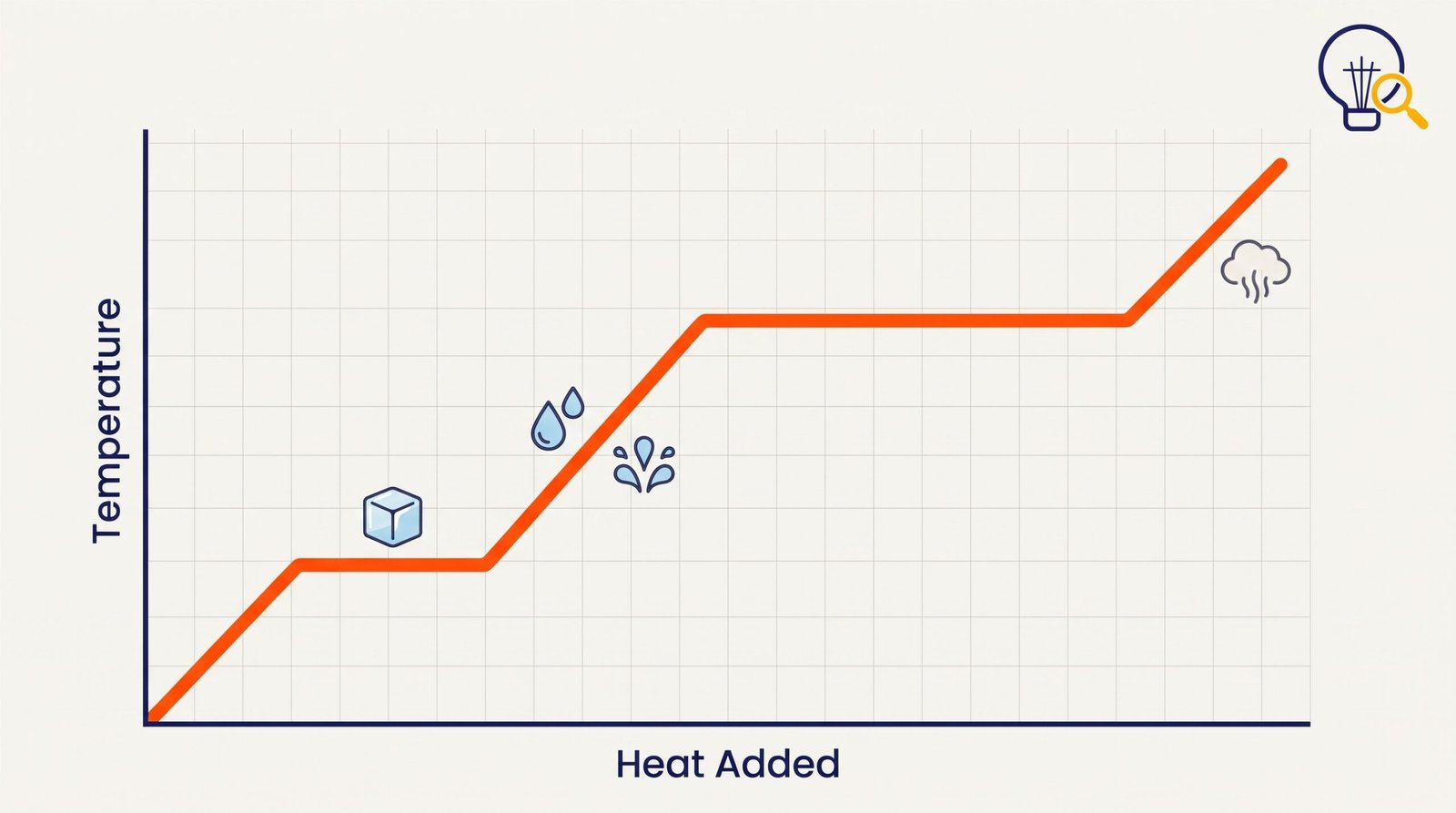
When you heat ice, its temperature rises until it reaches 32°F (0°C). Then it stops. It stays there until all the ice has melted, even though you’re still adding heat.
Where does the energy go? It goes into breaking the bonds that hold the particles in place, not into raising the temperature. This hidden energy is called latent heat, and it’s larger than you’d expect:
- Melting 1 gram of ice takes about as much energy as warming liquid water by roughly 144°F (80°C).
- Boiling away 1 gram of water takes about as much energy as warming it by roughly 970°F (540°C).
Steam burns are so serious for this reason. Steam carries all that extra energy and dumps it on your skin as it condenses
Pressure matters too. Water boils at 212°F (100°C) at sea level, but in Denver it boils at about 202°F because the air pressure is lower. A pressure cooker does the opposite. It raises the pressure and lets you cook at a higher temperature.
Matter vs. Mass vs. Energy
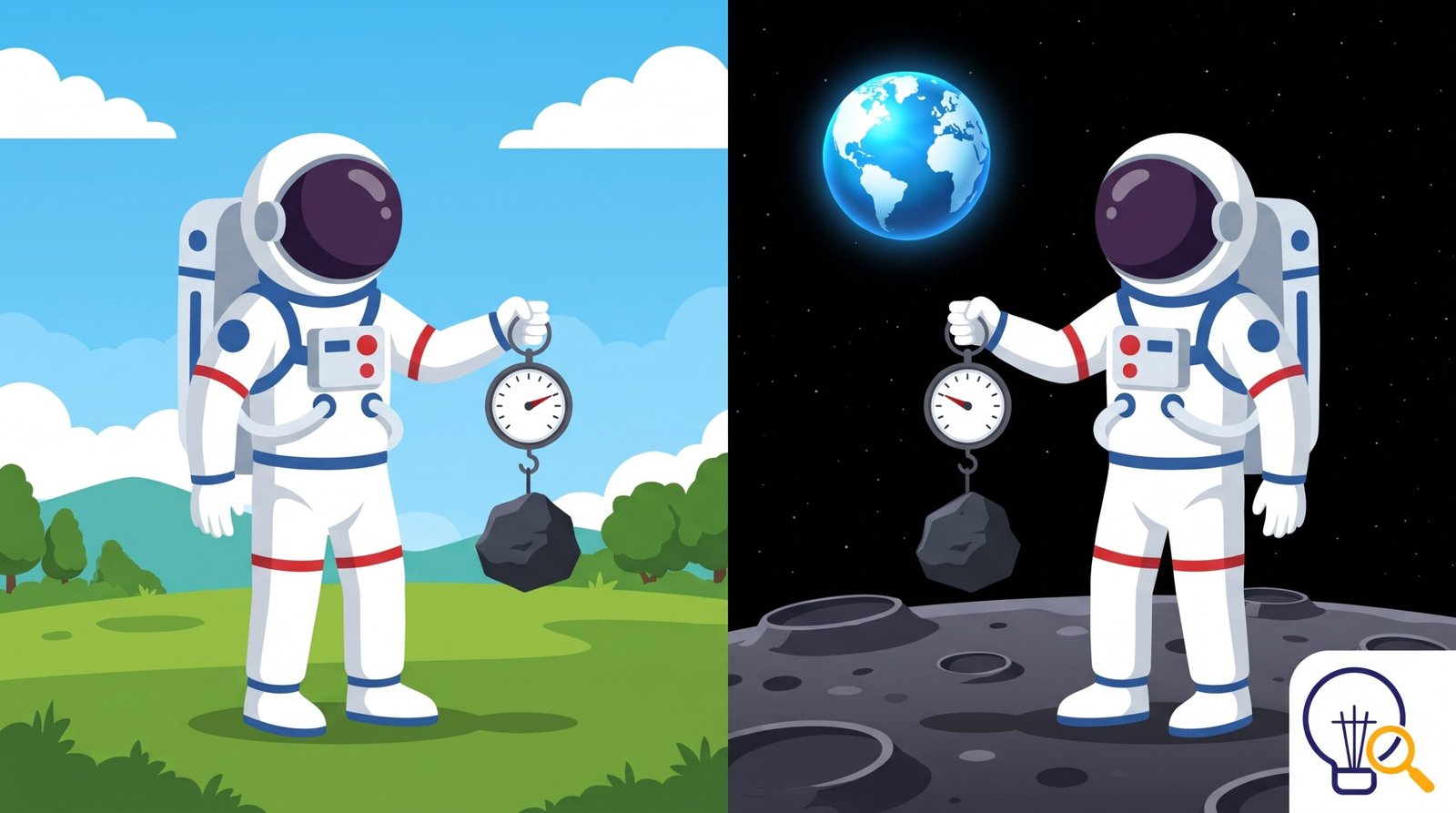
The mix-up between mass and weight trips up almost everyone. This table separates the four terms.
| Term | What it means | Changes with location? |
| Matter | The physical stuff itself | No |
| Mass | The amount of matter in an object | No |
| Weight | The pull of gravity on that mass | Yes |
| Energy | The ability to cause change or do work | No, but it changes form |
The U.S. Nuclear Regulatory Commission’s Science 101 guide uses this idea well. Your mass is the same anywhere in the universe, but your weight depends on gravity. On the Moon, where gravity is about one-sixth of Earth’s, a 150-pound (68 kg) person would weigh around 25 pounds (11 kg). They’d still be made of exactly the same amount of matter.
Even on Earth, your weight changes slightly. You weigh a little more at the poles than at the equator.
Matter also carries energy, including kinetic energy (motion) and heat. That connection is part of why energy and matter are so closely linked in physics.
Law of Conservation of Mass
French chemist Antoine Lavoisier showed in the late 1700s that in a closed system, matter isn’t created or destroyed during a chemical reaction. It only rearranges.
Think about a burning log. It looks like most of it disappears, but the wood turns into ash plus carbon dioxide and water vapor that drift into the air. Collect everything, and the total mass matches what you started with.
There’s one famous exception. In nuclear reactions, a small amount of rest mass converts into energy, as described by Einstein’s matter-energy equivalence. The Sun does this constantly. It converts roughly 4 million tons of its mass into energy every second.
Everyday Examples of Matter
You don’t need a lab to see facts about matter in action. Walk through a typical morning:
- Your alarm clock is a solid.
- Tap water and orange juice are liquids.
- The steam above your coffee is a gas.
- The glow of an overhead fluorescent light comes from plasma.
Your breakfast table shows all three common states at once: a solid bowl, liquid milk, and the air around you.
Things That Are Matter and Things That Aren’t
| Matter | Not matter | Why |
| Air | Light | Light is electromagnetic radiation, made of photons that have no rest mass |
| Water | Heat | Heat is energy moving between objects |
| Your body | Sound | Sound is a vibration, not a substance |
| Stars and planets | Thoughts and emotions | They aren’t physical objects |
| Food | Ideas | They have no mass or volume |
Yes, air is matter. It has mass and takes up space. Light doesn’t have mass, so the popular question “is light matter?” gets a clear no.
What Is Dark Matter?
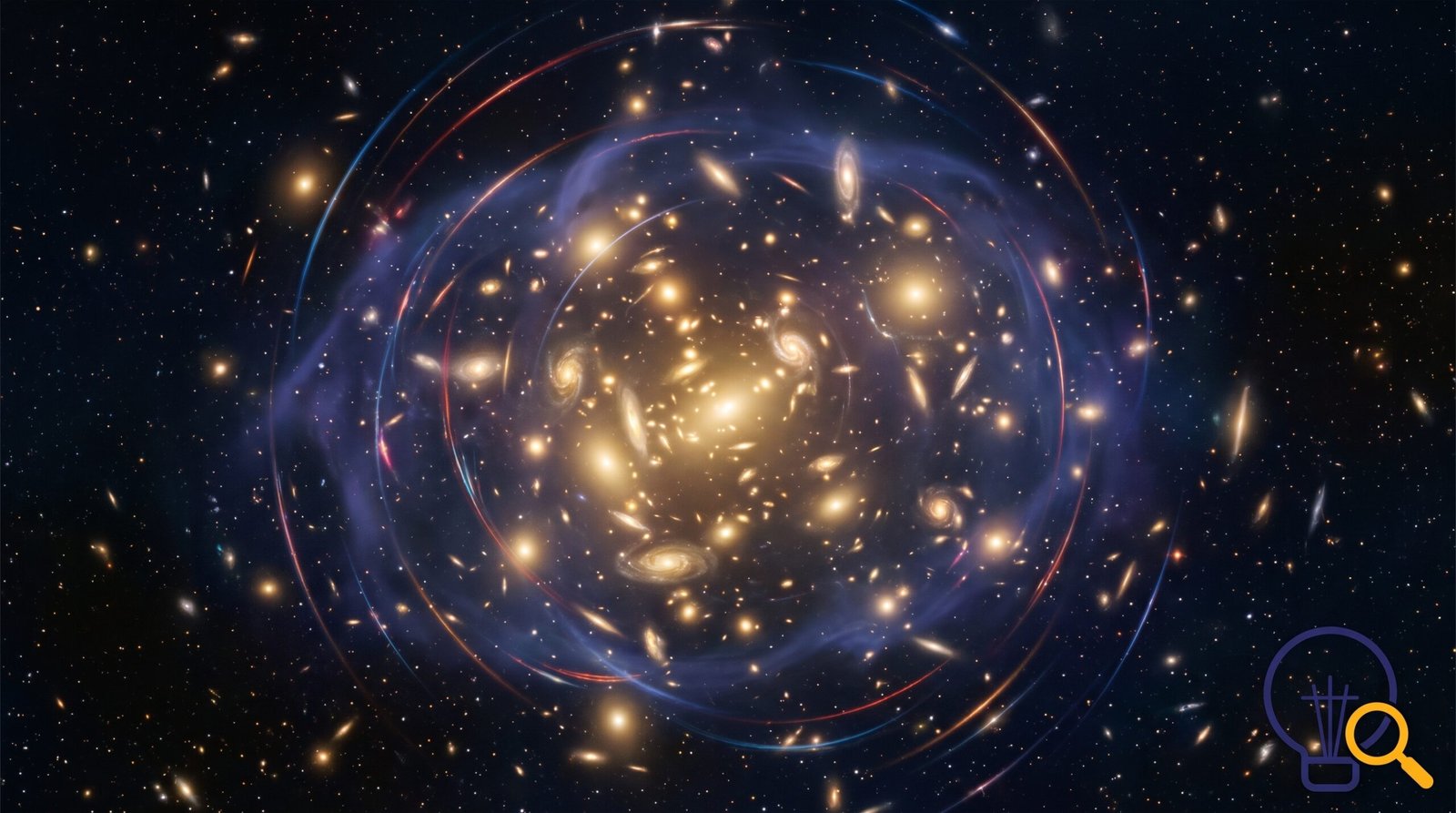
Dark matter is where the facts about matter get strange. It’s a form of matter that doesn’t absorb, reflect, or give off light, so no telescope can see it. We know it’s there mainly because of its gravitational pull.
Here’s how scientists found it:
- Fritz Zwicky noticed in the 1930s that galaxies in the Coma Cluster moved too fast for their visible mass to hold them together.
- Vera Rubin showed in the 1970s that stars far from the center of a galaxy orbit at nearly the same speed as stars near it. That only works if a large amount of unseen mass surrounds the galaxy, including our own Milky Way.
- Gravitational lensing bends light from distant galaxies. Mapping that bending reveals where extra mass sits.
- Patterns left over from the Big Bang also point to matter that doesn’t interact with light.
Interesting Facts About Dark Matter
- Dark matter makes up about 27% of the universe’s total content. Set dark energy aside, and that works out to roughly 85% of all matter.
- It likely helped galaxies form. Its gravity pulled ordinary gas together in the early universe.
- Astronomers use lensing surveys to build maps of where it’s located across the sky.
- It still hasn’t been detected directly. Underground experiments have searched for it for years without a confirmed result.
- Dark matter isn’t dark energy. Dark matter pulls things together with gravity, while dark energy seems to push the universe’s expansion faster.
- Dark matter isn’t normal matter. It almost certainly isn’t made of atoms, and it doesn’t interact with light.
Matter vs. Antimatter
Antimatter is a different idea, and it’s not the same thing as dark matter. Every particle has an antiparticle with the same mass but opposite charge. The antimatter partner of the electron is the positron, discovered by Carl Anderson in 1932.
When matter and antimatter meet, they annihilate, turning entirely into energy. It isn’t just science fiction either:
- Hospitals use positrons in PET scans.
- Bananas release a positron roughly every 75 minutes, thanks to a natural form of potassium.
- Scientists at CERN have held antihydrogen atoms in magnetic traps for minutes at a time.
The big puzzle is why the universe has so much more matter than antimatter. After the Big Bang, there was only about one extra matter particle for every billion pairs. Those leftovers became everything we can see. Nobody knows for sure why the balance tipped that way.
Why Is Matter Important?
The most practical reason matter matters is that we build everything from it. It’s the reason you have air, food, shelter, and a body to enjoy them.
It shows up in daily life like this:
- Cooking: recipes are a mix of state changes and chemical reactions.
- Weather: rain, snow, and fog are water changing state.
- Medicine: drug molecules work by fitting precisely onto molecules in your body.
- Technology: silicon, the main material in computer chips, is chosen for its electrical properties.
- Construction: engineers pick steel, concrete, or glass by comparing density, strength, and melting point.
Chemistry is the study of matter and how it changes, so almost every science class you take builds on this topic.
Common Misconceptions About Matter
Even people who know plenty of facts about matter get these wrong.
- “Gas has no weight.” It does. A basketball weighs more when it’s pumped up than when it’s flat.
- “An empty container is empty.” It’s usually full of air.
- “Mass and weight are the same.” They’re related, but weight depends on gravity and mass doesn’t.
- “Burning destroys matter.” It only changes form, as the burning log example above shows.
- “Glass is a slow-flowing liquid.” It isn’t. Glass is an amorphous solid, meaning its particles lack a repeating pattern. Old windows look thicker at the bottom because of how the glass was made, not because it flowed.
- “Fire is a state of matter.” Fire is a chemical reaction called combustion. It gives off hot gases and light, and only a small part of a flame is ionized.
Simple Experiments to Learn About Matter
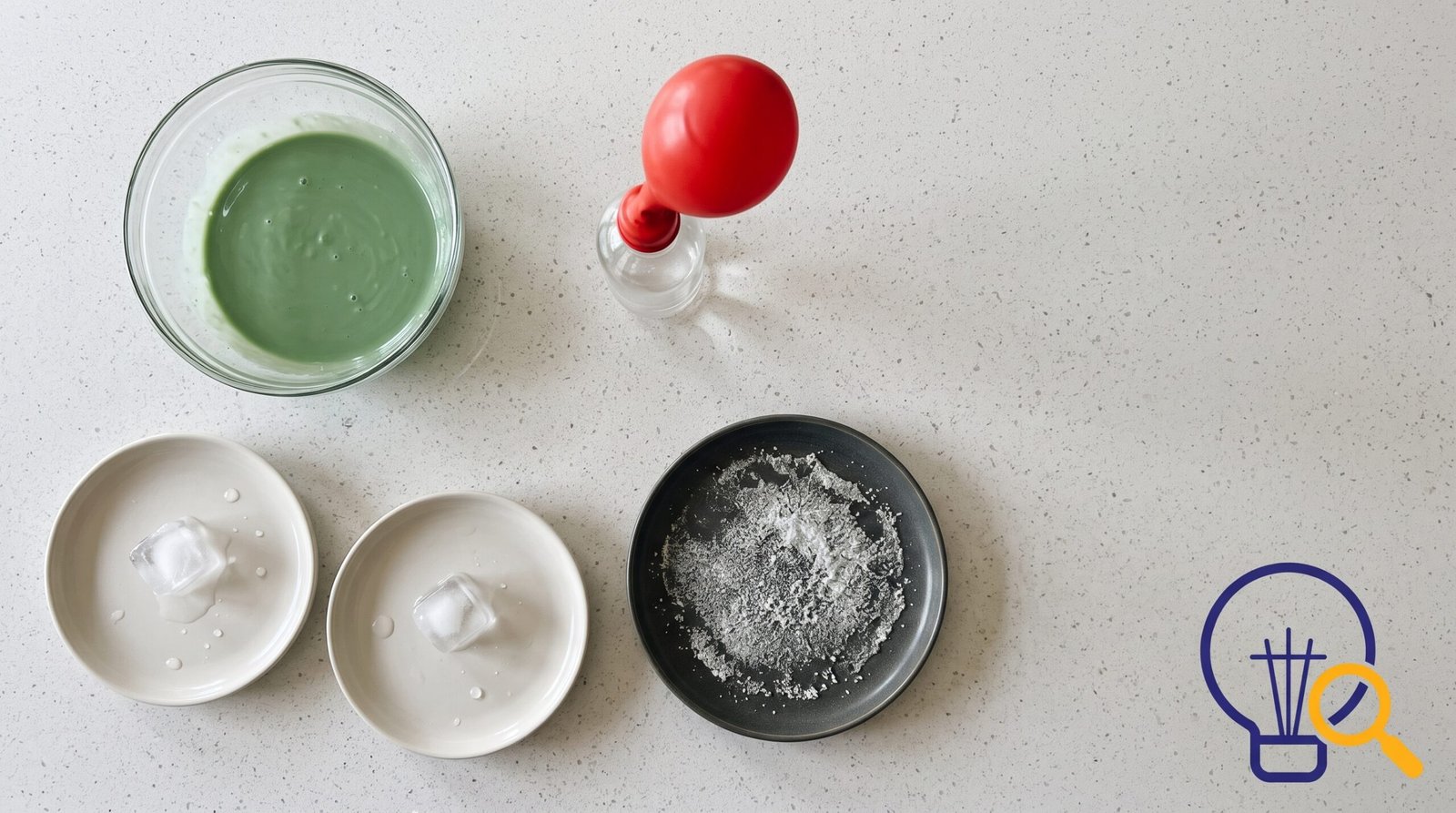
Reading about matter is good. Seeing it happen is better. These four matter experiments for kids work just as well for adults, and you only need kitchen items.
1. Melting Race
Materials: 2 ice cubes, 2 plates, a warm spot, a cool spot
Steps: Put one cube in each place and time how long each takes to melt.
What it shows: Temperature changes the speed of melting.
2. Salt Water Recovery
Materials: 1 tablespoon of salt, 1 cup warm water, a dark plate
Steps: Dissolve the salt, pour the water onto the plate, and leave it in a sunny window for a day or two.
What it shows: Dissolving is a physical change. When the water evaporates, the salt remains.
3. Balloon Gas Test
Materials: A bottle, vinegar, baking soda, a balloon
Steps: Add vinegar to the bottle, put a spoonful of baking soda into the balloon, stretch the balloon over the bottle’s neck, then lift the balloon so the soda drops in.
What it shows: The gas produced takes up space, so the balloon inflates.
4. Oobleck
Materials: 2 cups cornstarch, 1 cup water, a bowl
Steps: Mix slowly, then try poking it fast and letting it sit.
What it shows: It flows like a liquid when you pour it but turns firm when you hit it. Some matter doesn’t fit neatly into one category.
Safety note: Keep an adult nearby. Never seal a bottle in the balloon test, don’t taste any experiment, and throw oobleck in the trash instead of down the drain, because it can clog pipes.
Quick Quiz: Test Your Knowledge
See how much you remember with five quick questions on these facts about matter.
1. True or false: Matter is anything that has mass and takes up space.
True.
2. What’s the name for gas changing directly into a solid?
Deposition, like frost on a window.
3. An astronaut has a mass of 60 kg (about 132 lb) on Earth. What’s their mass on the Moon?
Still 60 kg. Only the weight changes.
4. Which one is a chemical property: density, flammability, or color?
Flammability.
5. True or false: While ice melts, its temperature keeps rising.
False. It stays at 32°F (0°C) until all the ice has melted.
FAQs About Matter
What are the most important facts about matter for students?
Matter has mass and takes up space. It’s made of atoms, exists mainly as solids, liquids, gases, and plasma, and changes state when temperature or pressure changes.
How many states of matter are there?
Most schools teach three: solid, liquid, and gas. Scientists also recognize plasma and the Bose–Einstein condensate, plus other exotic states.
Is air matter?
Yes. Air is a mix of gases with real mass, and it takes up space.
Is fire a plasma?
Not really. Fire is a reaction that produces hot gases and light. Only a small portion of a flame is ionized, and fire isn’t classed as its own state.
Why do liquids form droplets?
The molecules attract each other, which pulls the liquid into the shape with the smallest surface area. That shape is a sphere.
Is dark matter real?
The evidence from gravity is strong, and scientists are confident that something invisible is there. What it’s made of is still unknown.
What is the most common state of matter in the universe?
Plasma is the most common state of ordinary matter, mostly because stars are made of it.
Conclusion
Matter is anything with mass that takes up space. It’s built from atoms, which are built from smaller particles, and it appears mostly as solids, liquids, gases, and plasma. It can change form, but it never simply vanishes.
You now know the essential facts about matter, from everyday examples to dark matter and antimatter. The best next step is to try one of the experiments above, because nothing makes these ideas stick like watching them happen on your own kitchen counter.