

Most people think of Ohio as a state you drive through, not one worth stopping in. Then you learn the Buckeye State gave the world the airplane and the cash register, and produced Neil Armstrong, the first person to walk on the moon.
Looking for fun facts about Ohio that go beyond the usual list? This guide has them. You’ll find surprising history, famous inventors, odd landmarks and Ohio trivia you can use at school, at a quiz night or on a road trip. Facts are cross-checked against official sources such as the Ohio History Connection and the U.S. Census Bureau. You’ll also find myth-busting, comparison tables and a quiz at the end. Ready to see why Ohio deserves a second look?
Fun Facts About Ohio at a Glance
Start here if you want the essentials fast. This table covers the questions people ask most.
| Category | Quick Fact |
| Nickname | The Buckeye State |
| Statehood date | March 1, 1803 (the 17th state) |
| Capital and largest city | Columbus |
| Motto | “With God, all things are possible” |
| State bird | Northern cardinal |
| State flower | Scarlet carnation |
| Counties | 88 |
| Population | About 11.8 million (7th largest, 2020 Census) |
| Highest point | Campbell Hill, 1,549 feet |
| Lowest point | About 455 feet, on the Ohio River near Cincinnati |
| Neighbors | Michigan, Pennsylvania, West Virginia, Kentucky, Indiana, plus Lake Erie and a water border with Canada |
Five quick facts you won’t see again below:
- Roughly two dozen astronauts were born in Ohio.
- Western novelist Zane Grey was born in Zanesville.
- Hollywood legends Clark Gable (Cadiz), Dean Martin (Steubenville) and Paul Newman (Shaker Heights) all came from Ohio.
- Ohio University in Athens, founded in 1804, was the first university in the Northwest Territory.
- Cuyahoga Valley became Ohio’s only national park in 2000.
Beyond the Spotlight: Things You Didn’t Know About Ohio
These are the fun facts about Ohio that rarely make the brochure. Each one is a teaser, and the bigger stories come later.
- The statehood paperwork wasn’t finished until 1953. The full story is in the history section.
- Zanesville’s Y Bridge lets you cross a river and end up on the same side where you started. It sits where the Licking and Muskingum rivers meet.
- Fostoria sits in three counties at once: Seneca, Hancock and Wood. That makes local jurisdiction a surprisingly fun puzzle.
- Ohio’s flag isn’t a rectangle. The flag section explains why.
- The official state beverage is tomato juice. The symbols table has the backstory.
- Ohio and Michigan once fought over Toledo. See the neighbor comparison for how it ended.
- The Cuyahoga River really did catch fire in 1969. The blaze was small and short-lived, and the dramatic photos often shown with the story actually come from an earlier fire in 1952. Still, the national coverage of 1969 became a symbol of industrial pollution and helped build momentum for the Clean Water Act of 1972.
- Golfers once played across an ancient monument. For about a century, the Newark Octagon, a roughly 2,000-year-old earthwork aligned with the moon’s 18.6-year cycle, sat inside a golf course. The Ohio History Connection has worked to open the site to the public.
- “The Heart of It All” is Ohio’s tourism slogan. It’s often tied to the state’s heart-like shape and its central spot in the eastern U.S.
Ohio Quick Facts and State Symbols
Ohio’s symbols show how the state sees itself, from farming to its place in the early Union.
Nickname, Motto, and Capital
The Buckeye State takes its name from the Ohio buckeye tree. Its glossy brown nut has a pale patch that looks like a deer’s eye, hence “buck’s eye.” The nickname gained popularity during William Henry Harrison’s 1840 presidential campaign, which leaned on log-cabin and buckeye imagery.
The state motto, “With God, all things are possible,” was adopted in 1959 and comes from the Gospel of Matthew.
Columbus has been the state capital since 1816. Chillicothe and Zanesville served earlier, and lawmakers eventually chose a central site for a planned city. The Ohio Statehouse took 22 years to build (1839–1861) and has a flat-topped cupola instead of a classic dome. Columbus also passed Cleveland as the state’s largest city by the 1990 Census.
Great Seal of Ohio
The Great Seal packs a surprising amount of symbolism into a small circle:
- Thirteen sun rays stand for the original colonies.
- A sheaf of wheat represents farming.
- Seventeen arrows mark Ohio as the 17th state.
- The mountains in the background are traditionally read as Ohio’s place west of the Alleghenies. More precisely, Ohio was the first state carved from the Northwest Territory.
The hill in the scene is widely understood to be Mount Logan, near Chillicothe, Ohio’s first capital.
Official State Flag
Ohio’s flag is technically a burgee, a swallowtail pennant shape borrowed from naval signal flags. John Eisemann designed it for the 1901 Pan-American Exposition, and it became official in 1902. It’s the only U.S. state flag that isn’t a rectangle.
The details are all intentional:
- The blue triangle represents hills and valleys.
- The red and white stripes stand for roads and waterways.
- Seventeen stars mark the statehood order: 13 around the circle for the original colonies and four at the triangle’s point.
- The red circle with a white center is both an “O” for Ohio and a buckeye.
Other Official State Symbols
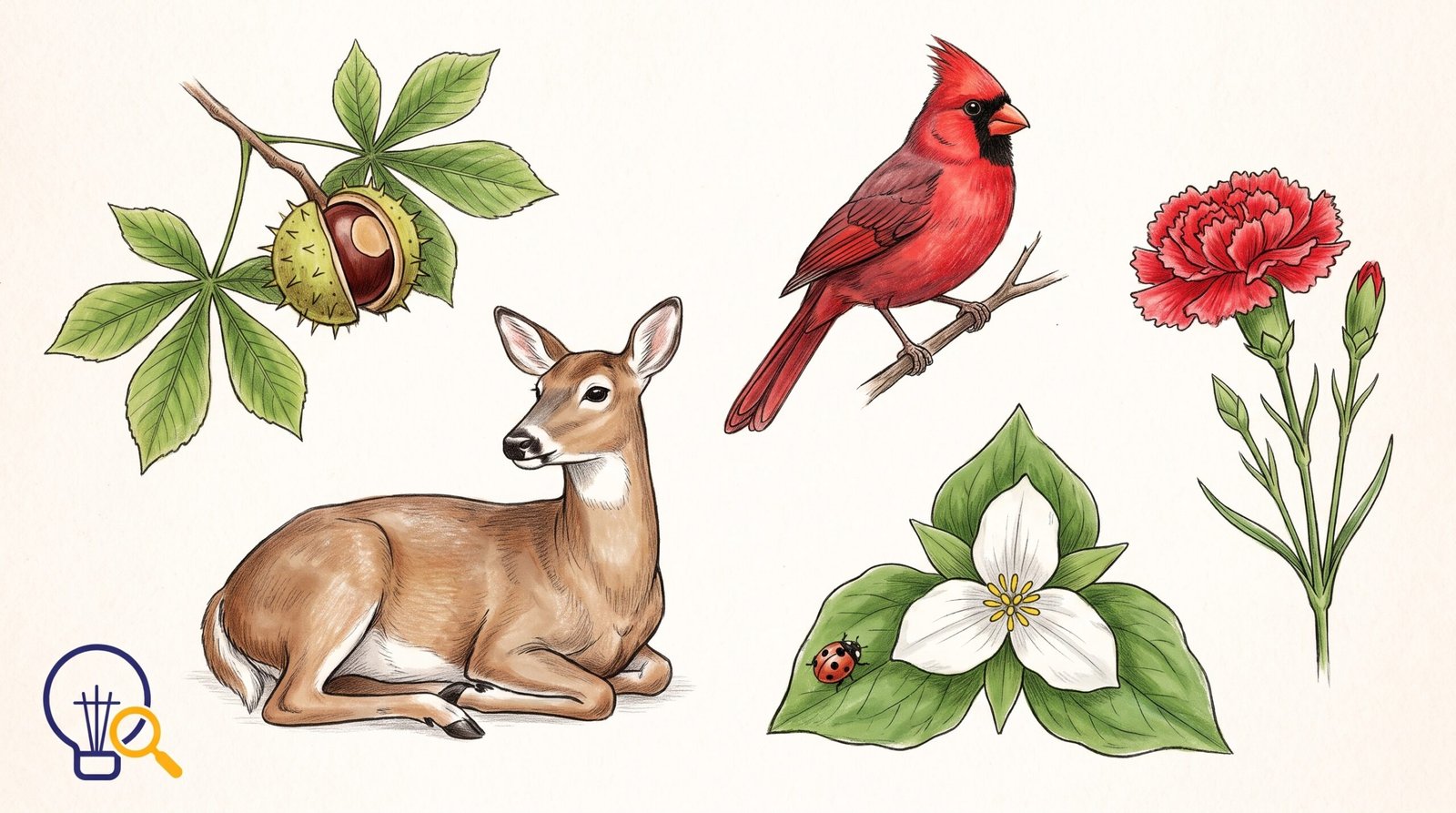
Ohio has one of the longer lists of state symbols in the country, and a few are real surprises.
| Symbol | Official Choice | Interesting Detail |
| Bird | Northern cardinal | Adopted in 1933 |
| Flower | Scarlet carnation | Honors President McKinley, who famously wore one for luck |
| Wildflower | Large white trillium | Blooms in spring woodlands |
| Tree | Ohio buckeye | Gives the state its nickname |
| Animal | White-tailed deer | Adopted in 1988 |
| Reptile | Black racer snake | Harmless and quick |
| Fish | Walleye | A favorite catch in Lake Erie |
| Gemstone | Ohio flint | Prized by ancient toolmakers |
| Fossil | Isotelus (a trilobite) | A reminder of Ohio’s ancient seas |
| Insect | Ladybug | Adopted in 1975 |
| Pet | Shelter pet | Chosen in 2019 to promote adoption |
| Song | “Beautiful Ohio” | Adopted in 1969 |
| Rock song | “Hang On Sloopy” | Named by lawmakers in 1985 |
| Beverage | Tomato juice | Adopted in 1965; Reynoldsburg’s Alexander Livingston helped popularize the garden tomato in the 1800s |
Ohio History Timeline
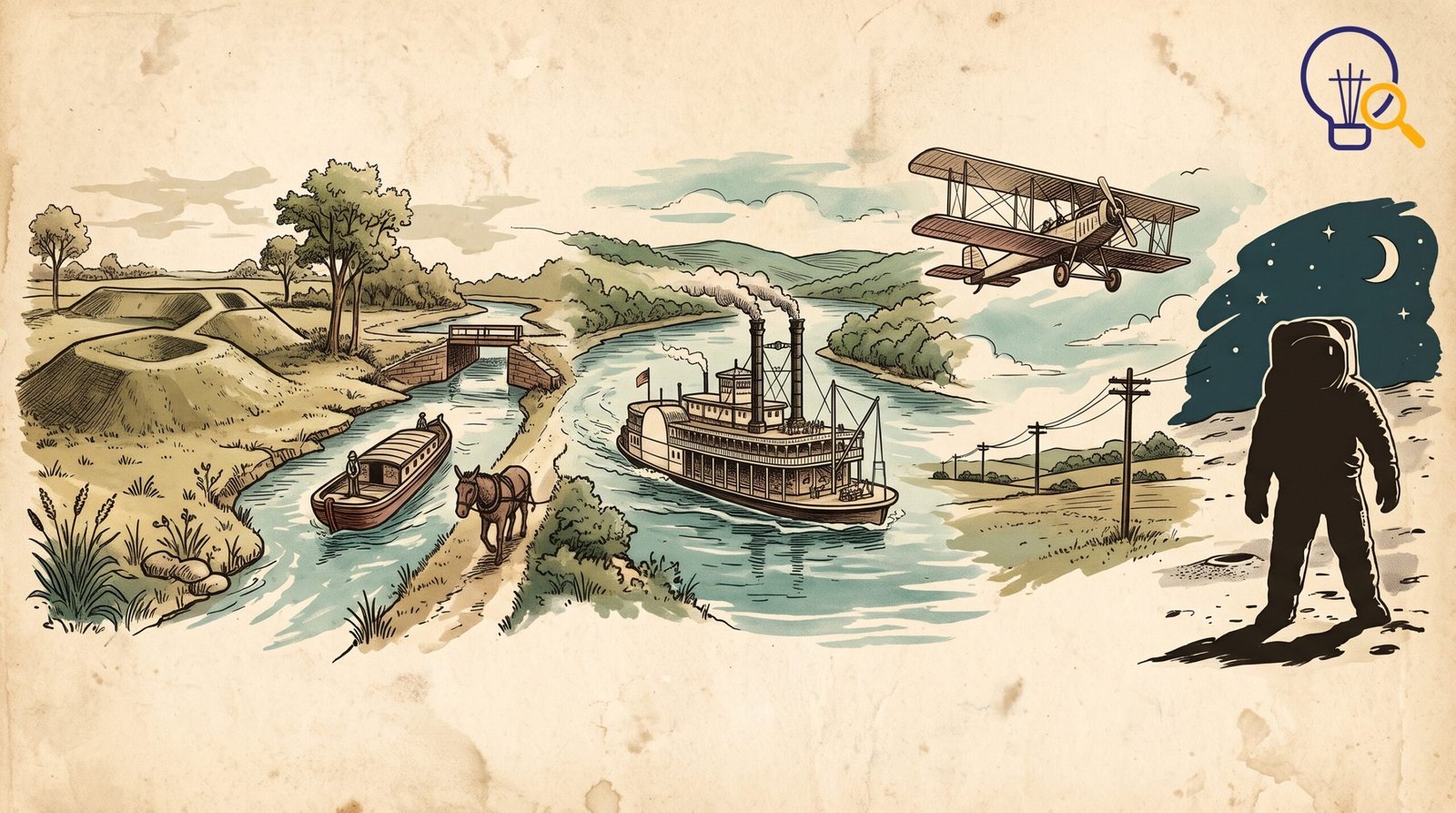
History is where many fun facts about Ohio begin, and the state’s past works as a compact tour of American history.
| When | What Happened |
| About 13,000 years ago | Earliest known human presence |
| About 800 BCE–500 CE | Adena and Hopewell cultures build earthworks |
| Late 1600s | French explorer La Salle reaches the region (traditionally dated to about 1670) |
| 1763 | Britain gains control after the French and Indian War |
| 1788 | Marietta founded, the first permanent settlement in the Northwest Territory |
| 1803 | Ohio joins the Union as the 17th state |
| 1832 | Ohio and Erie Canal fully opens |
| 1861–1865 | Civil War |
| 1903–1905 | Wright brothers develop the practical airplane |
| 1969 | Neil Armstrong walks on the moon |
Native American Heritage
People have lived in what is now Ohio for at least 13,000 years. The Adena and Hopewell peoples, often grouped together as Mound Builders, built enormous earthworks for ceremony and astronomy. Eight Hopewell sites, including the Newark Earthworks, were added to UNESCO’s World Heritage list in 2023.
Serpent Mound in Adams County is the largest serpent effigy in the world at roughly 1,300 feet. Even its age is debated. Some researchers date it to the Adena period, while others point to the later Fort Ancient culture.
Later Native American tribes included the Shawnee, Miami, Wyandot and Delaware. The Erie people, who gave Lake Erie its name, were largely wiped out in the mid-1600s during wars with the Iroquois.
Path to Statehood on March 1, 1803
After the French and Indian War, Britain controlled the region until the American Revolution. Ohio then became part of the Northwest Territory. The Ordinance of 1785 created the land survey grid that is still visible from airplanes today, and the survey began near East Liverpool on the Pennsylvania border. In 1788, Rufus Putnam founded Marietta, named in honor of Queen Marie Antoinette.
Ohio’s lawmakers met on March 1, 1803, and the state was treated as admitted to the Union from that date. But Congress never passed a formal admission resolution at the time. Lawmakers noticed the gap in the early 1950s, and President Eisenhower signed a resolution in August 1953 that made Ohio’s membership official, retroactive to 1803.
So both dates are real. The statehood date people celebrate is 1803, and Congress’s formal sign-off came 150 years later.
Civil War and Underground Railroad Role
More than 300,000 Ohioans served in the Union forces. At home, the anti-war faction was nicknamed Copperheads, and Dayton’s Clement Vallandigham was their best-known leader.
Ohio’s position across the river from slave states made it a major corridor on the Underground Railroad. Many routes ran through towns along the Ohio River and Lake Erie, and the John Rankin House in Ripley is one well-known stop. Today the National Underground Railroad Freedom Center in Cincinnati, which opened in 2004, tells those stories.
The Ohio and Erie Canal’s Impact
Before highways, Ohio’s farmers had no good way to ship crops east. The Ohio and Erie Canal, built between 1825 and 1832, linked Cleveland on Lake Erie to Portsmouth on the Ohio River. It cut shipping costs, created boomtowns and pulled settlers into the interior, which made it a key part of the nation’s westward expansion.
The canal declined after railroads arrived, and a great flood in 1913 destroyed much of it. You can still walk or bike its path on the Towpath Trail in Cuyahoga Valley National Park.
Why Is It Called Ohio? Name Origins
Historians admit some uncertainty, but the best-supported explanation traces the name to a Seneca (Iroquoian) word, ohi:yo’, often translated as “great river” or “large creek.” The river came first, and the Ohio River then lent its name to the territory and the state. So when people ask about the origin of the name, the short answer is that the river was named first and the state followed.
Where Ohio’s 88 Counties Got Their Names
Ohio’s counties fall into a few clear naming groups:
- Presidents and statesmen: Washington, Jackson, Harrison
- Revolutionary War figures: Wayne (for General Anthony Wayne) and Warren (for Joseph Warren)
- Native American words and nations: Miami, Wyandot, Tuscarawas
- Places abroad: Gallia (from Gaul, an old name for France) and Lorain (for Lorraine in France)
For the full list, the Ohio History Connection’s Ohio History Central site gives a name story for every county.
Famous Firsts and Inventions from Ohio
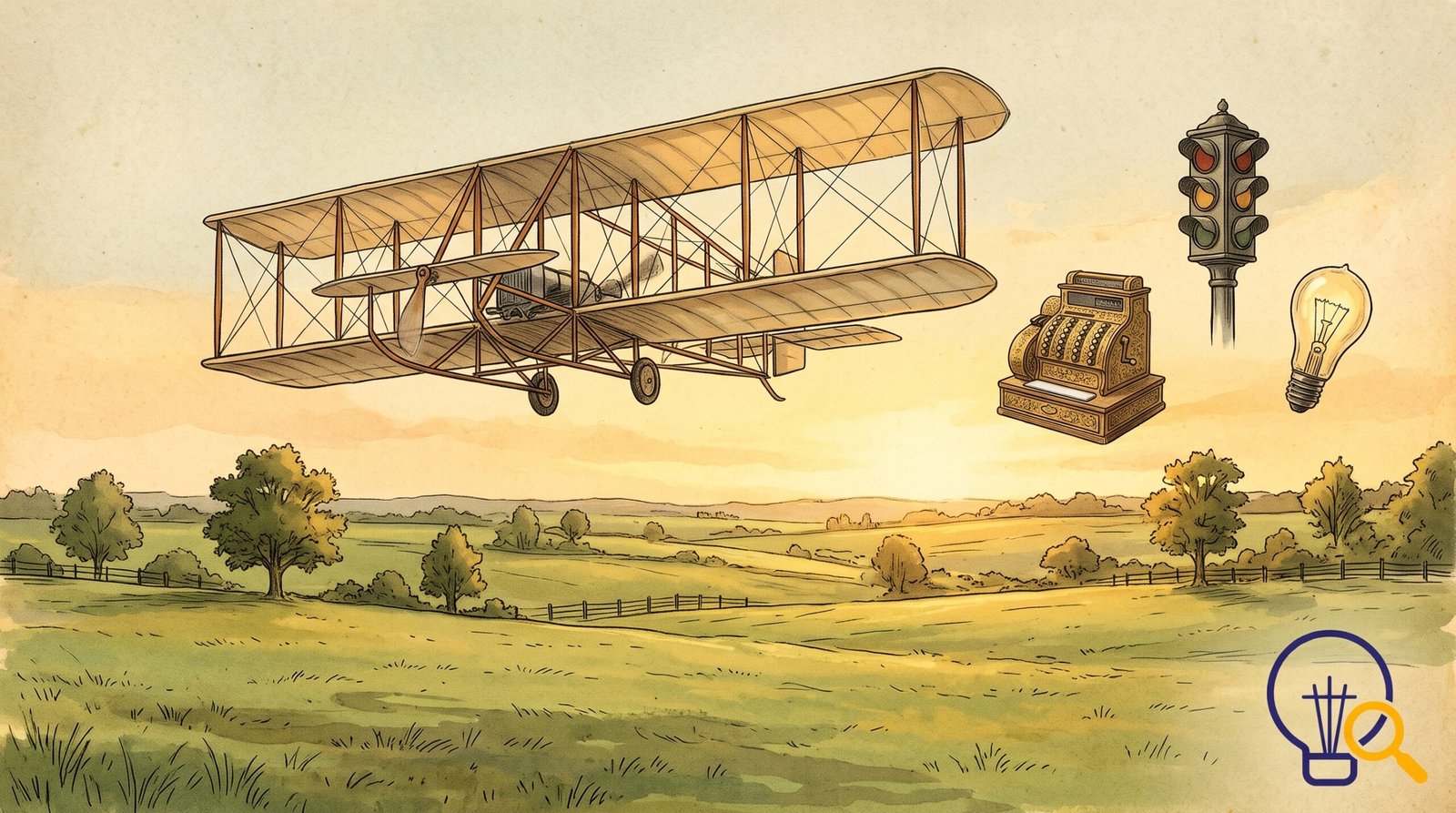
Few states can match Ohio’s record for pioneers and innovators. Here are the inventions behind the fun facts about Ohio that people repeat most, along with a few corrections to popular claims.
| Invention or First | Person | Place | Year |
| Practical airplane | Wilbur and Orville Wright | Dayton area | 1903–1905 |
| Cash register | James Ritty | Dayton | 1879 |
| Electric street arc lighting | Charles Brush | Cleveland | 1879 |
| Electric traffic signal | American Traffic Signal Co. | Cleveland | 1914 |
| Electric starter for cars | Charles Kettering | Dayton | 1911 |
| Aluminum smelting process | Charles Martin Hall | Oberlin | 1886 |
| Pull-tab beverage can | Ermal Fraze | Dayton area | 1959 |
| Professional baseball team | Cincinnati Red Stockings | Cincinnati | 1869 |
The Wright brothers did more than fly at Kitty Hawk. Their first powered flights in 1903 happened in North Carolina, but the bicycle shop, the wind-tunnel experiments and the engineering all came from Dayton. In 1904 and 1905, they refined their controls at Huffman Prairie, a pasture outside the city, and flew the first practical airplane.
That’s why Ohio calls itself the birthplace of aviation, a claim North Carolina answers with its own “First in Flight” slogan. Orville was born in Dayton, while Wilbur was born in Indiana.
Cleveland’s lights came early. Charles Brush’s arc lights lit Public Square in 1879. In 1888, he also built one of the first wind turbines to generate electricity.
A few claims need a small correction. Thomas Edison was born in Milan, Ohio, but he developed his famous inventions in New Jersey. Charles Goodyear invented rubber vulcanization in Massachusetts, and the Goodyear company in Akron was named in his honor decades later. Roy Plunkett, born in New Carlisle, discovered Teflon in 1938 while working at a DuPont lab in New Jersey.
More Ohio firsts worth knowing:
- Cincinnati’s fire department. The city is often credited with the first fully paid fire department, organized in 1853.
- Early ambulances. A Cincinnati hospital launched an ambulance service in 1865, widely cited as the first of its kind for civilians.
- Police on wheels. Akron put an electric police patrol wagon on the road in 1899.
- Higher education. Ohio University opened in 1804, and Oberlin College admitted Black students in 1835 and women in 1837, a pioneering step for interracial and coeducational college.
- Public office. John Mercer Langston was elected town clerk of Brownhelm Township in the 1850s and is widely regarded as one of the first Black Americans elected to public office.
Presidents and Famous People from Ohio
Ohio earned its title as the Mother of Presidents by producing seven U.S. presidents in the decades after the Civil War.
| President | Birthplace | Years in Office |
| Ulysses S. Grant | Point Pleasant | 1869–1877 |
| Rutherford B. Hayes | Delaware | 1877–1881 |
| James A. Garfield | Moreland Hills | 1881 |
| Benjamin Harrison | North Bend | 1889–1893 |
| William McKinley | Niles | 1897–1901 |
| William Howard Taft | Cincinnati | 1909–1913 |
| Warren G. Harding | Blooming Grove | 1921–1923 |
Three of the seven died in office: Garfield and McKinley by assassination, and Harding of natural causes. Taft later became Chief Justice, the only person to hold both jobs.
Virginia still holds the record with eight presidents, so the “Mother of Presidents” title is shared. Ohio fans sometimes add William Henry Harrison, who was born in Virginia but lived and is buried in Ohio. That would make eight for Ohio, too, but most official lists keep the count at seven.
Beyond politics, Ohio is also home to many famous natives:
- Neil Armstrong of Wapakoneta commanded Apollo 11 and was the first person to walk on the moon in 1969.
- John Glenn orbited Earth in 1962 and returned to space in 1998 at age 77, setting a record as the oldest astronaut.
- Jesse Owens, who grew up in Cleveland, won four gold medals at the 1936 Berlin Olympics.
- DeHart Hubbard of Cincinnati became the first African American to win an individual Olympic gold medal, in the 1924 long jump.
- Paul Laurence Dunbar of Dayton was a celebrated poet and a classmate and friend of Orville Wright.
- Toni Morrison, born in Lorain, won the Nobel Prize in Literature in 1993.
- Annie Oakley (born in Darke County) became a world-famous sharpshooter, and Steven Spielberg (born in Cincinnati) became one of the best-known film directors.
Geography and Landforms
Ohio is a Midwest state on the edge of the Great Lakes region, and its landscape changes more than most visitors expect. Glaciers shaped roughly half of it, which is why geography supplies so many fun facts about Ohio.
Lake Erie and the Ohio River
Lake Erie forms about 312 miles of Ohio’s northern shoreline. It is the shallowest of the Great Lakes, with an average depth around 62 feet, so it warms quickly and also freezes quickly. Because the international boundary runs through the lake, Ohio shares a water border with Canada.
The Ohio River forms the state’s southern and eastern edge, and it comes with a legal quirk. Ohio’s border sits along the river’s northern shore, so the water itself falls under Kentucky and West Virginia’s jurisdiction. The Supreme Court confirmed this in 1980. In plain terms, Ohio is bordered by water on both its north and south sides, and both waterways shaped trade, cities and identity, from Cleveland and Toledo on the lake to Cincinnati on the river.
Regions and Natural Wonders
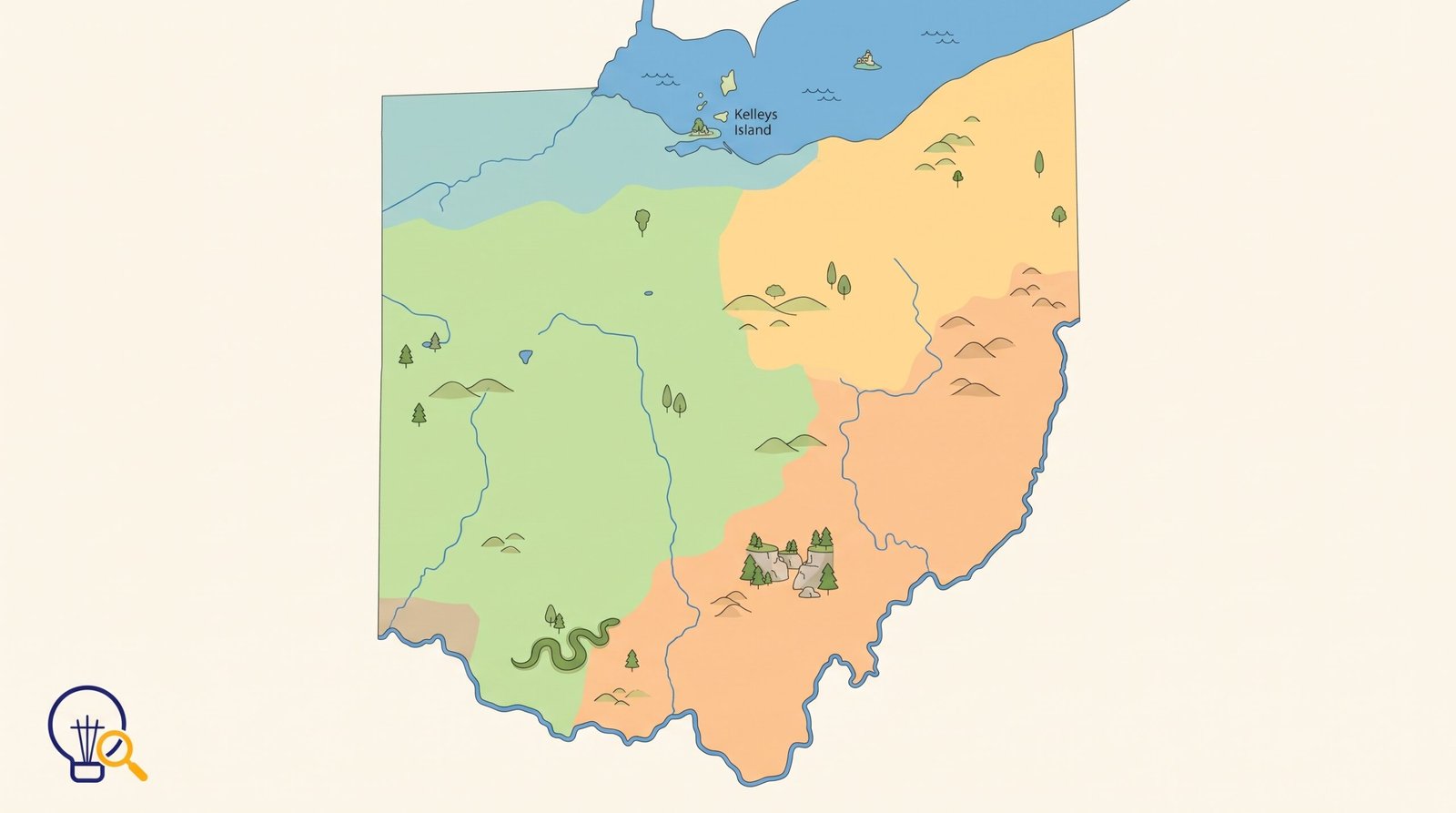
Geographers divide Ohio into five regions:
- Great Lakes Plains in the north and northwest, with flat, fertile land.
- Till Plains in the west and center, where the Corn Belt begins and where the state’s high point, Campbell Hill, sits.
- Glaciated Appalachian Plateau in the northeast.
- Unglaciated Appalachian Plateau in the southeast, the roughest country in the state.
- Bluegrass Region in the southwest.
A few natural stops are worth knowing:
- Kelleys Island has the Glacial Grooves, long furrows scraped into limestone by an ice sheet roughly 18,000 years ago.
- Hocking Hills has sandstone gorges and waterfalls, plus Ash Cave, a massive horseshoe-shaped recess cave.
- Serpent Mound sits in an area of disturbed bedrock that geologists link to an ancient impact or similar event.
Climate and Seasons
Ohio has a humid continental climate with four distinct seasons: warm, humid summers and cold winters. Cold air crossing Lake Erie dumps heavy lake-effect snow on the northeastern “snowbelt,” while the lake also keeps nearby shoreline temperatures milder in spring and fall. If you’re planning a visit, spring and fall are usually the most comfortable seasons.
Wildlife, Birds, and State Nature Symbols
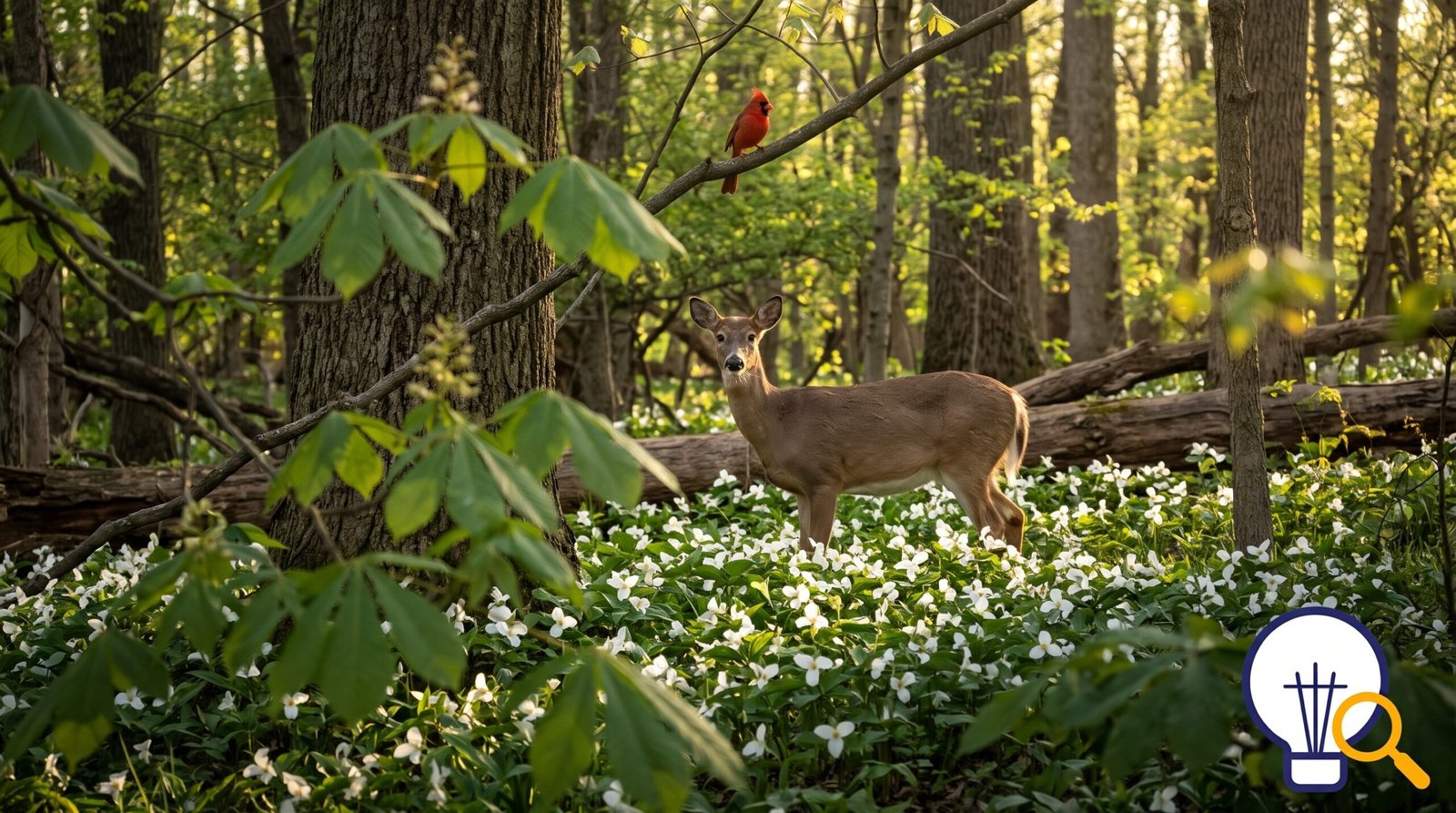
Ohio’s wildlife list is longer than most people expect. More than 350 bird species have been recorded in the state, and many pass through during migration.
- Mammals: white-tailed deer, coyotes, bobcats, beavers, and a small but growing black bear population in the southeast.
- Birds: cardinals, great horned owls, wild turkeys and blue jays, plus bald eagles, which have made a strong comeback since the late 20th century.
- Reptiles and amphibians: black racers, box turtles, Lake Erie water snakes and spotted salamanders.
- Plants: buckeyes, large white trillium and the pawpaw.
The pawpaw deserves a spotlight. It’s the largest edible fruit native to the U.S., with a custardy, tropical flavor, and Albany, Ohio, hosts a pawpaw festival every September.
Seasonal tip: Visit woodlands in late April for trillium and other spring wildflowers. For birds, the Lake Erie marshes in May are famous for warbler migration, including at Magee Marsh, and draw birders from around the world.
Ohio by the Numbers: Economy, Census, and Cities
Natural Resources and Economy
Ohio’s natural resources are bigger than its cornfields suggest. The state has coal in the east, natural gas from shale formations and large beds of rock salt. Salt is mined deep underground beneath Lake Erie, and much of it becomes winter road salt for Great Lakes cities. Fertile soil supports agriculture and farming, from corn and soybeans to a large greenhouse and nursery industry.
When the Industrial Revolution reached the Midwest, canals, railroads and nearby resources turned Ohio cities into factory towns. The state economy has moved well beyond the old Rust Belt image since then:
- Manufacturing hub: Ohio still makes cars, steel, machinery and polymers. Honda’s Marysville plant made the company the first Japanese automaker to build cars in the U.S.
- Rubber capital of the world: Akron earned the nickname through Goodyear, Firestone and other tire makers.
- Corporate headquarters: Procter & Gamble and Kroger are based in Cincinnati, and Wendy’s, which began in Columbus in 1969, has its headquarters in Dublin.
- Healthcare and logistics now employ huge numbers of workers, helped by Ohio’s central location in the eastern half of the country.
Ohio’s economy typically ranks among the top ten in the nation, though the exact rank shifts from year to year.
Census and Population Facts
For hard numbers, the U.S. Census Bureau is the most reliable source. These figures come from the 2020 Census.
| Measure | Figure (2020 Census) |
| State population | About 11.8 million (7th largest) |
| Total area | About 44,800 square miles (34th) |
Population numbers change every year, so check the Census Bureau’s Ohio data profile before you use a figure in a report or presentation.
Columbus, Cleveland, and Cincinnati at a Glance
| City | 2020 Population | Standout Facts |
| Columbus | About 906,000 | Hosts the Ohio State Fair and is home to Ohio State University’s main campus |
| Cleveland | About 373,000 | West Side Market (opened 1912) and the real house from the film A Christmas Story |
| Cincinnati | About 309,000 | The Roebling Suspension Bridge (1866), a forerunner of the Brooklyn Bridge, and Findlay Market (1855), Ohio’s oldest continuously operating public market |
Fun Trivia on Sports, Food, and Culture
Sports and food are where some of the best fun facts about Ohio come to life.
Pro Football Hall of Fame and Sports Legacy
Canton is where team owners met in September 1920 to form the league that became the NFL, so the Pro Football Hall of Fame opened there in 1963. The new league’s first games were played a few weeks later, including one in Dayton.
Three more sports stories are worth knowing:
- Cincinnati Reds: The 1869 Red Stockings were the first fully professional team, and the Reds played baseball’s first major-league night game in 1935. The city still holds an Opening Day parade.
- Cleveland: The Cavaliers won the 2016 NBA title and ended a 52-year championship drought for Cleveland’s major pro teams.
- Ohio State football: Ohio Stadium holds more than 100,000 fans. The marching band’s “Script Ohio” formation has been a tradition since 1936, and players earn Buckeye leaf stickers for their helmets, a custom that started in 1968.
Music has a home here, too. Cleveland disc jockey Alan Freed helped popularize the phrase “rock and roll,” and the Rock and Roll Hall of Fame opened on Lake Erie in 1995.
Local Food Favorites

Ohio’s regional cuisine reflects its immigrant history.
- Cincinnati chili: A spiced meat sauce served over spaghetti, created by Macedonian immigrants in the 1920s. Order it “three-way” with cheese, or add onions or beans for a four-way or five-way.
- Buckeye candy: Peanut butter fudge dipped in chocolate, with a small circle left bare so it looks like the nut.
- Pierogies and kielbasa: Cleveland’s Polish and Slovak communities made these staples. The “Polish Boy” sandwich stacks kielbasa, fries, coleslaw and barbecue sauce.
- Amish baked goods and cheese: Holmes County has one of the largest Amish communities in the world, and nearby Charm is where Baby Swiss cheese was created around 1960.
- State fair treats: At the Ohio State Fair in Columbus, you’ll find classic fair food and a life-size butter cow sculpture, a long-running tradition.
Strange and Quirky Ohio Laws and Oddities
Some of the most memorable fun facts about Ohio are roadside oddities, but viral lists also invent plenty. Take “weird laws” with caution. Many are outdated, misreported or never existed, and no one has produced a real statute for the popular claim that it’s illegal to get a fish drunk. If you plan to share a law, look it up in the Ohio Revised Code first.
The real oddities are easier to verify:
- The Longaberger Basket Building in Newark is a seven-story replica of the company’s Medium Market Basket, built at about 160 times the original size and opened as corporate headquarters in 1997. It has been vacant since 2016, but it still stands beside Route 16. It’s private property, so view it from the road.
- Dresden’s Basket Village bills itself as home to the world’s largest basket.
- Sugarcreek is known for its Swiss-style downtown and a clock billed as the world’s largest cuckoo clock.
- Bellefontaine has Court Avenue, widely recognized as the first concrete street in the United States, poured in 1891.
- The Mansfield Reformatory operated as a prison until 1990 and is best known as the setting for The Shawshank Redemption.
Ohio vs. Its Neighbors: Quick Comparisons
Here’s how Ohio compares with the states around it, using 2020 Census data.
| State | Statehood Order | Population Rank | Total Area (sq mi) | Notable Feature |
| Ohio | 17th (1803) | 7th | 44,826 | Mother of Presidents |
| Michigan | 26th (1837) | 10th | 96,714 | Borders four Great Lakes |
| Indiana | 19th (1816) | 17th | 36,418 | Indianapolis 500 |
| Kentucky | 15th (1792) | 26th | 40,408 | Bourbon and horse racing |
| Pennsylvania | 2nd (1787) | 5th | 46,054 | Independence Hall |
| West Virginia | 35th (1863) | 40th | 24,230 | New River Gorge National Park |
The Toledo War in brief. Ohio and Michigan both claimed a strip of land around Toledo. In 1835, both sent militias and tensions rose, though almost no one was hurt. Congress broke the stalemate in 1836. Ohio kept Toledo, and Michigan received the Upper Peninsula as it moved toward statehood in 1837. Many Michiganders thought it was a bad deal at the time, but the peninsula’s copper and iron proved enormously valuable.
Top Places to Visit in Ohio
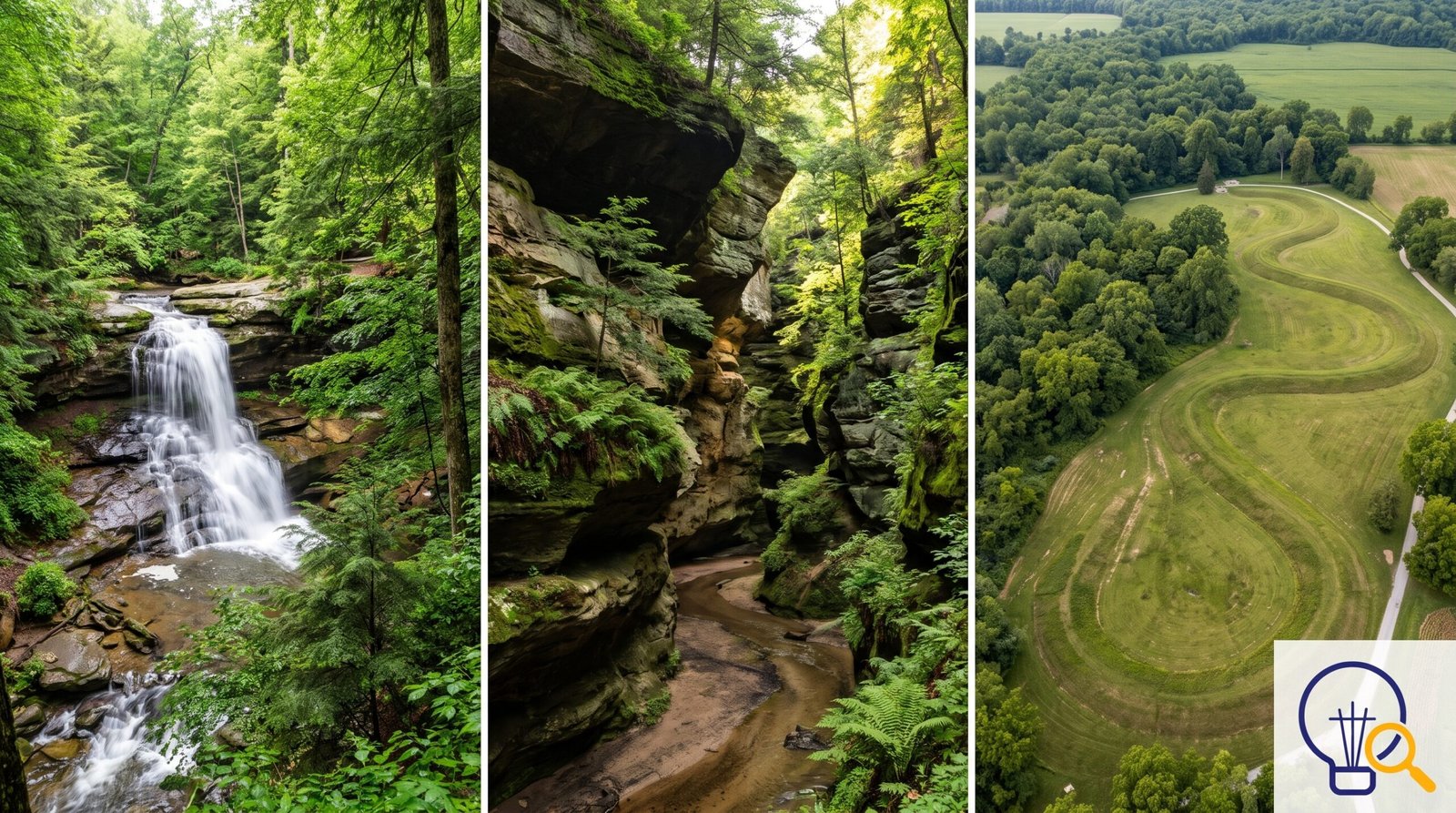
Turn fun facts about Ohio into a trip. The best way to enjoy these places is to pair each one with the story behind it.
Cities, Parks, and Landmarks
| Place | Connects To | Best Season |
| Cuyahoga Valley National Park | The Ohio and Erie Canal Towpath and waterfalls like Brandywine Falls | Fall for color, spring for waterfalls |
| Hocking Hills State Park | Glacial landforms and recess caves | Spring and fall, or winter for ice formations |
| Cedar Point (Sandusky) | Amusement park open since 1870 | Weekdays in June or September |
| National Museum of the U.S. Air Force (Dayton) | The state’s aviation heritage, with free admission | Any season; plan most of a day |
| Serpent Mound (Adams County) | The mystery of the Mound Builders | Fall, when it’s less crowded |
| Put-in-Bay (Lake Erie) | Perry’s Victory memorial from the War of 1812 | Summer, by ferry |
Also consider the Rock and Roll Hall of Fame in Cleveland, the Pro Football Hall of Fame in Canton and the Freedom Center in Cincinnati. Train fans can ride the Cuyahoga Valley Scenic Railroad, and history lovers can explore Carillon Historical Park in Dayton.
Fun Facts About Ohio for Kids

Here are some short, simple facts for young readers, parents and teachers.
- Ohio’s state bug is the ladybug.
- Ohio has an official state groundhog. Buckeye Chuck of Marion predicts the arrival of spring every Groundhog Day.
- The state amphibian is the spotted salamander.
- Ohio has a state fossil fish called the Dunk. It’s a giant armored fish, Dunkleosteus, that lived about 360 million years ago.
- The state pet is the shelter pet. Lawmakers picked it to encourage people to adopt animals.
- The Wright brothers fixed bicycles in Dayton before they built the first practical airplane.
- Neil Armstrong grew up in Wapakoneta, a small Ohio town, and became the first person to walk on the moon.
- Ohio has 88 counties, and each one has its own name story.
- Try this at home: Count the stars on Ohio’s flag. You’ll find 17, one for each state in the Union when Ohio joined.
Common Ohio Myths and Mistakes to Avoid
Even popular lists of fun facts about Ohio repeat the same errors. Watch out for these.
- Myth: The Wright brothers’ first flight happened in Ohio. It happened in North Carolina in 1903. Ohio is where they built and perfected their aircraft.
- Myth: Ohio has silly laws like getting a fish drunk. There’s no verified statute for this, and many “weird law” lists copy each other.
- Myth: Ohio became a state in 1953. Statehood is counted from March 1, 1803. The 1953 resolution only formalized it.
- Myth: Ohio has produced eight presidents. Seven were born there. Eight requires counting William Henry Harrison as an adopted son.
- Myth: Garrett Morgan invented the first traffic light. Cleveland installed an electric traffic signal in 1914. Morgan, a Cleveland inventor, patented a three-position signal in 1923.
- Myth: Buckeye nuts are edible. Buckeye candy is safe, but real buckeye nuts are toxic if eaten raw.
Quick tip for verifying trivia: Look for a primary or official source, such as a government site, a state historical society or a museum, then check a second source. If a fact only appears on listicles that copy each other, treat it with suspicion.
Ohio Trivia Quiz: Test What You Learned
Ready to check what stuck? These fun facts about Ohio all appear above. Try answering before you look at the key.
- In what year did Congress formally resolve Ohio’s statehood?
- Which Ohio river caught fire in 1969?
- Which Ohio astronaut flew in space again at age 77?
- How many U.S. presidents were born in Ohio?
- Which state received the Upper Peninsula after the Toledo War?
- Which Ohio college admitted Black students in 1835?
- What is the highest point in Ohio?
- Which Ohio city is home to the Pro Football Hall of Fame?
- What is Ohio’s official state beverage?
- Which Cleveland-raised athlete won four gold medals at the 1936 Olympics?
Answer key: 1) 1953; 2) Cuyahoga River; 3) John Glenn; 4) Seven; 5) Michigan; 6) Oberlin College; 7) Campbell Hill; 8) Canton; 9) Tomato juice; 10) Jesse Owens.
How to use this quiz:
- Teachers: Have students find a source that confirms each answer, then rank which fact surprised them most.
- Trivia hosts: Split the questions into easy, medium and hard rounds, and keep a source ready in case someone challenges an answer.
- Students: Cite the original source for each fact and write down the date you accessed it, since numbers and web pages change.
Final Thoughts on Ohio’s Most Interesting Facts
Ohio rarely brags, yet its record is hard to beat: ancient earthworks, the cash register, a moonwalker and a statehood date that took 150 years to finalize.
Bookmark these fun facts about Ohio for your next quiz night, class report or road trip. Then pick one place from the list above and go see it for yourself. Even familiar fun facts about Ohio feel different when you’re standing where they happened.
Sources and further reading: Ohio History Connection (Ohio History Central), U.S. Census Bureau, National Park Service, UNESCO World Heritage List, Ohio Revised Code, Ohio Secretary of State (state symbols).
Frequently Asked Questions
These are the questions behind most searches for fun facts about Ohio.
What is Ohio best known for?
Ohio is best known for aviation history, seven U.S. presidents, astronauts like Neil Armstrong and John Glenn, football and Lake Erie. It’s also a major manufacturing and logistics hub in the Midwest.
Why is Ohio called the Buckeye State?
The nickname comes from the Ohio buckeye tree, whose dark nut with a pale spot resembles a deer’s eye. It spread in popularity during William Henry Harrison’s 1840 presidential campaign.
When did Ohio become a state?
Ohio is treated as having joined the Union on March 1, 1803, as the 17th state. Congress passed a formal resolution confirming it in 1953.
How many counties does Ohio have?
Ohio has 88 counties. They’re named for presidents, Revolutionary War figures, Native American words and places abroad. Lorain County, for example, is named for the Lorraine region of France.
What is Ohio’s state animal?
The white-tailed deer, adopted in 1988.
What is Ohio’s state pet?
The shelter pet. The designation, made official in 2019, was meant to raise awareness about animal adoption.
What is the Ohio state bug?
The ladybug, adopted as the state insect in 1975.
What are the best resources to learn more about Ohio?
Start with the Ohio History Connection and its Ohio History Central site. The U.S. Census Bureau’s Ohio data profile covers population figures, and the National Park Service has pages for Ohio sites such as Cuyahoga Valley National Park and the Dayton aviation sites.
