
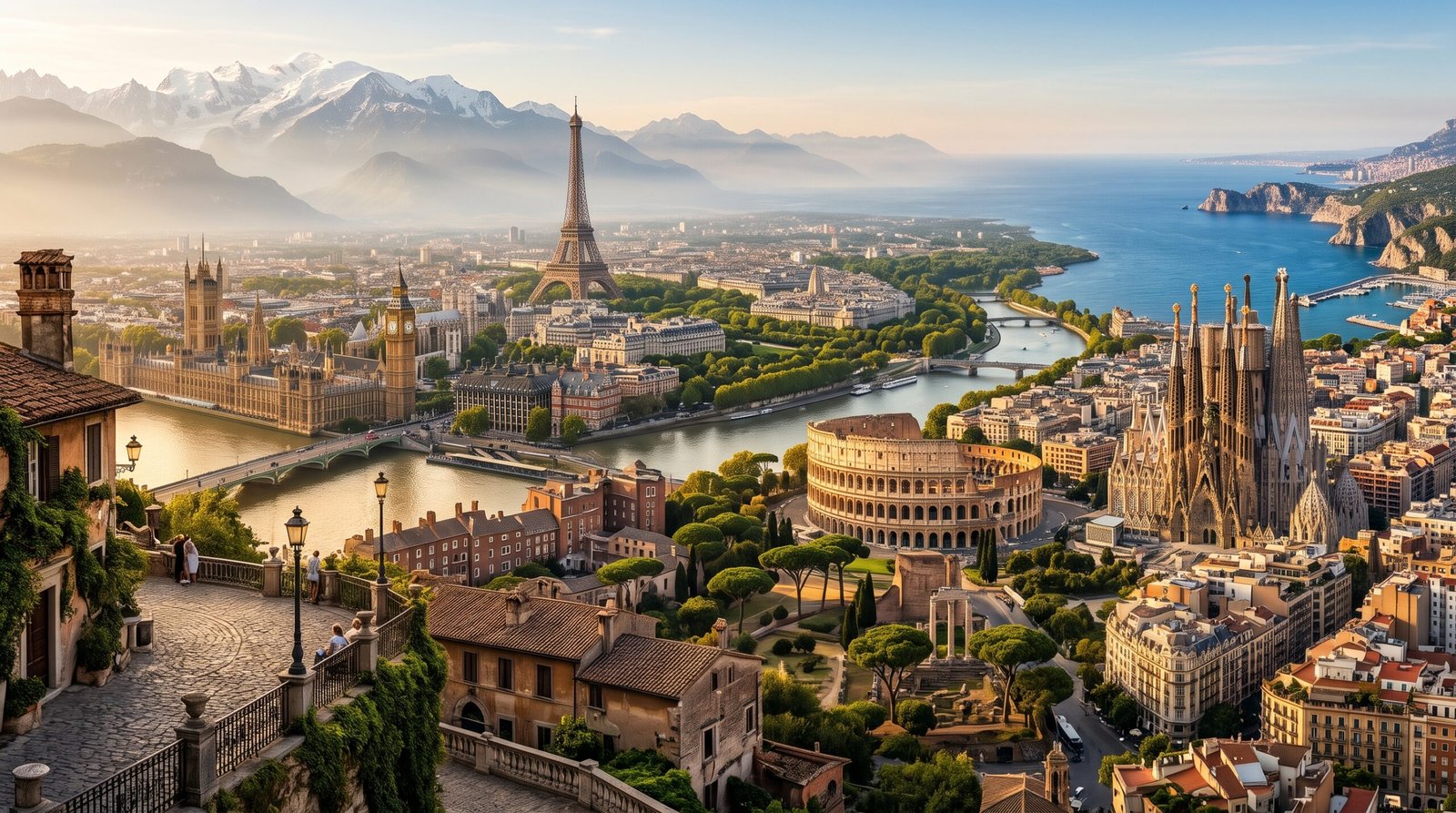

Europe is full of contrasts: a continent where ancient parliaments sit alongside modern political unions, where one city spans two continents, and where a famous basilica became the world’s tallest church in 2026. Even familiar destinations can surprise you when you look beyond the usual landmarks.
This guide brings together facts about Europe that explain its geography, people, history, culture, natural environment and travel systems. These Europe facts are written for readers who want clear context rather than trivia without explanation. It also clears up common mix-ups between Europe, the European Union and the Schengen Area. Figures are approximate where borders, definitions or measurement methods differ.
Key Takeaways
- Europe covers about 10.2 million km² (3.9 million sq mi) and has roughly 740–745 million residents, depending on the population estimate and country list.
- Europe is a continent; the European Union is a political and economic union of 27 member states; the Schengen Area is a separate border-free travel zone.
- Iceland’s long-standing “mosquito-free” reputation changed in October 2025, when three mosquitoes were confirmed in the country.
- The Sagrada Família in Barcelona became the world’s tallest church in February 2026, reaching 172.5 metres (565 feet).
- Finland ranked first in the 2026 World Happiness Report, while France recorded 102 million international visitors in 2025.
- Europe’s records depend on definitions: the boundary with Asia, the meaning of “town,” and how coastlines or castles are counted can change the answer.
Table of Contents
- Unexpected facts about Europe
- Europe at a glance
- Europe, the EU and Schengen
- Geology, mountains and climate
- Landmarks and record holders
- Languages and cultural diversity
- Laws, customs, food and farming
- A short history of Europe
- Science, art, sport and wildlife
- Myths and comparisons
- Practical travel information
- Quick Europe quiz
- Frequently asked questions
- Final thoughts
Unexpected Europe Facts
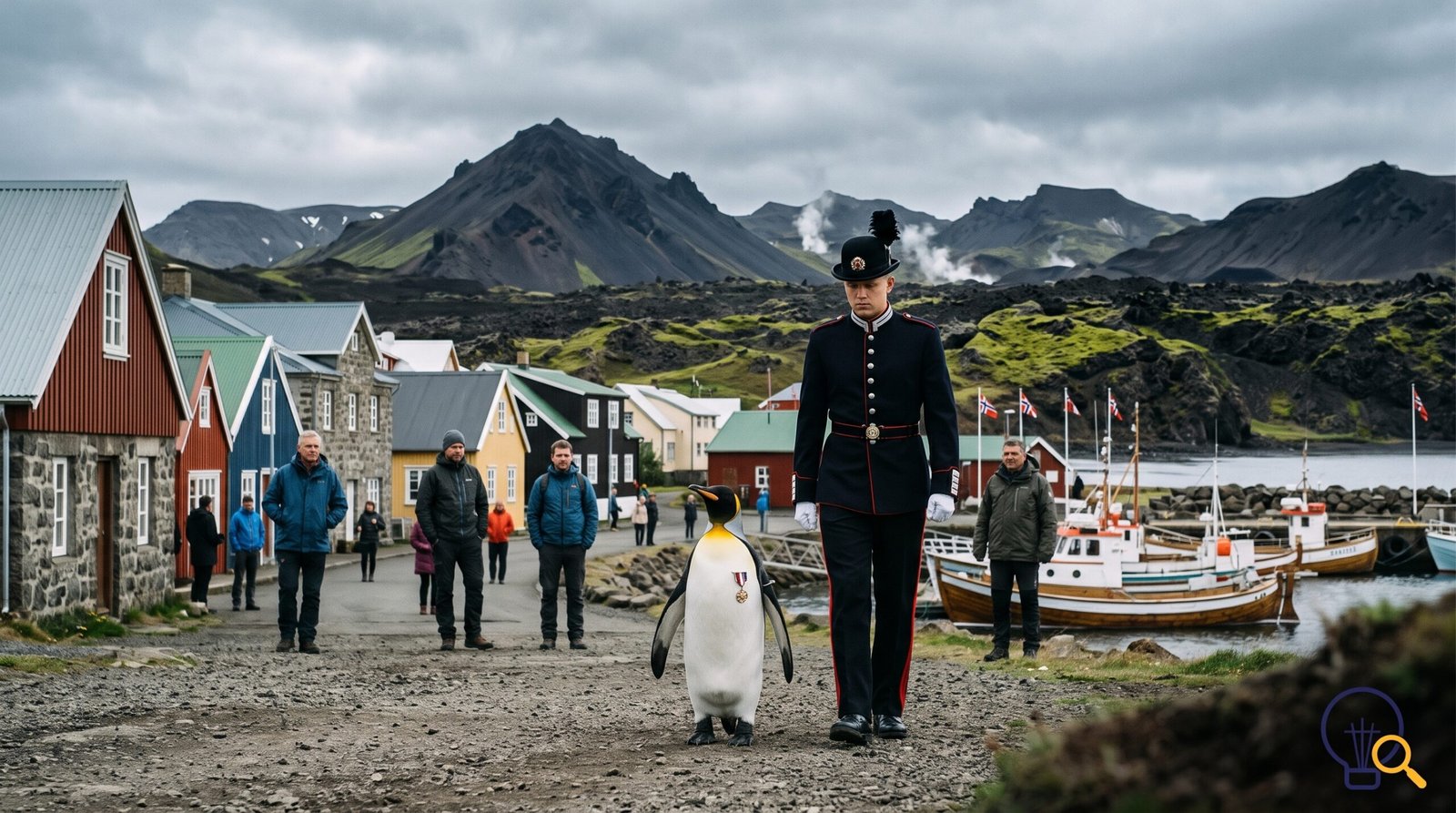
These interesting facts about Europe show how quickly old trivia can become outdated. The first of these Europe facts is a reminder to check dates before repeating a popular claim.
- Mosquitoes have been found in Iceland. For decades, Iceland was commonly described as one of the few places without mosquitoes. That changed in October 2025, when three mosquitoes were found in Kjós and confirmed by the Icelandic Institute of Natural History. The insects were identified as Culiseta annulata, a cold-tolerant species. The discovery does not, by itself, prove that a large breeding population has become established. An entomologist at the institute told Icelandic broadcaster RÚV that the species could be capable of surviving there.
- A penguin received a Norwegian knighthood. Nils Olav, a king penguin at Edinburgh Zoo in Scotland, serves as the mascot of Norway’s King’s Guard. The penguin’s unusual military-style honours have included a knighthood and later promotions.
- A Welsh village has one of Europe’s longest place names. Llanfairpwllgwyngyllgogerychwyrndrobwllllantysiliogogogoch is often shortened to Llanfair PG. Its long form became a memorable attraction for visitors arriving by rail.
- A Norwegian village is simply called Å. The letter is pronounced roughly like “aw” in English and appears in the names of several Scandinavian places. Å in the Lofoten Islands is especially well known to visitors.
- Iceland’s Althing is among the world’s oldest parliamentary institutions. It was established around 930 CE. It is safer to describe it as one of the oldest parliamentary institutions with a continuing historical identity than to claim, without qualification, that it is the oldest parliament in every modern sense.
- Europe has several monarchies. They include the United Kingdom, Spain, Sweden, Norway, the Netherlands, Belgium, Denmark, Luxembourg, Monaco, Liechtenstein and Andorra. Vatican City is an elective monarchy headed by the pope, which makes its system different from a hereditary royal family.
Europe at a Glance: Size, Population and Borders
Here are the basic numbers behind the continent:
- Area: approximately 10.2 million km² (3.9 million sq mi).
- Population: roughly 740–745 million people in 2026 estimates, depending on the definition of Europe and the source used.
- Oceans and seas: the Arctic Ocean lies to the north, the Atlantic Ocean to the west, and the Mediterranean, Black and Caspian seas are among the major waters to the south and southeast.
Europe is slightly larger than the United States by land area, but its population is substantially larger. Population totals differ because some estimates include all or parts of transcontinental countries.
How Many Countries Are in Europe?
There is no single number accepted by every institution. This is one of the most important Europe facts to remember when comparing country lists. Lists commonly include around 44 countries, while broader counts reach 50 or more when transcontinental states and partially recognized territories are included.
The difference usually comes from three questions:
- Transcontinental countries: Russia and Türkiye (Turkey) span Europe and Asia. Kazakhstan, Georgia and Azerbaijan are also treated differently depending on the geographic boundary used. Cyprus is politically associated with Europe and is an EU member, although it lies geographically in the eastern Mediterranean near Asia.
- Partially recognized states: Kosovo is recognized by many countries but not by all.
- Microstates: Vatican City, Monaco, San Marino, Liechtenstein and Andorra are small, independent states and are included in standard European country lists.
For that reason, a country count should always state which definition it follows.
Where Does Europe End and Asia Begin?
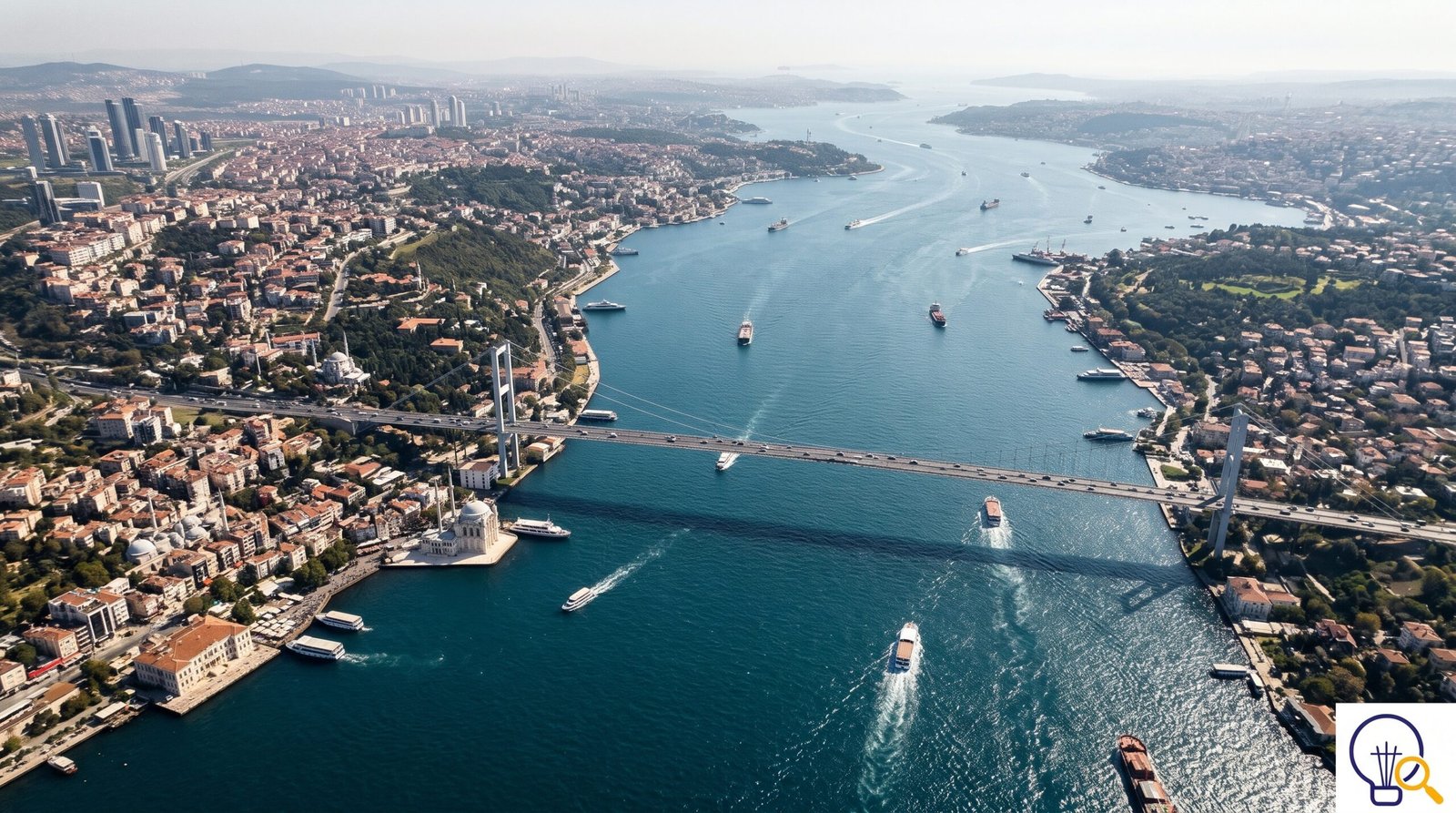
Europe and Asia form one continuous landmass known as Eurasia. Their dividing line is a geographic convention rather than a clear ocean boundary.
A widely used route follows the Ural Mountains, the Ural River and the Caspian Sea. The boundary through the Caucasus is less consistent: some references place the main watershed within Europe, while others use a different line. This is why the status of places near the Caucasus can vary between maps.
Istanbul is a clear example of Europe’s unusual geography. The Bosphorus Strait separates the city’s European and Asian sides, and ferries regularly carry residents and visitors between the two.
Population by Country: A Quick Comparison
The following mini-table gives rounded 2026 estimates for several of Europe’s most populous countries. Population is a useful starting point when putting Europe facts into context. Russia is transcontinental, and the figures for France and other countries may differ depending on whether overseas territories are included.
| Country | Approx. population (2026) |
| Russia | 143.4 million |
| Germany | 83.5 million |
| United Kingdom | 69.6 million |
| France | 69.1 million |
| Italy | 58.9 million |
| Spain | 49.6 million |
| Ukraine | 39.5 million |
| Poland | 36.3 million |
| Romania | 19.0 million |
| Netherlands | 18.1 million |
These are country-level estimates, not a perfectly uniform census count for the whole continent. The EU’s own population total was about 452 million on January 1, 2026, according to Eurostat; that is not the same as Europe’s total population.
Which European Countries Are Landlocked?
Landlocked countries have no direct coastline on an open sea or ocean. The commonly listed landlocked states wholly or largely associated with Europe include:
Andorra, Austria, Belarus, Czechia (Czech Republic), Hungary, Liechtenstein, Luxembourg, Moldova, North Macedonia, San Marino, Serbia, Slovakia, Switzerland and Vatican City. Kosovo is also landlocked, although its statehood is not universally recognized.
Europe vs. the European Union and Schengen
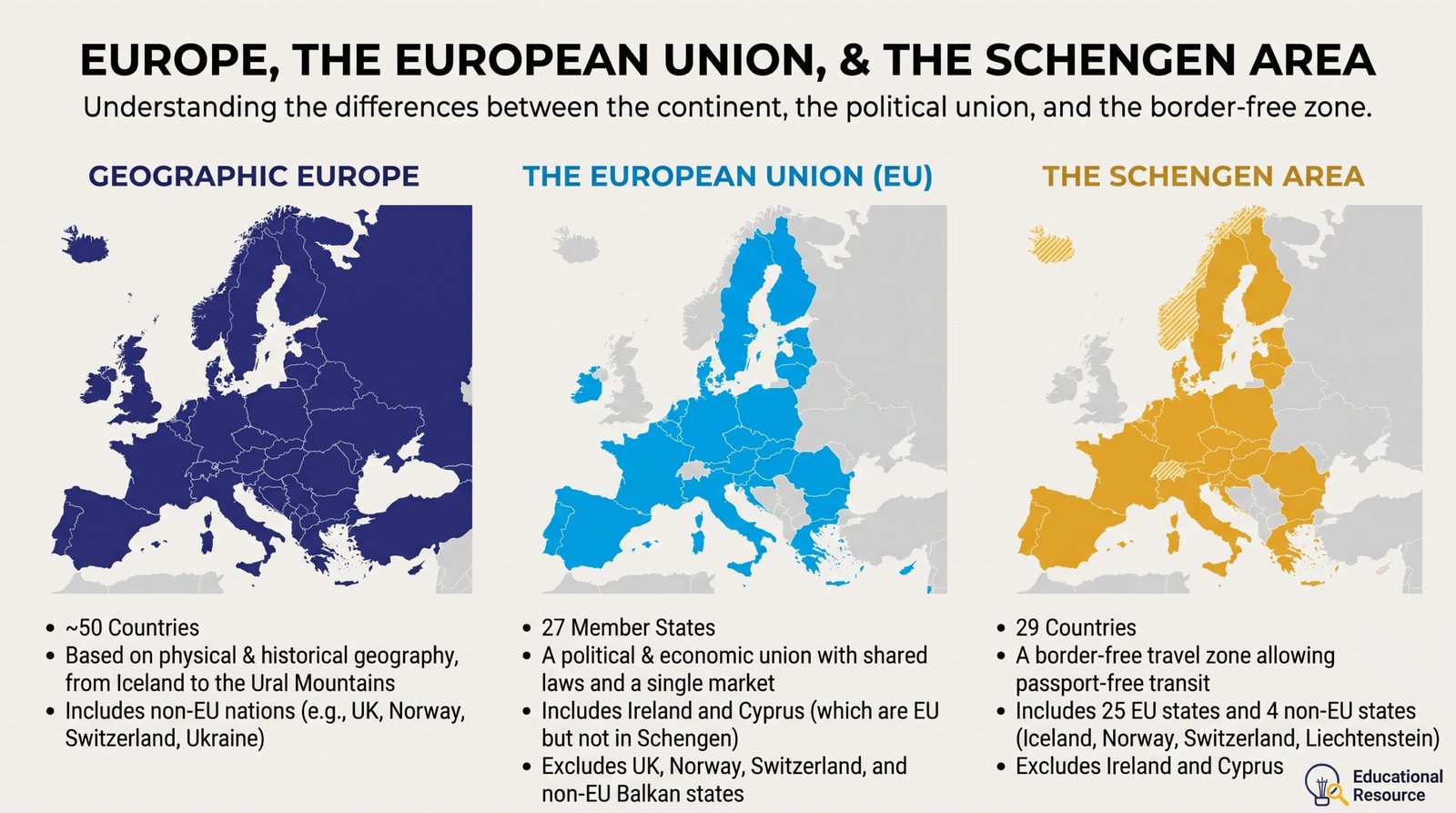
Europe, the European Union and the Schengen Area are three different things. Many inaccurate Europe facts begin when these three categories are treated as interchangeable. Confusing them can lead to incorrect country counts and travel advice.
| Topic | Europe | European Union (EU) | Schengen Area |
| What it is | A continent | A political and economic union | A common travel area with no routine internal border checks |
| Membership | Geographic definition varies | 27 member states | 29 participating countries in 2026 |
| Main purpose | Geographic region | Shared laws, policies and economic cooperation | Easier movement across participating borders |
| Examples outside it | Not applicable | Norway, Iceland, Switzerland and the UK are European but not EU members | Ireland and Cyprus are EU members but not in Schengen |
The United Kingdom left the EU in January 2020, but it did not leave Europe. Norway, Iceland and Switzerland are also outside the EU while participating in Schengen.
The euro is used by 21 EU countries in 2026, following Bulgaria’s adoption of the currency on January 1, 2026. Czechia, Denmark, Hungary, Poland, Romania and Sweden retain their own currencies. Kosovo and Montenegro use the euro unilaterally, outside formal eurozone membership.
Map graphic brief: Insert a three-colour map that distinguishes (1) the geographic continent of Europe, (2) the 27 EU member states and (3) the 29 Schengen countries. Include a legend and label non-EU Schengen members and EU members outside Schengen. Do not use one colour for all three groups.
Geology, Mountains, Seas and Climate
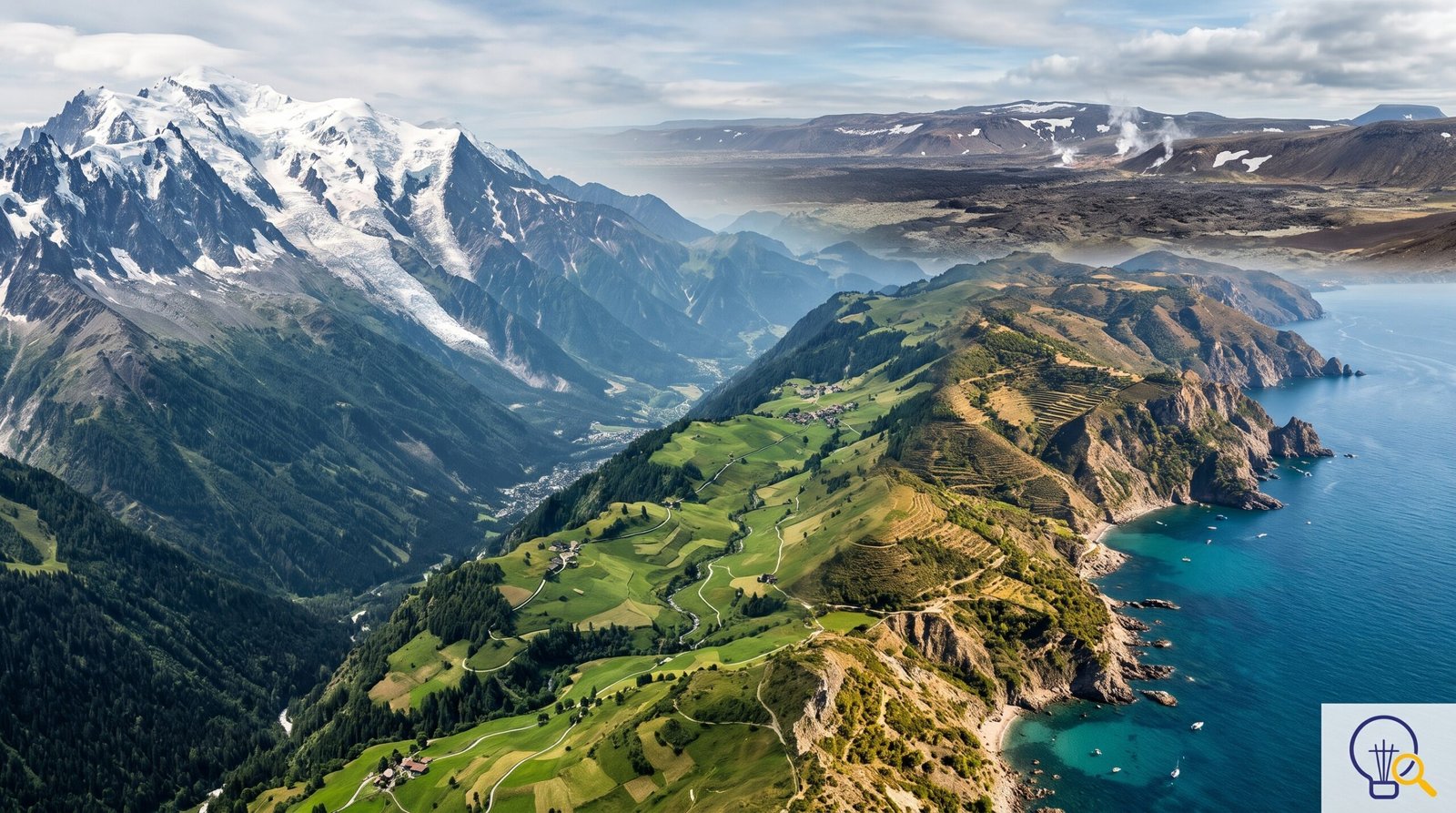
Europe’s landscape reflects moving tectonic plates, volcanic activity and repeated ice ages. These geological details add depth to familiar Europe facts about mountains and volcanoes.
Ancient rocks: The Baltic Shield in northern Europe contains some of the continent’s oldest exposed rocks. Parts of the shield date back more than three billion years.
Mountain building: The Alps, Pyrenees and Carpathians formed through long-running tectonic processes associated with the movement of the African and Eurasian plates. The region remains seismically active, particularly around the Mediterranean.
Iceland’s spreading plates: Iceland sits on the Mid-Atlantic Ridge, where the North American and Eurasian plates move apart by roughly 2–2.5 cm per year. Volcanic activity, hot springs and geysers are visible results of this geological setting.
Glacial landscapes: Ice sheets and glaciers carved Norway’s fjords and shaped many lakes in Finland and Sweden. As the ice melted, sea levels rose and coastlines changed.
Volcanoes: Mount Etna in Sicily and Mount Vesuvius near Naples are among Europe’s best-known volcanoes. Earthquake activity is also common in parts of Greece, Italy and Türkiye.
Why Is Much of Western Europe Relatively Mild?
The North Atlantic Drift, an extension of the Gulf Stream system, helps keep the ocean around western and northwestern Europe relatively mild. Prevailing winds carry maritime air inland, moderating winter temperatures in places such as the British Isles and parts of western Europe.
This does not mean every part of Europe has a warm climate. Northern Scandinavia has long, cold winters; Mediterranean regions have hot, dry summers; and central and eastern areas can experience larger seasonal temperature contrasts. Latitude, altitude, distance from the sea and local geography all matter.
Landmarks and Record Holders
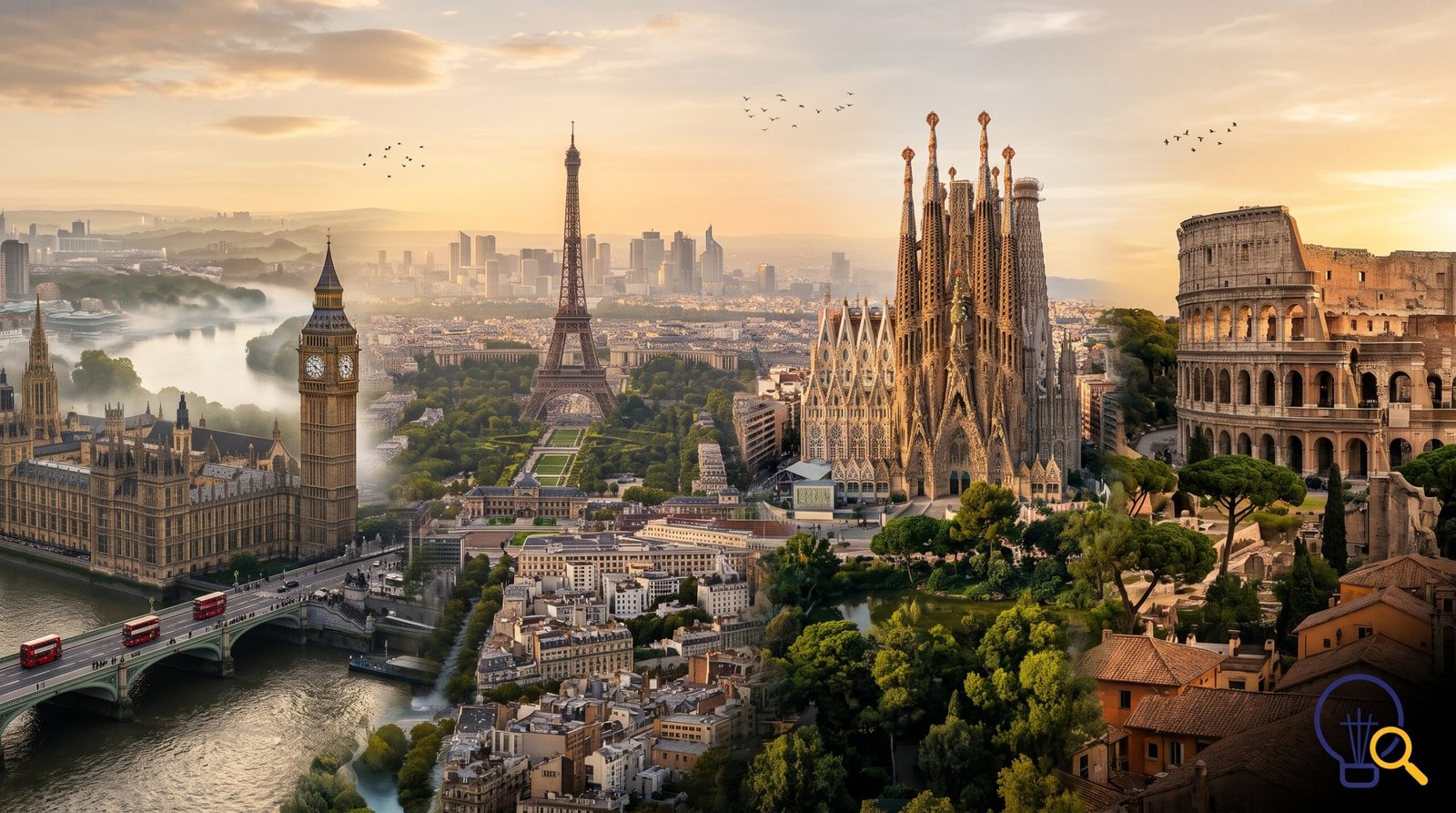
Europe’s historic buildings and modern towers illustrate very different periods of architecture. Landmark records are among the most shared Europe facts, but the measurement date matters.
Famous Attractions and Visitor Access
| Attraction | Visitor context | Entry information |
| Notre-Dame Cathedral, Paris | Reopened in December 2024 after restoration | Cathedral entry is free; a free time-slot reservation is optional but can reduce waiting |
| Louvre Museum, Paris | One of the world’s most visited art museums | Ticketed; check current admission arrangements |
| Colosseum, Rome | Major archaeological attraction | Ticketed |
| Eiffel Tower, Paris | Landmark with paid access to its viewing levels | Ticketed |
Notre-Dame’s current visitor policy is important: the cathedral itself is free to enter, and advance booking is not mandatory. Its official visitor information says a free reservation can help visitors avoid long queues. Be cautious of third parties claiming to sell admission tickets.
Tallest, Largest and Historic Buildings
- Tallest building: The Lakhta Center in St. Petersburg, Russia, stands 462 metres (1,516 feet) tall. It is commonly listed as Europe’s tallest building, although Russia’s transcontinental geography should be kept in mind.
- World’s tallest church: Barcelona’s Sagrada Família reached 172.5 metres (565 feet) on February 20, 2026, when the upper part of its central tower’s cross was installed. Guinness World Records recorded it as the tallest church in the world. Exterior work on the tower was completed, while interior and other finishing work continued.
- Largest church by floor area: St. Peter’s Basilica in Vatican City is widely listed among the largest churches by interior area. Rankings can vary according to whether floor area, volume or another measurement is used.
- Ancient monuments: Stonehenge’s earliest major construction dates back roughly 5,000 years. The Parthenon in Athens was built in the fifth century BCE.
- Castles: Czechia is known for a large number of castles and chateaux, but totals vary because inventories differ on whether ruins, manor houses and small fortifications count as castles.
European Record Holders
| Record | Holder | Detail |
| Smallest sovereign state | Vatican City | About 0.44 km² (0.17 sq mi) |
| Largest country by total area | Russia | About 17.1 million km² (6.6 million sq mi); spans Europe and Asia |
| Largest country entirely in Europe | Ukraine | About 603,000 km² (233,000 sq mi) |
| Highest population density among sovereign states | Monaco | Roughly 19,000 people per km² (about 49,000 per sq mi); estimates vary by year and method |
| Highest capital city in Europe | Andorra la Vella | Around 1,050 m (3,445 ft) above sea level |
| Largest island in Europe | Great Britain | The largest island in the European archipelago |
| Northernmost town in mainland Europe | Hammerfest, Norway | A coastal town in northern Norway; claims that include Svalbard use a different geographic scope |
| Northernmost settlement with a substantial year-round community in the European Arctic | Longyearbyen, Svalbard | A high-Arctic settlement; it is not the same category as a mainland town |
| Northernmost civilian research settlement often cited | Ny-Ålesund, Svalbard | A research settlement farther north than Longyearbyen; it is not usually described as a conventional town |
| Largest city wholly in Europe by population | Moscow | More than 13 million residents in the city proper, depending on the estimate |
| Longest river in Europe | Volga, Russia | About 3,530 km (2,193 mi) |
Rivers, Lakes, Coastlines and Peaks
- Longest river: The Volga runs about 3,530 km (2,193 miles) through western Russia before reaching the Caspian Sea.
- International river: The Danube passes through or along the borders of ten countries and is about 2,850 km (1,770 miles) long.
- Largest lake by area in Europe: Lake Ladoga in northwestern Russia covers about 17,700 km² (6,834 sq mi).
- Highest mountain: Mount Elbrus reaches 5,642 m (18,510 ft) in the Caucasus. Whether it is counted as Europe’s highest peak depends on where the Europe–Asia boundary is drawn. Mont Blanc, at about 4,806 m (15,768 ft), is the highest peak in the Alps.
- Long coastline: Norway’s coastline becomes extremely long when fjords and islands are included. Figures differ greatly depending on the measurement scale and what is counted.
- Waterfall: The Rhine Falls in Switzerland are among Europe’s largest waterfalls by volume.
- Major port: Rotterdam in the Netherlands is one of Europe’s leading seaports and a major gateway for international trade.
Record-holders infographic brief: Create a clean infographic with the Volga, Lake Ladoga, Great Britain, Andorra la Vella, Sagrada Família and Lakhta Center. Put the measurement and unit beside each record, and add a small note that some records depend on geographic definitions.
Languages, Religion and Cultural Diversity
Europe has more than 200 languages, while the EU recognizes 24 official languages. Language diversity is another reason Europe facts should distinguish the continent from the EU. The difference exists because the continent includes many countries outside the EU and many regional or minority languages.
A few examples show this variety:
- Writing systems: Latin is widely used. Russian, Ukrainian and Bulgarian use Cyrillic, while Greek has its own alphabet.
- Language families: Romance languages include French, Spanish and Italian; Germanic languages include German, Dutch and Swedish; Slavic languages include Polish, Czech and Russian.
- Basque: Spoken in parts of northern Spain and southwestern France, Basque is a language isolate, meaning it has no proven relationship with another living language.
- Icelandic word formation: Icelandic often creates new words from existing roots. The word tölva, meaning computer, combines elements associated with numbers and a prophetess.
- English as a shared language: According to the European Commission’s 2024 Eurobarometer, 47% of people surveyed in the EU said they could speak English well enough to hold a conversation. The survey was conducted in 2023 across the 27 EU member states; it is not a survey of every European country.
Christianity is the continent’s largest religious tradition, but Europe is not religiously uniform. Muslim, Jewish and other religious communities, as well as people with no religious affiliation, are part of its diverse societies.
Customs, Food and Farming
Some popular “European laws” are actually local customs or informal traditions. The distinction matters because rules can vary by country, region and municipality.
| Place | Commonly reported rule or custom | What to know |
| Hungary | Avoiding clinking beer glasses | A folk tradition often linked to the events of 1849; it is not a nationwide legal ban |
| Denmark | Rules for registering a baby’s first name | Parents generally choose from approved names or seek approval for another name |
| Switzerland | Quiet hours for noisy chores | Local rules and building regulations vary by municipality and canton |
| Germany | Many shops close on Sundays | Sunday trading is restricted, with exceptions that vary by state and type of shop |
| Italy | A restaurant may add a coperto | This is a cover charge, not a tip; it should be clearly disclosed on the menu |
The Hungarian beer-glass story is commonly connected to Austrian celebrations after the execution of Hungarian leaders in 1849. Whether people follow the custom today varies, and it should not be presented as a law.
Food and Farming Traditions
European food names can be protected by regional-origin rules. Within the EU, labels such as Protected Designation of Origin (PDO) and Protected Geographical Indication (PGI) help identify products tied to a particular place and production method.
| Product | Country or region | What makes it distinctive |
| Feta | Greece | Protected production area and specified milk requirements |
| Parmigiano Reggiano | Italy | Produced in a defined area under specific standards |
| Champagne | France | The protected name applies to sparkling wine from the Champagne region |
| Gouda Holland | Netherlands | A protected geographical name with defined standards |
Belgium is internationally associated with chocolate and fries, although the precise origin of fries remains debated. Pilsner lager was first brewed in Plzeň in 1842. Vienna’s coffee-house culture was recognized by UNESCO as intangible cultural heritage in 2011. France, Italy and Spain are among the world’s major wine-producing countries.
Agriculture also varies widely. Major crops include wheat, barley, maize, sugar beet, grapes and olives. France is the EU’s largest agricultural producer by overall agricultural output in many commonly used comparisons, although rankings depend on the measure and year.
Europe is an important potato-growing region, but it does not produce three-quarters of the world’s potatoes. Asia produces a larger share, with China and India among the leading producers.
A Short History of Europe
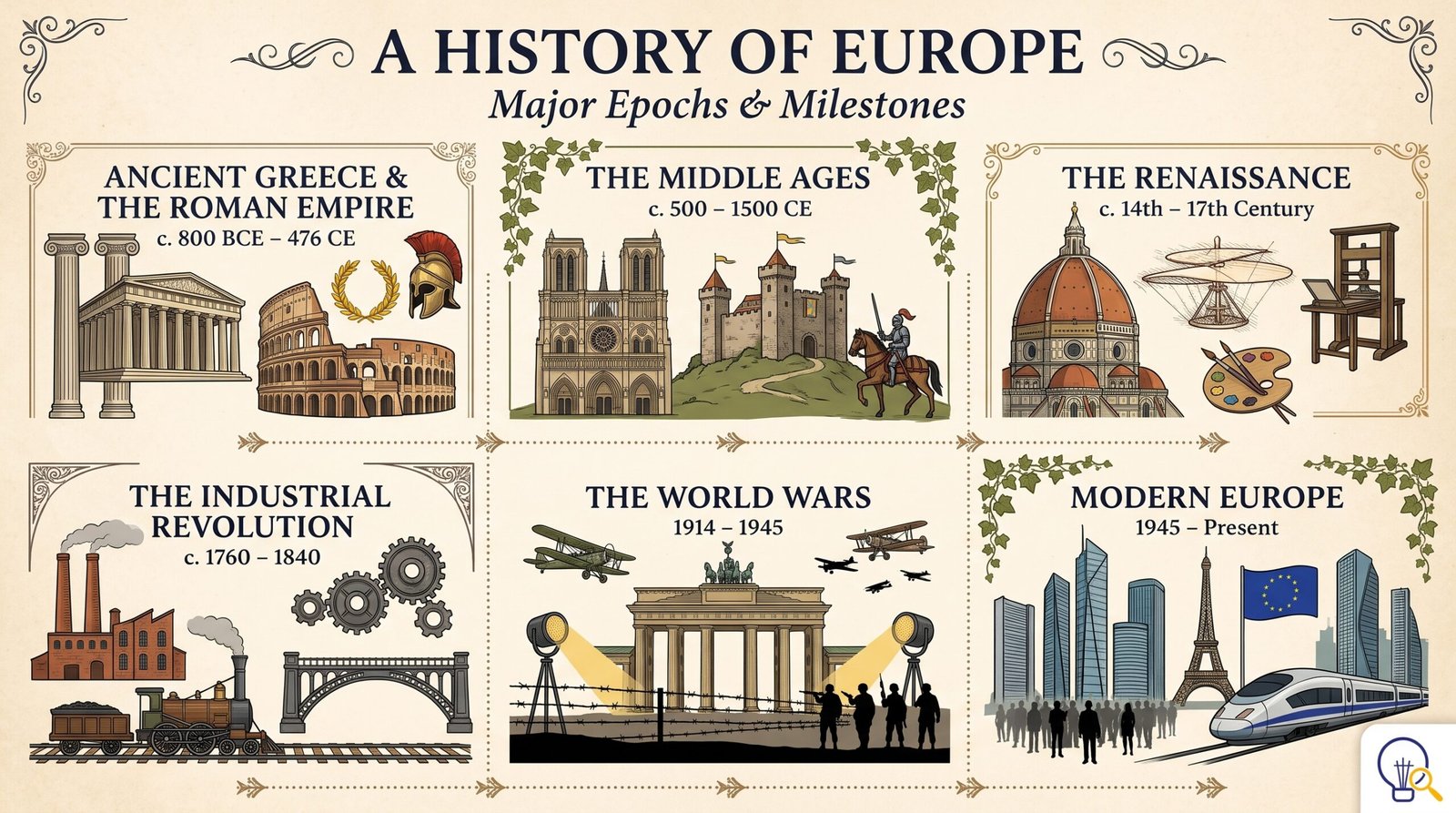
| Period or event | Turning point | Why it matters |
| Ancient Greece | The first recorded ancient Olympic Games are traditionally dated to 776 BCE | Greek political thought, philosophy and sport influenced later societies |
| Roman Empire | Reached its greatest territorial extent under Trajan around 117 CE | Roman law, roads, urban planning and Latin shaped European history |
| Medieval universities | Universities developed in cities such as Bologna, Paris and Oxford from the 11th and 12th centuries | They helped establish enduring institutions for higher learning |
| Renaissance | From the 14th to 17th centuries | Art, science, literature and trade changed across Europe |
| Reformation | Began in the 1510s | Reshaped religious and political life |
| Thirty Years’ War | Ended in 1648 | The peace settlements influenced the development of state sovereignty |
| Industrial Revolution | Began in Britain during the 1760s | Mechanized production transformed work, transport and cities |
| French Revolution | Began in 1789 | Ideas about citizenship, rights and political authority spread widely |
| World Wars | 1914–1918 and 1939–1945 | Borders changed and European political cooperation took new forms |
| Cold War | Late 1940s–1991 | Europe was divided into competing political and military blocs |
| Berlin Wall | Fell in 1989 | Helped pave the way for German reunification |
| European integration | Treaty of Rome in 1957; Maastricht Treaty took effect in 1993 | Built the foundations of today’s EU |
Science, Art, Sport and Wildlife
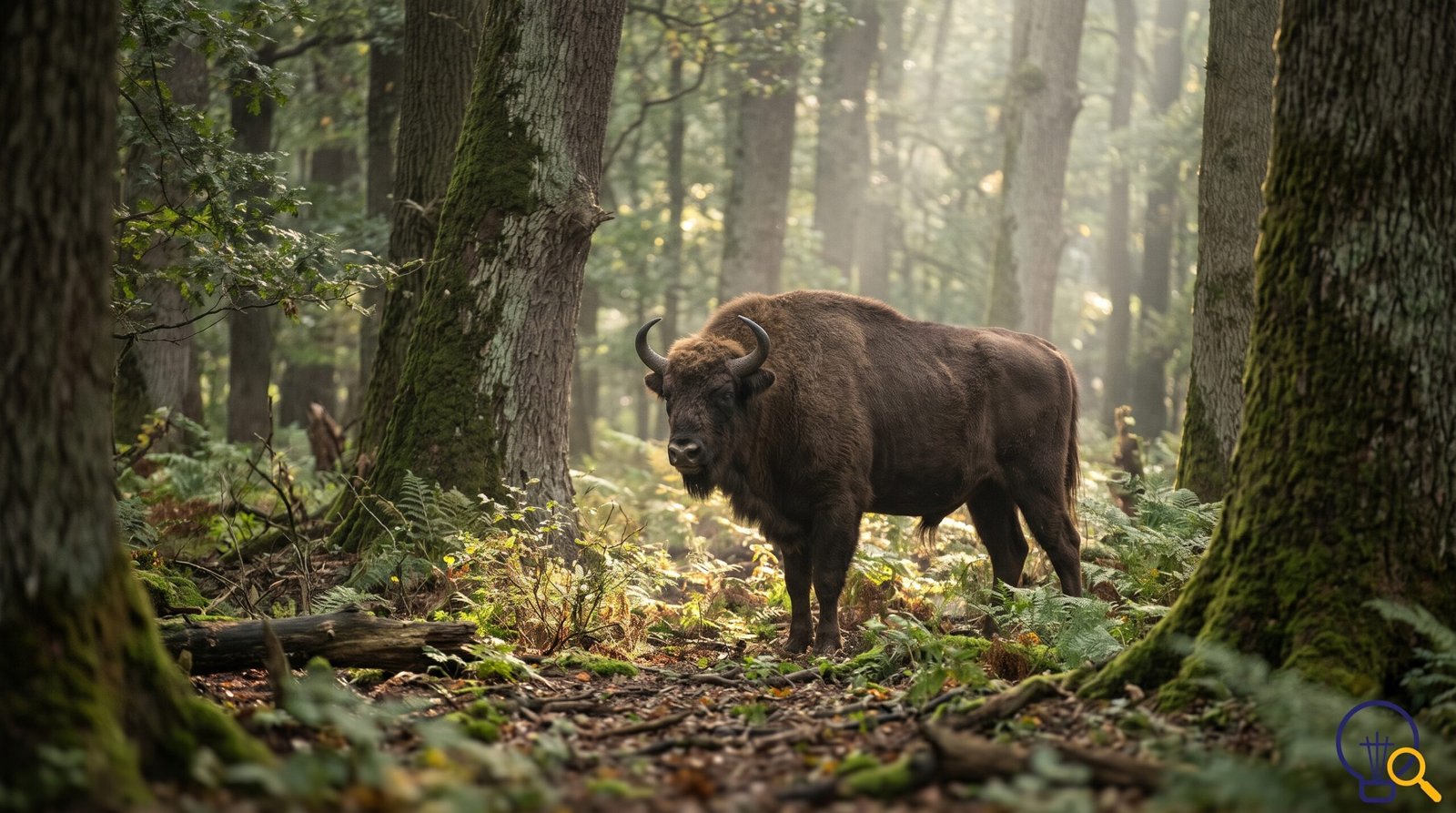
Europe’s contributions to science, art and sport developed across many centuries and through international exchange. Johannes Gutenberg’s movable-type printing system in Mainz around the mid-15th century helped books and ideas circulate more widely. Nicolaus Copernicus, Galileo Galilei and Isaac Newton made influential contributions to astronomy and physics. Renaissance artists such as Leonardo da Vinci and Michelangelo transformed painting, sculpture and engineering.
Scottish scientist Alexander Fleming identified penicillin’s antibacterial effect in 1928. At CERN, near Geneva, Tim Berners-Lee proposed the World Wide Web in 1989. CERN’s Large Hadron Collider is a 27-km (16.8-mile) ring beneath the France–Switzerland border. The modern Olympic Games were revived in Athens in 1896, and the Football Association in England established a widely adopted set of association-football rules in 1863.
Wildlife is just as varied. Białowieża Forest, on the Poland–Belarus border, protects one of Europe’s best-known areas of ancient lowland forest and is an important home for European bison. Brown bears live in parts of the Carpathians, including Romania. Iceland is a major breeding area for Atlantic puffins, while the northern lights can sometimes be seen in northern Norway, Sweden, Finland and Iceland. The word “geyser” comes from Geysir, a famous hot spring in Iceland. Northern Ireland’s Giant’s Causeway contains around 40,000 basalt columns formed by ancient volcanic activity.
Europe’s Forests: Tropical vs. Temperate Rainforest
The phrase “European rainforest” needs context. Tropical rainforests are not found in Europe’s temperate climate zones, but temperate rainforests do exist along some wet Atlantic-facing coasts, including parts of Ireland, western Scotland, Wales and Norway. Perućica in Bosnia and Herzegovina is better described as an old-growth forest, rather than a tropical rainforest. These are different forest types, so describing all of them with the same label creates a misleading contradiction.
Common Myths and How Europe Compares
| Myth | Reality |
| Britain left Europe | The UK left the EU in 2020, not the continent |
| Europe and the EU are the same | The EU has 27 members; Europe is a geographic continent with a broader and debated country count |
| Antarctica is the smallest continent | Europe is generally considered the second-smallest continent by area; Australia is smaller |
| Czechia is the largest landlocked country in Europe | Belarus is larger among countries wholly in Europe |
| One attraction is unquestionably Europe’s most visited | Rankings depend on the year and how visits are counted |
| Greenland is geographically part of Europe | Greenland is geographically part of North America, although it is an autonomous territory within the Kingdom of Denmark |
| Europe grows most of the world’s potatoes | Asia produces more potatoes overall |
How Europe Compares with Other Continents
Figures below are rounded estimates and may vary between demographic sources.
| Continent | Area (km²) | Area (sq mi) | Approx. population |
| Asia | 44.6 million | 17.2 million | 4.7 billion |
| Africa | 30.4 million | 11.7 million | 1.5 billion |
| North America | 24.7 million | 9.5 million | 600 million |
| South America | 17.8 million | 6.9 million | 440 million |
| Antarctica | 14.2 million | 5.5 million | No permanent residents |
| Europe | 10.2 million | 3.9 million | 740–745 million |
| Australia/Oceania | 8.5 million | 3.3 million | 45–50 million |
Europe is the second-smallest continent by area under the seven-continent model, but it has a much larger population than Australia/Oceania and Antarctica. Its population density is also higher than that of several larger continents.
Practical Travel Information
Schengen Entry Rules
The Schengen Area has 29 participating countries in 2026. It allows travel across internal borders without routine passport checks, although temporary checks can be reintroduced in certain circumstances. The area is not identical to the EU: Norway, Iceland, Switzerland and Liechtenstein are Schengen members but not EU members, while Ireland and Cyprus are EU members outside Schengen.
US citizens can generally visit Schengen countries for up to 90 days in any 180-day period without a short-stay visa, provided they meet the entry conditions. The 90-day allowance is shared across the Schengen Area, not reset in each country.
The EU’s Entry/Exit System (EES) became fully operational on April 10, 2026. It records the entry and exit of eligible non-EU short-stay visitors at the external borders of participating countries, replacing manual passport stamping with digital records and biometric checks where applicable. ETIAS is a separate electronic travel authorisation for visa-exempt visitors. As of November 14, 2026, the European Commission says ETIAS is not yet in operation; travellers should check the official EU announcement before departure rather than assume they can apply already.
Money
- The euro is used by 21 EU countries in 2026, but it is not Europe’s only currency. The UK uses the pound sterling, Switzerland uses the Swiss franc, and countries such as Denmark, Sweden, Poland, Hungary, Czechia and Romania use their own currencies.
- If a card terminal offers to convert a purchase into US dollars, compare the rate and fees. Paying in the local currency often avoids the merchant’s dynamic currency conversion markup.
Getting Around
- Trains connect many major cities, and high-speed services operate in several countries. Rail passes can be useful for some itineraries, but seat reservations may cost extra.
- Budget airlines can offer low fares, but baggage, seat selection and airport-transfer costs can increase the total price.
- The emergency number 112 works throughout the EU and in many other European countries. Local emergency arrangements can vary outside the EU.
Phone Plans
- EU “roam like at home” rules apply across the EU and, through related arrangements, the European Economic Area. They do not automatically cover every European destination: the UK, Switzerland and Andorra may be excluded from a traveller’s plan.
- Before travelling, check the roaming terms of your mobile provider or compare a suitable travel eSIM.
Practical planning note: Keep a copy of important travel details available offline, including accommodation information and emergency contacts. Entry requirements, transport schedules and local rules can change, so verify them shortly before departure.
France Tourism and Finland’s Happiness Ranking
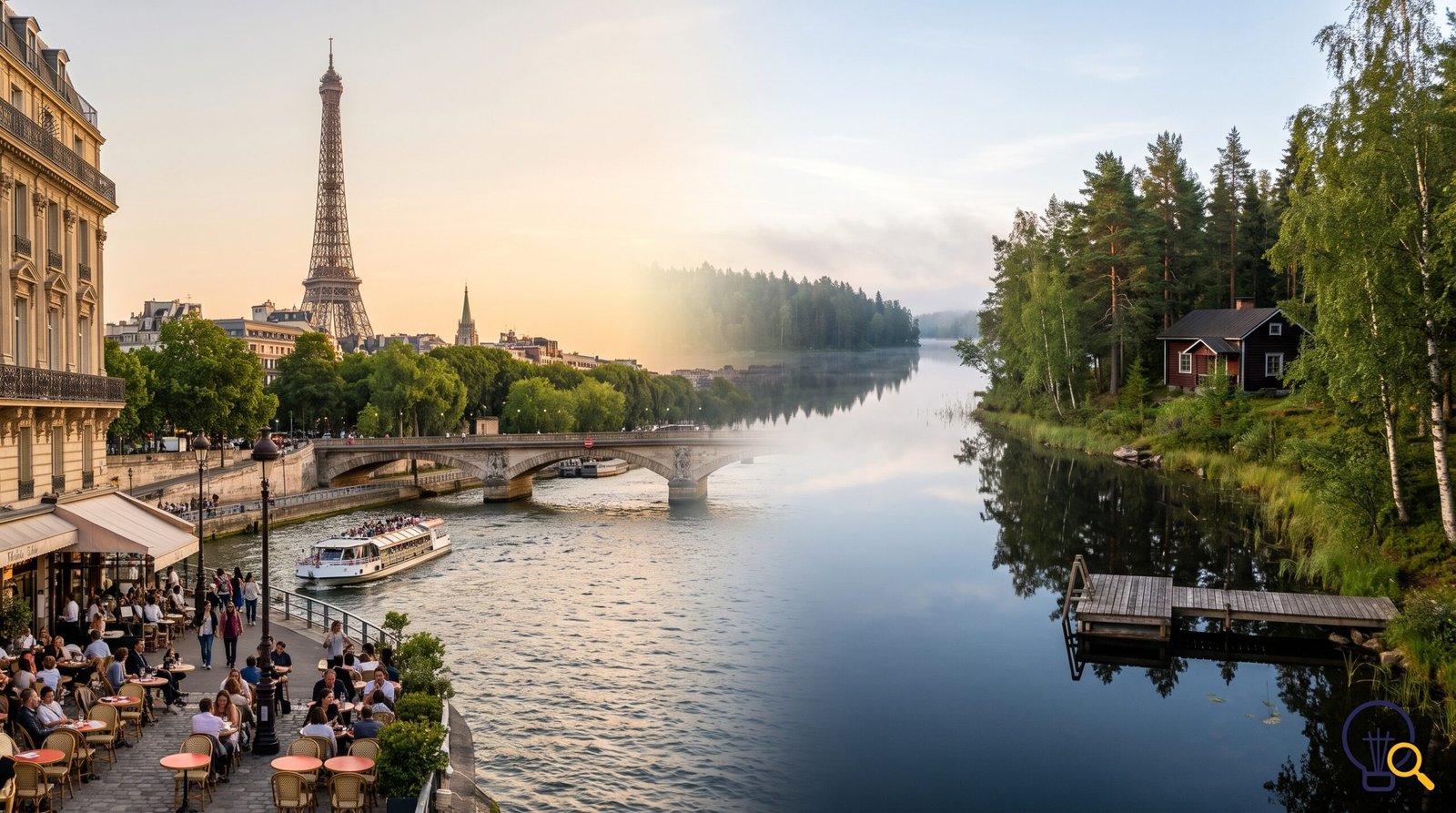
France remained the world’s leading international tourist destination in 2025, recording approximately 102 million international visitors, according to the French government’s February 2026 tourism review. Visitor totals depend on the reporting definition, but the figure illustrates the country’s continuing appeal.
Finland ranked first in the 2026 World Happiness Report, with a life-evaluation score of 7.764 based on Gallup World Poll data collected from 2023 to 2025. The report measures how people evaluate their lives; it is not a simple ranking of holiday destinations or a claim that every resident feels happy all the time.
Test Your Knowledge: Quick Quiz
Try these six questions before checking the answers.
- Which country is the largest one entirely inside Europe?
A) France B) Ukraine C) Spain D) Germany - Which river flows through or along the borders of ten countries?
A) Rhine B) Volga C) Danube D) Seine - How many EU countries use the euro in 2026?
A) 19 B) 20 C) 21 D) 27 - Which is the largest landlocked country entirely in Europe?
A) Czechia B) Belarus C) Austria D) Hungary - Which is the smallest sovereign state in Europe by area?
A) Monaco B) San Marino C) Liechtenstein D) Vatican City - Which building became the world’s tallest church in February 2026?
A) Lakhta Center B) Eiffel Tower C) The Shard D) Sagrada Família
Answers and explanations
- B) Ukraine. It is the largest country located entirely within Europe by area.
- C) Danube. The river passes through or borders ten countries.
- C) 21. Bulgaria adopted the euro on January 1, 2026, becoming the 21st euro-area EU member.
- B) Belarus. It is larger than the other listed landlocked countries.
- D) Vatican City. Its area is about 0.44 km² (0.17 sq mi).
- D) Sagrada Família. Its central tower reached 172.5 metres in February 2026, giving it the world record for the tallest church.
Sources and Further Reading
The article’s key figures and changing claims were checked against the following institutions and reporting sources. Titles are provided for reference; no hyperlinks are included.
- European Commission — Migration and Home Affairs: Smart Borders; EES and ETIAS status updates (2026).
- Eurostat: Key Figures on Europe, 2026 edition; EU population data for January 2026.
- Guinness World Records: Tallest church/cathedral spire — Sagrada Família (February 2026).
- Notre-Dame de Paris: Official visitor reservation and admission information.
- European Commission — Eurobarometer: Europeans and Their Languages (2024 publication).
- World Happiness Report 2026: Country rankings and life-evaluation data.
- French Ministry of Economy and Finance: 2025 tourism results, published February 19, 2026.
- Icelandic National Broadcasting Service (RÚV): Mosquitoes arrive in Iceland, October 20, 2025.
- International Civil Aviation Organization: North Atlantic ocean currents and temperature information, 2026 edition.
- UNESCO World Heritage Centre: World Heritage information and cultural heritage records.
Final Thoughts
Europe combines a relatively compact land area with a remarkable range of languages, landscapes, political arrangements and historic sites. Its records are fascinating, but the most useful lesson is that definitions matter: a continent is not the same as a political union, and a record can change when new measurements or discoveries appear.
For schoolwork, research or travel planning, use the date and source behind each statistic. Population estimates, border procedures, visitor policies and world records can change, so check the latest official information before relying on them.
Frequently Asked Questions
What are 10 interesting facts about Europe?
Europe has the world’s smallest country, Vatican City, the longest river in the EU, the Danube, and the highest capital city, Andorra la Vella. It is also home to many historic landmarks and diverse cultures.
What are some important facts about Europe?
Europe is a continent with more than 40 countries, diverse languages, and rich history. It is also home to the European Union, a political and economic union of 27 member countries.
What are the most interesting facts about Europe’s landmarks?
Europe has some of the world’s most famous landmarks, including the Eiffel Tower, Colosseum, Big Ben, and Sagrada Família. Many reflect centuries of architecture, art, and history.
What is Europe best known for?
Europe is best known for its historic cities, famous landmarks, art, architecture, diverse cultures, and influential contributions to science, literature, and philosophy.
Is Europe the same as the European Union?
No. Europe is a continent, while the European Union (EU) is a political and economic union of 27 European countries. Not every European country is an EU member.
Can you visit Notre-Dame Cathedral for free?
Yes. Entry to Notre-Dame Cathedral in Paris is free, although visitors can make a free optional reservation to help reduce waiting time.
