
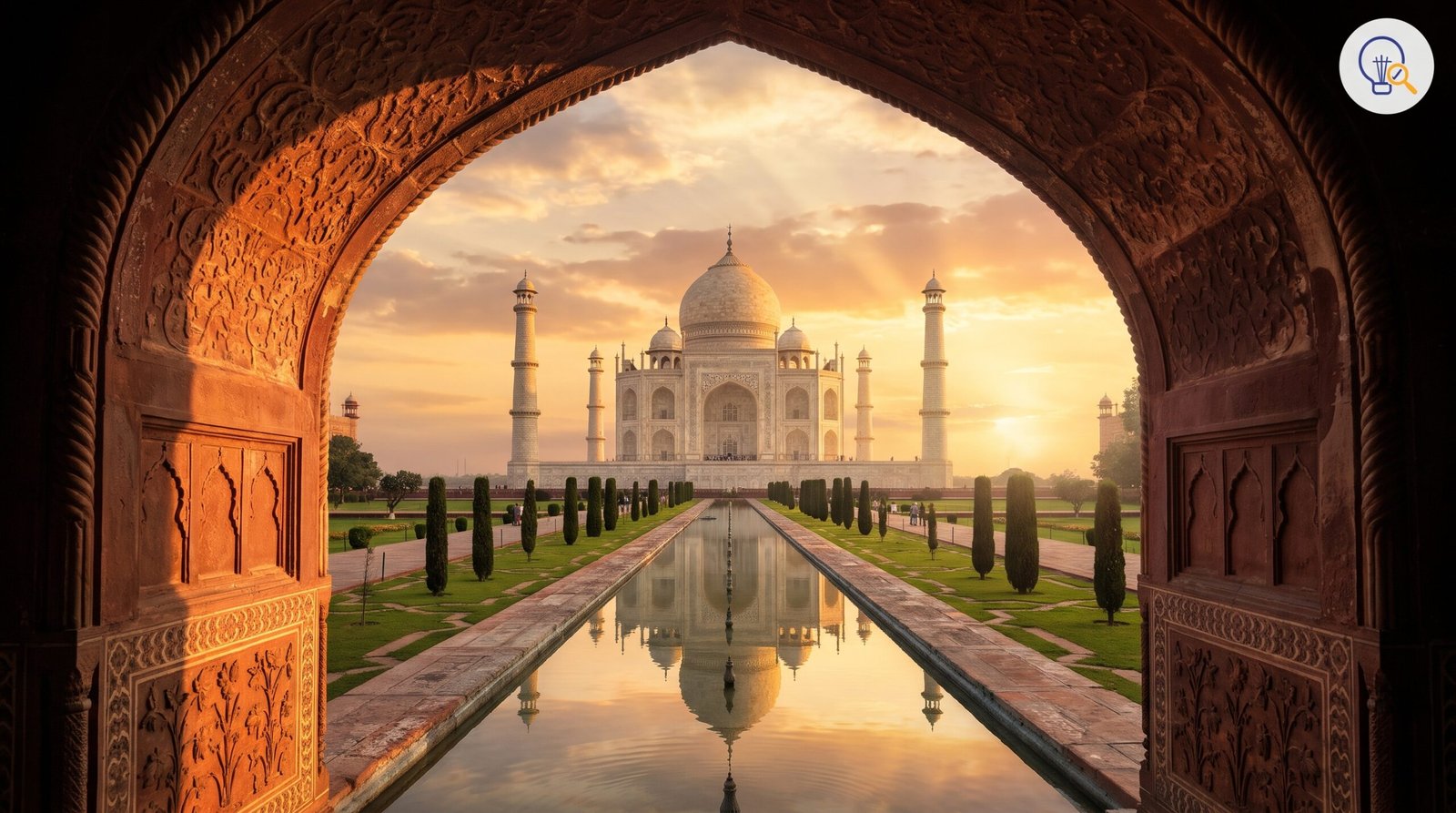

What makes the Taj Mahal one of the most admired monuments in the world? Beyond its beautiful white marble, this masterpiece holds centuries of history, remarkable architecture, and fascinating stories. These taj mahal facts reveal how Mughal Emperor Shah Jahan commissioned this iconic mausoleum in memory of Mumtaz Mahal, how thousands of skilled workers helped build it, and why its appearance changes throughout the day.
Located in Agra, India, the Taj Mahal is much more than a famous tourist attraction. It represents Mughal history, artistic achievement, religious traditions, and extraordinary craftsmanship. From its precious stone decorations to its carefully planned gardens, every part of the complex has something interesting to discover.
Whether you are researching world history, learning about Mughal architecture, or planning a trip to India, these facts will help you understand why the Taj Mahal remains a wonder of the world.
20+ Interesting Taj Mahal Facts You Probably Didn’t Know
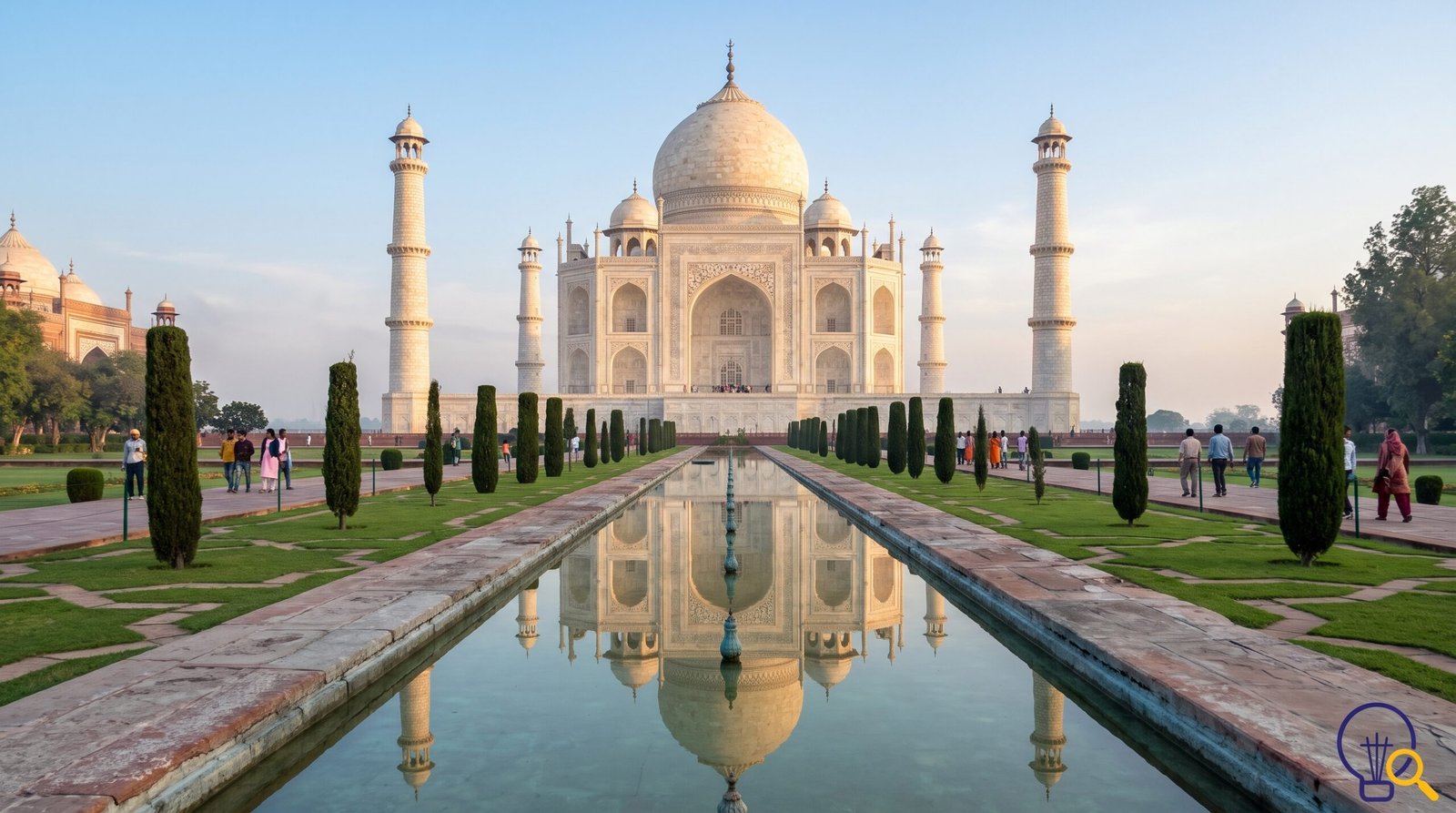
The Taj Mahal is famous for its white marble appearance, but many of its most interesting details are less obvious. Its construction involved thousands of workers, its design includes clever visual techniques, and its history contains stories that are still discussed today.
Here are 22 interesting facts about this remarkable monument.
1. It Took Around 22 Years to Complete
Construction of the Taj Mahal began in 1632. The main marble mausoleum was completed around 1648, while work on the wider complex continued afterward.
The mosque, guest house, main gateway, and other surrounding structures were completed by 1653. This is why the commonly repeated construction period is around 22 years. The figure refers to the larger project rather than only the central tomb.
2. Around 20,000 Workers Helped Build It
The Taj Mahal required a huge workforce. Estimates commonly place the number of workers at around 20,000.
The project involved architects, engineers, stonecutters, marble carvers, calligraphers, painters, sculptors, and specialist craftsmen. Workers and artisans came from different parts of the Mughal Empire and beyond.
Their combined skills helped create the monument’s detailed marble surfaces, impressive dome, decorative patterns, and surrounding buildings.
3. Its Marble Appears to Change Color
The Taj Mahal’s white marble can look different depending on the time of day and lighting conditions.
It may appear soft pink at sunrise, bright white during strong daylight, and slightly golden around sunset. Under moonlight, it can look cooler and more silvery.
The marble does not actually change color. Different light conditions affect how its surface reflects and scatters light.
4. It Features Precious Stone Decorations
The Taj Mahal contains detailed floral designs created with a decorative technique called Pietra Dura, also known as Parchin Kari in the Indian tradition.
Craftsmen carefully cut small pieces of colored stone and fitted them into the marble surface. Materials used in this work include jade, lapis lazuli, and carnelian.
The finished designs feature flowers, leaves, vines, and geometric patterns. The level of detail shows the patience and precision required from the artisans.
5. Its Four Minarets Lean Slightly Outward
Four minarets stand at the corners of the raised platform surrounding the main mausoleum.
An interesting architectural detail is that they lean slightly outward rather than standing perfectly vertical. A commonly cited engineering explanation suggests this arrangement could help reduce the risk of a collapsing minaret falling directly onto the central tomb.
However, the original builders’ exact intention has not been conclusively established.
6. Shah Jahan and Mumtaz Mahal Are Buried Inside
The Taj Mahal was originally built as the tomb of Mumtaz Mahal. Shah Jahan was later buried beside her.
Visitors can see two decorated marble structures called cenotaphs inside the main chamber. These mark the positions of the royal burials, but they are not the actual graves.
The real graves are located in a lower chamber beneath the main room.
7. It Was Built Mainly With White Makrana Marble
Much of the main mausoleum is covered with white marble brought from Makrana in Rajasthan, India.
However, the entire complex is not made from white marble. Red sandstone was used in the mosque, guest house, and other structures. Brick, mortar, and precious decorative stones also played important roles.
The contrast between white marble and red sandstone gives the complex much of its distinctive appearance.
8. Shah Jahan’s Burial Changed the Interior Symmetry
The Taj Mahal is famous for its balanced design, but one part of its interior is not perfectly symmetrical.
Mumtaz Mahal’s cenotaph occupies the central position in the main chamber. Shah Jahan’s cenotaph was added beside hers after his death.
This difference reflects the original purpose of the building: it was first designed as a mausoleum for Mumtaz Mahal.
9. Its Calligraphy Was Designed to Look Balanced
The Taj Mahal features Arabic calligraphy, including passages from the Quran, on its entrance gateway and other architectural surfaces.
One clever visual detail is that the lettering becomes slightly larger in higher sections. This adjustment helps the inscriptions appear more uniform when viewed from the ground.
The calligraphy is associated with the Persian artist Amanat Khan Shirazi, whose signature appears on an inscription inside the monument.
10. It Became a UNESCO World Heritage Site in 1983
The Taj Mahal was added to the UNESCO World Heritage List in 1983.
This recognition reflects its outstanding cultural, historical, and architectural importance. Its design combines Persian, Islamic, and Indian influences and represents an important achievement in Mughal architecture.
11. It Was Named One of the New Seven Wonders of the World
In 2007, the Taj Mahal was selected as one of the New Seven Wonders of the World through an international public voting campaign.
It was included alongside famous landmarks such as the Great Wall of China and Petra.
This recognition is different from UNESCO World Heritage status. The 2007 selection came from a public global vote, while UNESCO recognition is based on cultural and heritage criteria.
12. The Black Taj Mahal Is a Famous Legend
A popular story suggests that Shah Jahan planned to build a second mausoleum made of black marble across the Yamuna River.
According to the legend, the black structure would have served as his own tomb and faced the white Taj Mahal.
However, there is no conclusive archaeological evidence that such a mausoleum was constructed or that work on it began. The story remains a famous legend rather than an established historical fact.
13. Its Main Architect Was Ustad Ahmad Lahori
Ustad Ahmad Lahori is widely identified as the principal architect associated with the Taj Mahal.
However, the monument was not the work of one person alone. Its design and construction involved a large group of architects, engineers, supervisors, artists, and specialist craftsmen.
14. Its Garden Follows a Charbagh Layout
The garden surrounding the Taj Mahal follows a Persian-inspired design called Charbagh.
The layout divides the garden into four main sections using pathways and water channels. This arrangement has symbolic connections with the gardens of paradise in Islamic tradition.
15. The Mausoleum Sits Beside the Yamuna River
The Taj Mahal stands on the right bank of the Yamuna River in Agra.
Its position beside the river is an important part of its design. Unlike many traditional garden tombs, the mausoleum stands at the northern end of the main garden, close to the river, rather than in the center of the garden.
16. It Has a Double-Shell Dome
The large central dome is one of the Taj Mahal’s most recognizable features.
It uses a double-shell design, meaning its inner and outer forms serve different architectural purposes. This approach creates an impressive exterior height while maintaining a more practical interior space.
A decorative finial sits at the top of the dome.
17. Its Interior Contains a Detailed Marble Screen
A beautifully carved marble screen surrounds the cenotaphs inside the main chamber.
The screen features delicate latticework, with small openings that allow light to pass through. Its detailed patterns demonstrate the skill of the craftsmen who worked on the interior.
18. The Mosque and Guest House Look Almost Identical
Two red sandstone buildings stand on either side of the main mausoleum.
The western building is a mosque used for prayer. The eastern building is commonly known as the guest house or jawab.
Their similar exterior designs help maintain the visual balance of the complex, although the two buildings serve different purposes.
19. The Monument Took Materials From Different Regions
The Taj Mahal required materials from several locations across the Mughal Empire and beyond.
White marble came from Makrana, while other building materials and decorative stones were transported from different regions. Historical accounts also describe the use of carts and animals, including elephants, to move heavy supplies.
20. Its Decorations Include Detailed Floral Designs
Flowers appear throughout the Taj Mahal’s decorative artwork.
Some are carved directly into the marble, while others are created using carefully fitted pieces of colored stone. These designs reflect the artistic traditions of the Mughal period.
21. It Was Built During Shah Jahan’s Reign
Shah Jahan ruled the Mughal Empire from 1628 to 1658.
His reign is known for major architectural projects, including the Taj Mahal, the Red Fort in Delhi, and the Jama Masjid. His interest in architecture helped shape an important period in Mughal artistic history.
22. Its Preservation Remains an Ongoing Challenge
Air pollution, dust, environmental changes, and visitor pressure create challenges for the long-term preservation of the Taj Mahal.
Conservation authorities monitor the monument and carry out maintenance to protect its marble surfaces, decorations, and surrounding structures.
Preserving the Taj Mahal is important because its original materials and craftsmanship cannot simply be replaced.
What Is the Taj Mahal? Quick Facts and Location
The Taj Mahal is a white marble mausoleum built during the Mughal Empire. A mausoleum is a large structure created to hold the remains of a person or people.
Mughal Emperor Shah Jahan commissioned it in memory of his wife, Mumtaz Mahal. It stands in Agra, Uttar Pradesh, India, on the right bank of the Yamuna River.
The complex includes the central tomb, gardens, a mosque, a guest house, and a monumental entrance gateway.
Taj Mahal at a Glance
| Feature | Information |
| Name | Taj Mahal |
| Location | Agra, Uttar Pradesh, India |
| Country | India |
| Commissioned by | Mughal Emperor Shah Jahan |
| Built in memory of | Mumtaz Mahal |
| Construction began | 1632 |
| Main mausoleum completed | 1648 |
| Wider complex completed | 1653 |
| Main building material | White Makrana marble |
| Architectural style | Mughal architecture |
| Main architect associated with the project | Ustad Ahmad Lahori |
| UNESCO World Heritage Site | Since 1983 |
| New Seven Wonders selection | 2007 |
Where Is the Taj Mahal Located?
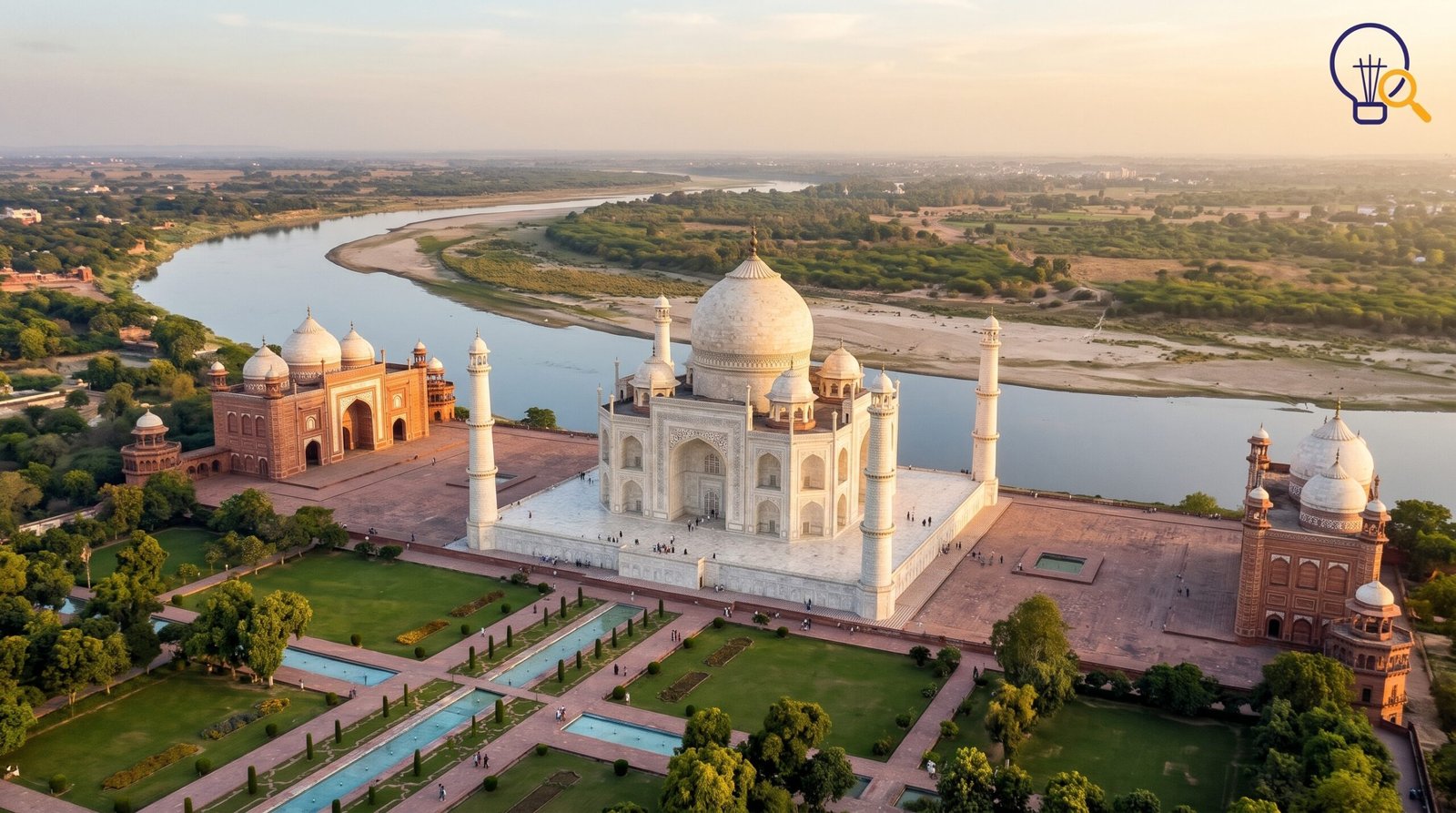
The Taj Mahal is located in Agra, a historic city in northern India. Agra is approximately 125 miles (200 kilometers) southeast of New Delhi.
Many travelers visit Agra as part of India’s Golden Triangle, a popular travel route connecting Delhi, Agra, and Jaipur.
The Yamuna River flows behind the monument. Its location beside the river played an important role in the original site planning and the arrangement of the surrounding buildings and gardens.
For visitors traveling from the United States, Delhi is often a convenient international arrival point before continuing to Agra by train, car, or organized tour.
Why Is the Taj Mahal So Famous?
The Taj Mahal is famous for its white marble structure, carefully balanced design, detailed stone decorations, and connection to Mughal history.
Its historical background also attracts worldwide interest. Shah Jahan commissioned it after the death of Mumtaz Mahal, and the monument has since become widely known as a symbol of love.
Other reasons for its fame include its UNESCO World Heritage status, impressive dome, four minarets, Quranic calligraphy, and Persian-inspired garden design.
Who Built the Taj Mahal and Why?
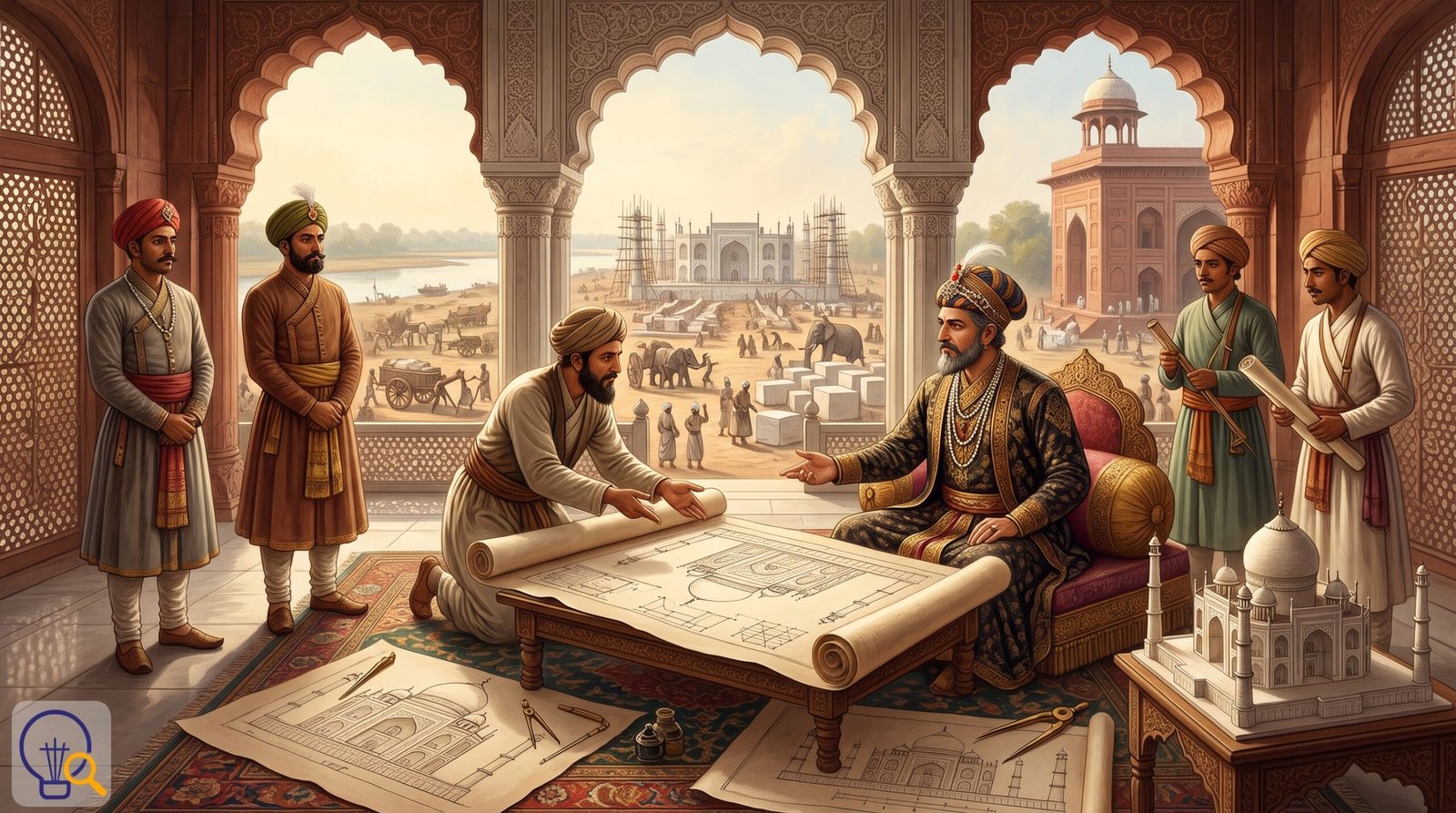
The Taj Mahal was commissioned by Mughal Emperor Shah Jahan in memory of his wife, Mumtaz Mahal. Construction began in 1632, following her death in 1631.
Shah Jahan ruled during a period when the Mughal Empire had considerable wealth and political influence. He supported several major architectural projects, and the Taj Mahal became one of the most ambitious examples of his patronage.
Although Shah Jahan ordered its construction, the monument was created through the combined efforts of architects, engineers, artists, and thousands of skilled workers.
Shah Jahan’s Love for Mumtaz Mahal
Mumtaz Mahal was Shah Jahan’s wife and an important member of the Mughal royal household. Her original name was Arjumand Banu Begum.
She received the title Mumtaz Mahal, commonly translated as something close to “Chosen One of the Palace.” She died in 1631 in Burhanpur while giving birth to her fourteenth child.
Her death deeply affected Shah Jahan, who commissioned a grand mausoleum to serve as her final resting place.
The story of their relationship helped make the Taj Mahal widely known as a monument of love. However, the building also reflects the wealth, religious beliefs, artistic interests, and political ambitions of the Mughal court.
What Does the Name Taj Mahal Mean?
The name Taj Mahal is commonly translated as “Crown Palace.”
It is also closely associated with Mumtaz Mahal, whose title means something similar to “Chosen One of the Palace.” The name therefore has a strong connection with the woman for whom the mausoleum was commissioned.
The Story Behind Its Construction
After Mumtaz Mahal’s death, Shah Jahan selected Agra as the location for her mausoleum.
The site beside the Yamuna River provided space for a large garden and a carefully arranged architectural complex. The emperor brought together skilled craftsmen from different parts of the Mughal Empire and beyond.
Their work involved designing the main structure, preparing the foundations, shaping the marble, creating decorative inlay, and completing the surrounding buildings.
The Taj Mahal was not simply a private memorial. It was also a major imperial project that displayed the artistic skill, resources, and authority of the Mughal Empire.
History of the Taj Mahal
The history of the Taj Mahal is closely connected to the rise and later decline of Mughal power.
Its construction took place during Shah Jahan’s reign, but the monument continued to hold importance long after his death. Understanding its timeline helps explain how the royal tomb became one of the world’s most recognized cultural landmarks.
When Was the Taj Mahal Built?
Construction began in 1632, following Mumtaz Mahal’s death in 1631.
The main marble mausoleum was completed in 1648. Other parts of the complex, including the mosque, guest house, and gateway, were completed later, with the wider project reaching completion around 1653.
| Event | Date |
| Mumtaz Mahal died | 1631 |
| Construction began | 1632 |
| Main mausoleum completed | 1648 |
| Wider complex completed | 1653 |
| UNESCO World Heritage inscription | 1983 |
| New Seven Wonders announcement | 2007 |
This timeline explains why different sources sometimes give different construction periods. Some focus on the central tomb, while others include the entire complex.
Important Events During the Mughal Era
The Taj Mahal was built during Shah Jahan’s reign, which lasted from 1628 to 1658.
This period is associated with major developments in Mughal art and architecture. Shah Jahan commissioned several important buildings, including the Red Fort in Delhi and the Jama Masjid.
In 1658, a war of succession led to Shah Jahan’s removal from power by his son Aurangzeb. Aurangzeb became emperor, while Shah Jahan spent his final years under confinement in Agra Fort.
Shah Jahan died in 1666 and was buried beside Mumtaz Mahal in the Taj Mahal.
What Happened to the Taj Mahal After Shah Jahan?
Over the following centuries, the Mughal Empire weakened, and the monument experienced periods of neglect.
During the British colonial period, parts of its gardens and surroundings were changed. Later conservation work helped protect the structure and its decorations.
Today, the Archaeological Survey of India is responsible for its maintenance, while its UNESCO World Heritage status recognizes its international cultural importance.
How Was the Taj Mahal Built?
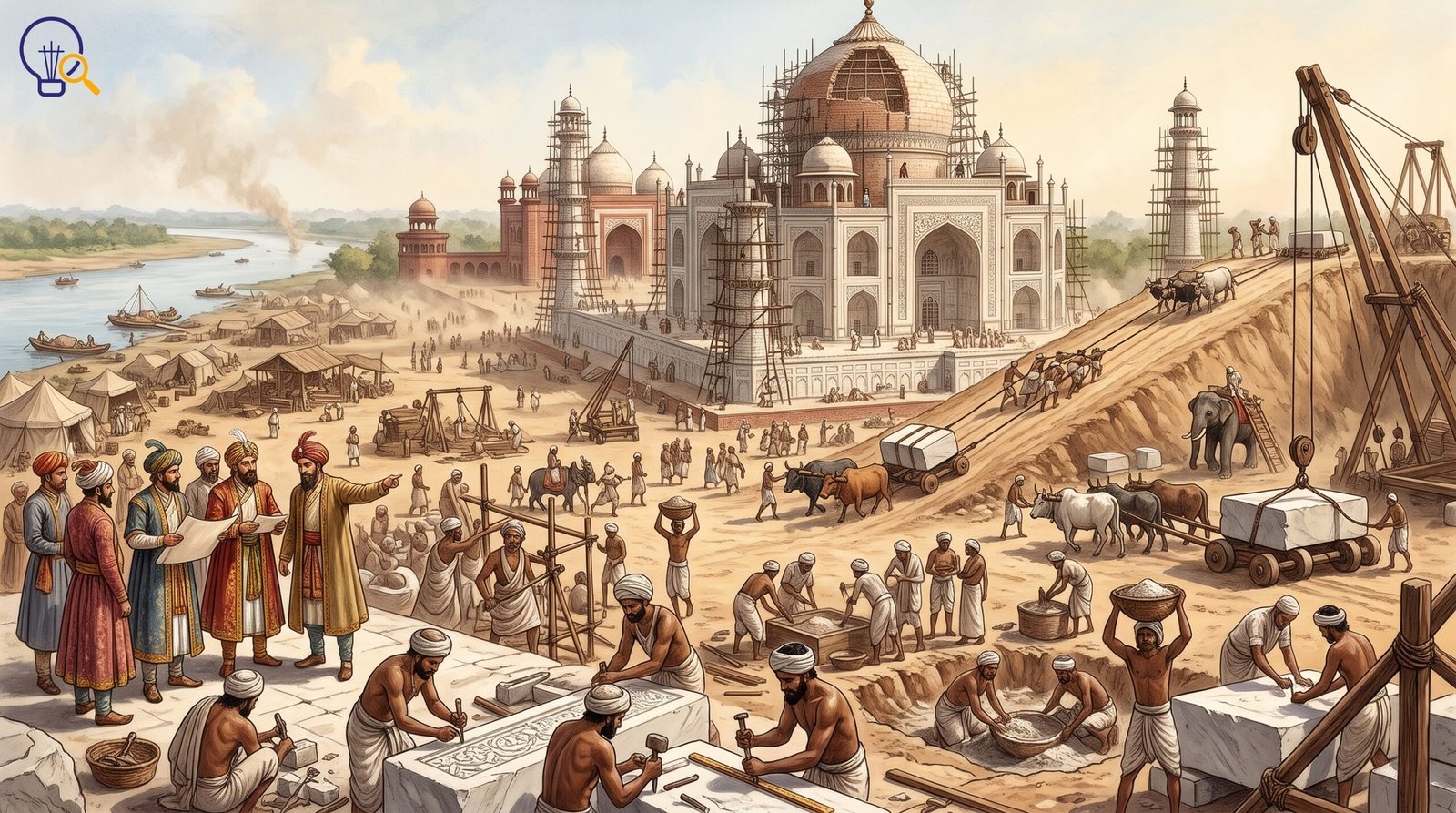
Building the Taj Mahal required careful planning, skilled labor, large quantities of materials, and advanced construction knowledge for its time.
The builders had to create a stable foundation near the Yamuna River, transport heavy stones over long distances, and assemble a complex structure with a large central dome and four minarets.
Every major decorative feature also required skilled work, much of it completed by hand.
Construction Materials and Transportation
The main mausoleum was built using white Makrana marble, while red sandstone and other materials were used in the surrounding structures.
Precious stones used in the inlay work also traveled long distances before reaching the craftsmen in Agra.
Transporting these materials was a major challenge. Historical accounts and architectural research describe the use of carts and animals, including elephants, to move heavy construction supplies.
Because the site was close to the river, the builders also had to address the challenge of supporting a heavy stone structure on riverbank ground. Historical descriptions refer to a system of wells and supporting materials beneath the foundations.
The Role of Craftsmen and Artists
The Taj Mahal’s appearance depends heavily on the skills of its craftsmen. Its marble surfaces, inscriptions, floral patterns, and decorative stones required different types of specialist knowledge.
Some of the most important roles included:
- Calligraphers: Created the Arabic inscriptions and Quranic passages.
- Stonecutters: Shaped marble and sandstone for the main structure.
- Inlay specialists: Cut and fitted colored stones into marble surfaces.
- Sculptors: Produced floral carvings and decorative details.
- Architects and supervisors: Helped plan and manage the construction.
Amanat Khan Shirazi is associated with important calligraphy work, while Chiranjilal is identified as a chief sculptor and mosaicist.
Their contributions show why the Taj Mahal is admired not only for its overall design but also for the quality of its smallest details.
Taj Mahal Architecture and Design
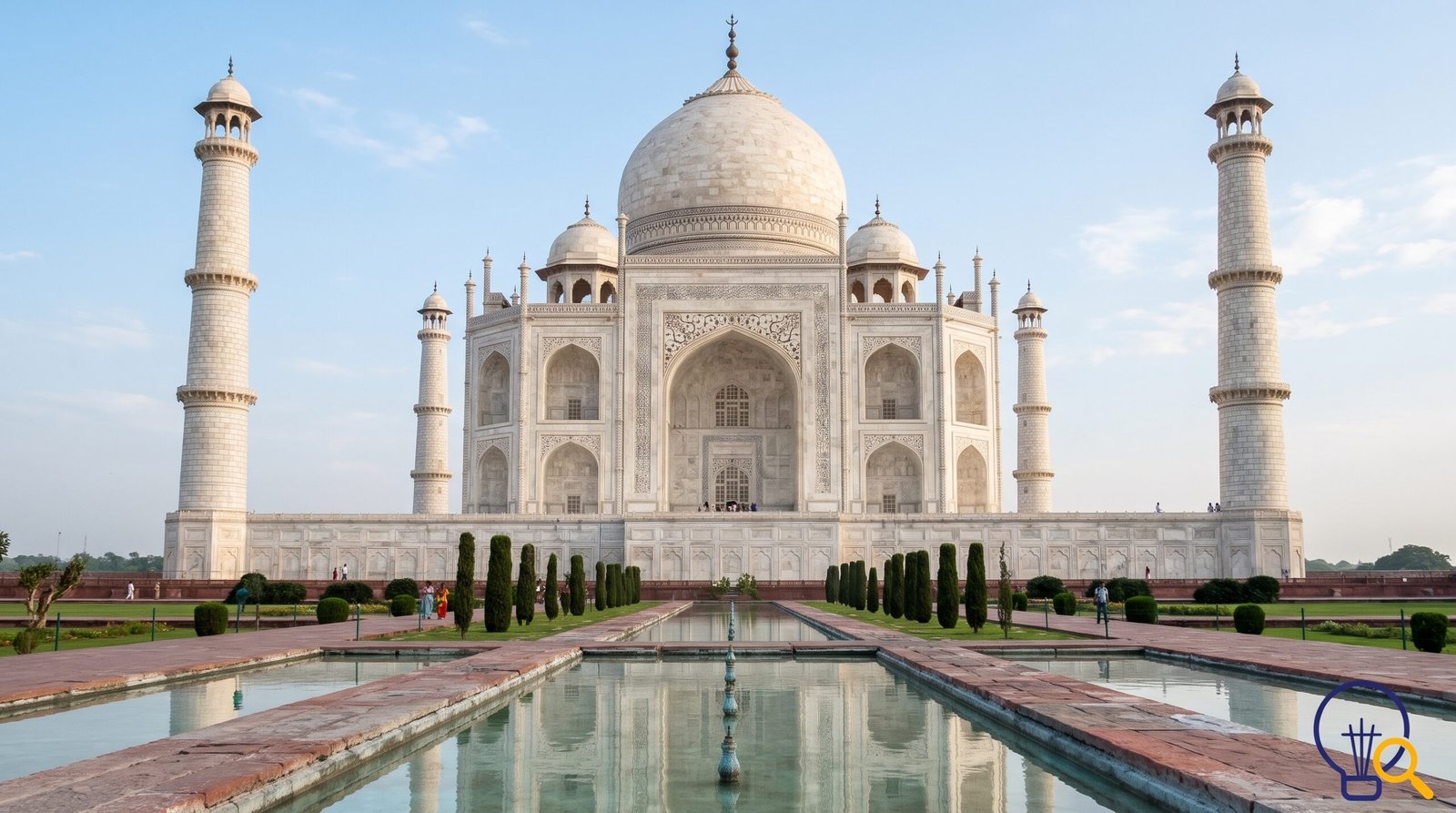
The Taj Mahal is one of the finest examples of Mughal architecture. Its design brings together Persian, Islamic, and Indian influences, creating a monument that feels balanced and unified.
Its most recognizable features include the central dome, four minarets, large marble platform, decorative arches, and carefully arranged gardens.
However, the design is impressive not only because of its size. Its proportions, repeating patterns, and carefully selected materials all contribute to its visual impact.
Mughal and Persian Architectural Influences
Mughal architecture developed through a combination of regional and international influences. Persian and Central Asian traditions played an important role, while Indian building methods and decorative styles shaped the final designs.
The Taj Mahal reflects this combination through its large central dome, symmetrical layout, pointed arches, geometric decoration, and Persian-inspired garden arrangement.
Earlier Mughal monuments also influenced its development. Humayun’s Tomb in Delhi, for example, introduced architectural ideas that later became important in Mughal tomb design.
The Taj Mahal refined these traditions through its extensive use of white marble and highly detailed stone decoration.
Exterior Design and White Marble
The exterior of the main mausoleum is covered largely with white marble.
Its surface includes carved flowers, geometric patterns, decorative arches, and Arabic inscriptions. The inlaid stones add color and detail, especially around the main entrance arches and other important architectural sections.
The white surface also creates a contrast with the red sandstone structures nearby, helping the central mausoleum stand out within the complex.
Interior Design and Decorations
The interior of the Taj Mahal is just as detailed as its exterior.
The main chamber contains the cenotaphs of Shah Jahan and Mumtaz Mahal, surrounded by an intricately decorated marble screen. This screen features delicate latticework, allowing light to pass through small openings.
The interior also includes floral carvings, stone inlay, and Quranic inscriptions. The combination of carved marble and carefully placed colored stones creates a rich decorative effect.
Symmetry and Geometric Patterns
Symmetry is a central feature of the Taj Mahal’s architecture.
The main mausoleum is organized around a central axis, with matching arches, decorative elements, and minarets arranged to create visual balance.
Geometric patterns also appear throughout the complex. Repeating shapes and carefully measured proportions help connect the different structures.
However, the placement of Shah Jahan’s cenotaph creates a notable difference inside the main chamber.
Famous Features of the Taj Mahal Complex
Many visitors think of the Taj Mahal as a single white marble building. In reality, it is a large complex containing several structures that work together to create the complete experience.
The central mausoleum is the main attraction, but its gardens, mosque, guest house, gateway, and water features are also important parts of its design.
The Main Marble Mausoleum
The central mausoleum is the most recognizable structure in the complex.
It stands on a raised marble platform and contains the burial chamber of Shah Jahan and Mumtaz Mahal. Its large central dome, four corner minarets, and detailed exterior decorations make it the focal point of the entire site.
The raised platform also gives the structure a commanding position within the garden, allowing visitors to view it from different angles.
The Four Minarets
Four minarets stand at the corners of the main platform. Their height and placement help frame the central mausoleum.
Each minaret includes balconies and a small domed structure at the top. Their design reflects traditional mosque architecture while also contributing to the overall balance of the monument.
Their slight outward inclination is another example of the attention given to architectural details.
The Central Dome
The central dome is one of the Taj Mahal’s most recognizable features.
Its rounded, onion-shaped design rises above the main building and is surrounded by smaller decorative elements. The double-shell design helps create an impressive exterior profile while maintaining a different interior form.
A decorative finial sits at the top, completing the dome’s appearance.
The Charbagh Garden
The garden surrounding the Taj Mahal follows the Persian-inspired Charbagh layout.
The word refers to a garden divided into four main sections by pathways and water channels. This arrangement has symbolic associations with the gardens of paradise in Islamic tradition.
The garden also creates a carefully planned approach to the mausoleum. Visitors move along pathways toward the central reflecting pool, which frames the famous view of the white marble building.
One unusual feature is the position of the mausoleum at the northern end of the garden, beside the Yamuna River, rather than in the garden’s center.
The Mosque and Guest House
Two red sandstone buildings stand on either side of the main mausoleum.
The western building is a mosque used for prayer. It includes architectural features associated with Islamic religious buildings and faces the direction of Mecca.
The eastern building is commonly known as the guest house or jawab. Its design mirrors the mosque, helping maintain the visual balance of the complex.
Although the two buildings look similar from the outside, they serve different purposes.
What Is Inside the Taj Mahal?
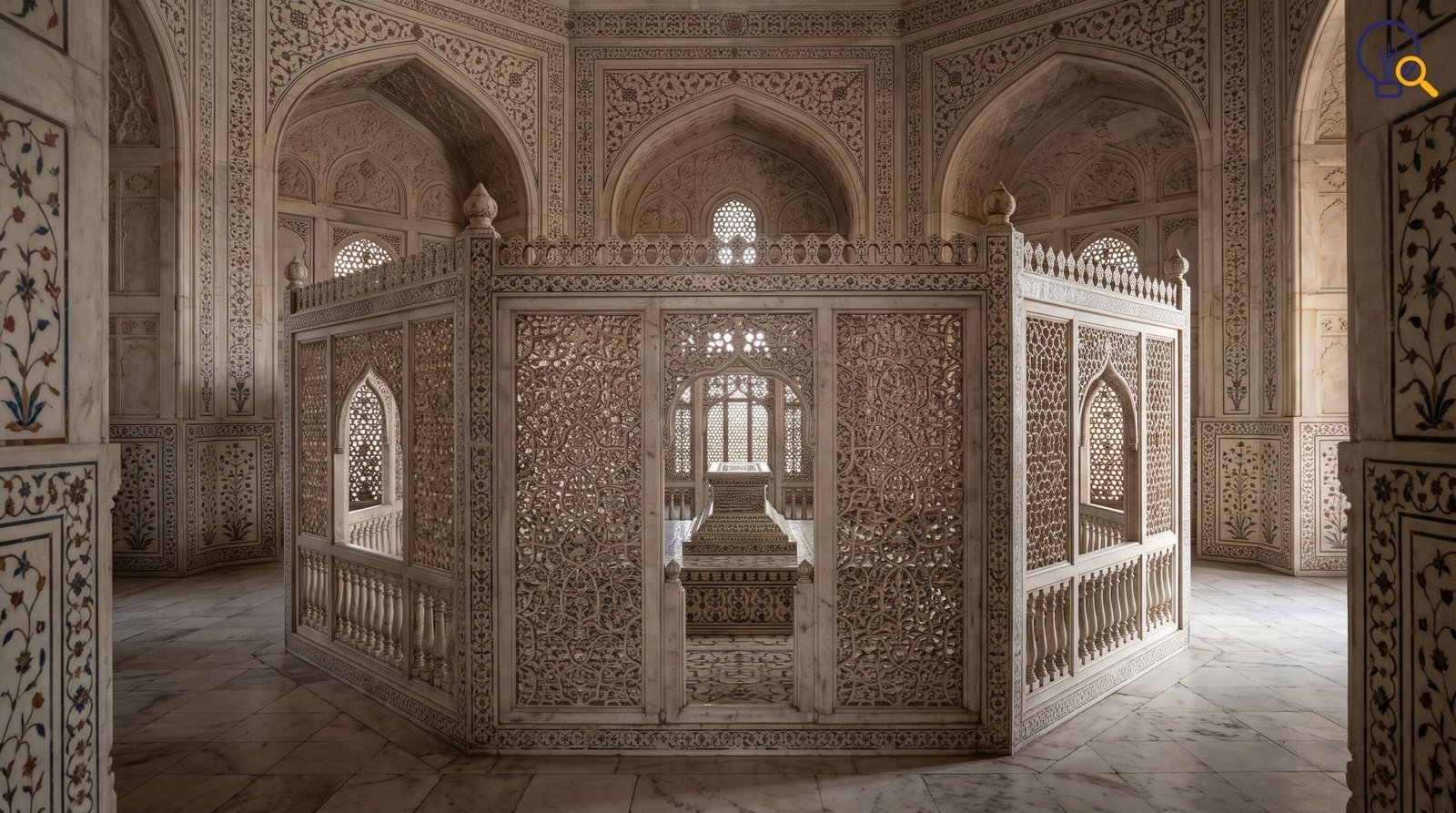
The interior of the Taj Mahal contains the cenotaphs of Shah Jahan and Mumtaz Mahal, detailed marble decorations, and a carefully designed burial chamber.
Visitors can see the main chamber, but the actual graves are located on a lower level. This distinction is important because the decorative structures seen by visitors are not the original burial places.
The Main Chamber and Cenotaphs
The main chamber contains the cenotaphs of Mumtaz Mahal and Shah Jahan.
These are decorative marble structures positioned to mark the royal burials. Mumtaz Mahal’s cenotaph is placed in the center, while Shah Jahan’s is beside it.
A detailed marble screen surrounds the cenotaphs, separating the central area from the rest of the chamber.
The Actual Graves Beneath the Main Chamber
The actual graves are located in a lower burial chamber beneath the decorative cenotaphs.
This arrangement follows a design tradition found in some Islamic royal tombs. The upper chamber serves as a formal and decorative space, while the lower level contains the actual burials.
The difference between the two levels is one of the most interesting details for visitors who want to understand the monument beyond its exterior appearance.
Marble Carvings and Calligraphy
The interior features detailed marble work, including carved flowers, geometric patterns, and inscriptions.
Some decorations use semi-precious stones fitted into the marble, while others are created through careful carving. The marble lattice screens also allow filtered light to enter the chamber.
The Quranic inscriptions were selected and arranged with great care. Their themes include faith, judgment, and paradise, connecting the monument’s decoration with its purpose as a royal mausoleum.
Why Does the Taj Mahal Change Color?
The Taj Mahal appears to change color because its white marble responds to different lighting conditions.
As the sun moves across the sky, the direction and warmth of the light change how the surface looks. The marble’s slightly translucent quality also contributes to its appearance.
The stone itself does not change color. Instead, different lighting conditions create different visual effects.
Appearance During Sunrise
At sunrise, the Taj Mahal can appear pinkish or softly golden.
The early morning light is warmer and less intense than midday sunlight. This creates a gentle glow across the white marble, making the monument look different from its appearance later in the day.
Sunrise is also popular with visitors because temperatures are often more comfortable, especially during warmer months.
Appearance During Daylight
During the middle of the day, strong sunlight makes the marble look bright white.
Shadows become more defined, and the monument’s architectural details are easier to see. However, bright light can make photography more challenging because of strong reflections.
Appearance During Sunset and Moonlight
Around sunset, the marble can appear warmer or slightly golden as the sunlight becomes softer.
Under moonlight, the Taj Mahal can look cooler and more silvery. Special night viewing is arranged on selected dates around the full moon, subject to visitor rules and availability.
What Makes the Taj Mahal So Special?
The Taj Mahal stands out because it combines historical importance, artistic skill, religious symbolism, and architectural innovation in one remarkable complex.
Its design, decorations, setting, and personal history all contribute to its identity.
Its UNESCO World Heritage Status
UNESCO added the Taj Mahal to its World Heritage List in 1983.
The designation recognizes its exceptional artistic and architectural importance. Its combination of Persian, Islamic, and Indian design traditions makes it an important example of cultural exchange.
World Heritage recognition also highlights the responsibility to preserve the monument for future generations.
Its Symbolism of Love
The Taj Mahal is widely known as a monument of love because Shah Jahan commissioned it after the death of Mumtaz Mahal.
The story has become part of the monument’s identity, attracting visitors who are interested in its emotional and historical background.
However, its meaning is broader than romance alone. It also reflects the Mughal Empire’s wealth, religious traditions, artistic achievements, and approach to royal burial architecture.
Its Influence on World Architecture
The Taj Mahal represents an important stage in the development of Mughal architecture.
It brought together design traditions that had developed across Persia, Central Asia, and the Indian subcontinent. Its use of white marble, large central dome, carefully arranged minarets, and detailed inlay work helped establish a distinctive architectural style.
It remains an important reference point for architects and historians studying Islamic and Indo-Islamic architecture.
Taj Mahal vs. Humayun’s Tomb
Humayun’s Tomb in Delhi and the Taj Mahal in Agra are two important examples of Mughal tomb architecture.
Both feature Persian influences, gardens, symmetrical planning, and impressive domes. However, they differ in their materials, design details, and historical periods.
| Feature | Taj Mahal | Humayun’s Tomb |
| Location | Agra, India | Delhi, India |
| Built for | Mumtaz Mahal and later Shah Jahan | Mughal Emperor Humayun |
| Main material | White marble with other materials | Red sandstone with white marble details |
| Construction period | 1632–1653 for the wider complex | Began in 1565 |
| Architectural importance | A highly refined Mughal mausoleum | An early major Mughal garden tomb |
Humayun’s Tomb was an important influence on later Mughal architecture. The Taj Mahal developed several of these earlier ideas into a more refined and visually distinctive design.
Taj Mahal Myths and Historical Mysteries
The Taj Mahal has inspired many stories over the centuries. Some are based on historical events, while others have developed through legends, speculation, or popular storytelling.
Understanding the difference between documented history and unverified claims helps readers appreciate the monument without confusing myths with facts.
Was There Really a Black Taj Mahal?
The Black Taj Mahal is a famous legend suggesting that Shah Jahan planned to build a second mausoleum made from black marble across the Yamuna River.
The proposed building was supposedly intended as his own tomb, facing the white Taj Mahal.
However, there is no conclusive archaeological evidence proving that Shah Jahan began constructing this second monument. The story is mainly associated with historical accounts and later interpretations of remains found in the area.
For that reason, the Black Taj Mahal should be treated as a legend rather than a confirmed historical project.
Did Shah Jahan Cut Off the Workers’ Hands?
A popular story claims that Shah Jahan ordered the hands of the workers to be cut off after the Taj Mahal was completed.
According to the legend, he wanted to prevent them from building another monument as beautiful as his own.
However, reliable historical evidence does not support this story. It is not accepted as an established event in respected historical scholarship.
The construction involved thousands of skilled workers, and their contributions are part of the monument’s history. It is more accurate to recognize their craftsmanship than to repeat an unsupported story as fact.
Was the Taj Mahal Originally a Hindu Temple?
Another claim suggests that the Taj Mahal was originally a Hindu temple or palace before Shah Jahan commissioned the mausoleum.
This claim has circulated widely, but it is not supported by the accepted historical and archaeological record. Historical records connect the monument’s construction to the 17th-century Mughal period.
It is important to distinguish popular theories from conclusions supported by historical documents and archaeological research.
Were Its Minarets Designed to Lean Outward?
Yes, the minarets have a slight outward inclination.
One commonly cited engineering explanation is that this arrangement could help protect the main mausoleum if a minaret collapsed.
However, historians and architectural researchers do not have a definitive statement from the original builders explaining this specific design decision.
The outward inclination is a real architectural feature, but its exact intention should be described carefully rather than presented as a proven fact.
Interesting Facts About the Taj Mahal’s Gardens and Surroundings
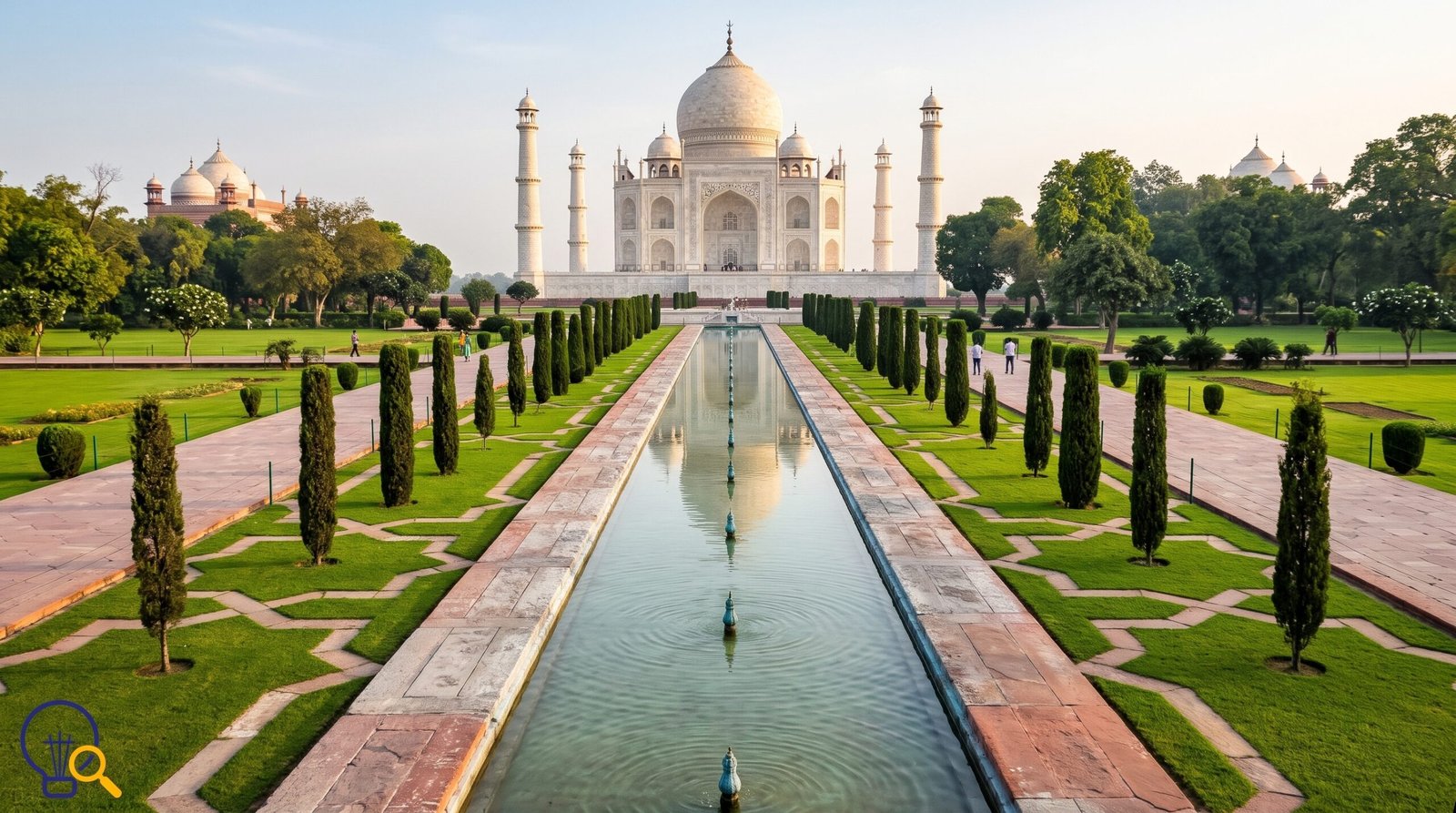
The Taj Mahal’s surroundings are an essential part of its design.
The gardens, water channels, river, and supporting buildings were planned to create a complete architectural experience rather than simply decorate the main tomb.
The Reflecting Pool
The long reflecting pool in front of the mausoleum is one of the most photographed features of the complex.
It runs along the main garden pathway and creates a reflection of the Taj Mahal when the water is still. This visual effect makes the monument appear even more balanced and symmetrical.
The pool also forms part of the garden’s larger water arrangement, connecting the pathways and the central view of the mausoleum.
The Yamuna River
The Yamuna River flows behind the Taj Mahal and played an important role in the original site planning.
The mausoleum was positioned near the river, with the garden and other structures arranged in front of it. This riverfront setting helped distinguish the Taj Mahal from other Mughal garden tombs.
Today, the Yamuna faces environmental pressures, including pollution and changes in water quality. Protecting the river is important for the surrounding environment and the long-term preservation of the historic landscape.
The Taj Mahal’s Surrounding Buildings
The Taj Mahal complex contains several important structures beyond the central tomb.
These include:
- The Great Gate: The monumental southern entrance to the complex.
- The Mosque: A red sandstone building on the western side.
- The Guest House: A matching building on the eastern side.
- The Garden: A carefully arranged landscape with pathways and water channels.
- The Outer Courtyard: An additional area with structures that form part of the wider complex.
Each feature contributes to the overall design and helps visitors understand why the Taj Mahal is considered an architectural complex rather than just a single building.
Preservation and Current Challenges Facing the Taj Mahal
The Taj Mahal is centuries old, but its preservation remains an ongoing responsibility.
Pollution, environmental changes, visitor pressure, and the natural aging of materials can all affect the monument. Protecting it requires regular maintenance, scientific monitoring, and cooperation between conservation authorities and the wider community.
Air Pollution and Marble Discoloration
Air pollution is one of the major environmental concerns surrounding the Taj Mahal.
Pollutants and airborne particles can affect the appearance of its white marble. Dust and other deposits can make surfaces look dull or discolored, while industrial emissions and traffic-related pollution create wider environmental pressures in the Agra region.
The marble’s bright surface is one of the monument’s most recognizable features. Conservation authorities therefore monitor the condition of the stone and take steps to protect it.
Conservation and Restoration Efforts
The Archaeological Survey of India is responsible for the monument’s conservation and maintenance.
Its work includes monitoring the condition of the structure, maintaining the grounds, protecting decorative surfaces, and carrying out conservation activities when needed.
Cleaning and restoration must be handled carefully. Marble is a natural material, and unsuitable treatments could damage its surface or affect its original appearance.
Why Protecting the Taj Mahal Matters
Preserving the Taj Mahal is important for several reasons.
First, it protects a major part of India’s history and Mughal cultural heritage. Second, it allows future generations to study an important example of architecture and craftsmanship.
Finally, it supports tourism and the local economy by helping maintain one of the world’s most recognized landmarks.
The monument cannot be replaced if its original materials and decorations are lost. Careful conservation helps ensure that visitors and researchers can continue to experience it in the future.
Visiting the Taj Mahal: Timings, Tickets, and Travel Tips
For travelers planning a visit, the Taj Mahal offers a memorable experience. However, knowing its opening arrangements, ticket requirements, and visitor rules can make the trip easier.
Opening arrangements, ticket prices, and entry conditions can change, so visitors should confirm the latest information before traveling.
Opening Hours and Weekly Closure
The Taj Mahal generally opens 30 minutes before sunrise and closes 30 minutes before sunset on normal visiting days.
It is closed to general visitors every Friday, although religious services take place at the mosque.
Sunrise is a popular time to visit because temperatures are often more comfortable and the marble can appear softly pink. Sunset is another attractive option, especially for visitors interested in photography.
Entry Tickets and Night Viewing
The Taj Mahal has different ticket categories for Indian and international visitors. An additional fee may apply for visitors who want access to the main mausoleum.
Ticket prices and conditions can change, so it is better to confirm the current rates before your visit rather than rely on older prices.
Night viewing is generally arranged on five nights each month: the full-moon night and the two nights before and after it. Visits take place in scheduled batches with limited visitor numbers.
Night viewing is subject to restrictions and is not available on Fridays or during certain religious periods.
Best Time to Visit
The best time to visit the Taj Mahal depends on your weather preferences and photography plans.
October to March is generally a comfortable period for exploring Agra because temperatures are usually lower than during the hottest months.
| Season | What to Expect |
| October–November | More comfortable weather for sightseeing |
| December–February | Cooler conditions, although morning fog can affect visibility |
| March | Warmer days with generally pleasant early mornings |
| April–June | Very hot weather, especially in the afternoon |
| July–September | Monsoon season, with rain and higher humidity |
If photography is your priority, sunrise can offer beautiful light. However, winter fog may sometimes limit visibility, so check local weather conditions before setting out.
Important Rules for Visitors
The Taj Mahal has security procedures and visitor restrictions designed to protect the historic site.
Before entering, keep these points in mind:
- Carry valid identification and your entry ticket.
- Follow security instructions at the entrance.
- Do not bring drones, which are prohibited inside the monument.
- Follow the photography rules and restrictions in different areas.
- Avoid touching or damaging marble decorations.
- Respect the religious and historical importance of the site.
- Follow instructions from monument staff.
Some items may be restricted, and rules can change. Confirm the latest visitor instructions before packing for your trip.
Expert Tips for First-Time Visitors
A little preparation can make your visit more enjoyable.
Arrive early: Sunrise visits can offer cooler temperatures and a chance to see the monument in soft morning light.
Use official ticket channels: Buy tickets through authorized channels and confirm the current entry conditions before your visit.
Allow enough time: Do not rush straight to the main mausoleum. Explore the gardens, entrance gateway, mosque, and guest house as well.
Check the weather: Fog, heat, and rain can affect visibility and comfort.
Plan your transport: If you are traveling from Delhi, arrange your train, car, or tour in advance, especially during busy travel periods.
Wear comfortable footwear: You may spend a considerable amount of time walking around the complex.
Conclusion: Why the Taj Mahal Remains a Wonder of the World
The Taj Mahal is much more than a famous white marble building. Its history connects it to Shah Jahan, Mumtaz Mahal, and the Mughal Empire, while its architecture demonstrates the remarkable skills of thousands of craftsmen.
From its carefully planned minarets and central dome to its detailed stone inlay, Quranic calligraphy, and Persian-inspired gardens, every part of the complex contributes to its lasting appeal.
These taj mahal facts show why the monument continues to attract visitors, historians, architects, and students from around the world. Its beauty is impressive, but its real importance lies in the history, creativity, and human effort preserved within its walls.
More than three centuries after its construction, the Taj Mahal remains a remarkable example of what people can create through vision, skill, and dedication.
Frequently Asked Questions About Taj Mahal Facts
1. What Are Five Interesting Facts About the Taj Mahal?
The Taj Mahal took around 22 years to complete, involved approximately 20,000 workers, and was built mainly with white Makrana marble. Its appearance changes with the light, and it became a UNESCO World Heritage Site in 1983.
2. What Is the Real History Behind the Taj Mahal?
Mughal Emperor Shah Jahan commissioned the Taj Mahal in memory of his wife, Mumtaz Mahal, who died in 1631. Construction began in 1632, and the wider complex was completed around 1653.
3. What Does the Name Taj Mahal Mean?
The name Taj Mahal is commonly translated as “Crown Palace.” It is also closely associated with Mumtaz Mahal, whose title means something similar to “Chosen One of the Palace.”
4. Who Was the Main Architect of the Taj Mahal?
Ustad Ahmad Lahori is widely identified as the principal architect associated with the Taj Mahal. However, many other architects, engineers, artists, and craftsmen contributed to the project.
5. Why Did It Take Around 22 Years to Build the Taj Mahal?
The project required detailed marble carving, stone inlay, calligraphy, engineering, and extensive landscaping. The central mausoleum was completed earlier, while work on the wider complex continued until around 1653.
6. How Many Workers Built the Taj Mahal?
The workforce is commonly estimated at around 20,000 people. It included architects, stonecutters, marble carvers, calligraphers, sculptors, and other skilled craftsmen.
7. Is the Taj Mahal Still One of the Seven Wonders of the World?
Yes. The Taj Mahal was selected as one of the New Seven Wonders of the World in 2007 through an international public voting campaign.
8. Is Mumtaz Mahal Still Buried Inside the Taj Mahal?
Yes. Mumtaz Mahal is buried inside the Taj Mahal alongside Shah Jahan. Their actual graves are located in a lower chamber beneath the decorative cenotaphs.
9. Why Does the Taj Mahal Change Color?
The white marble reflects and scatters natural light differently throughout the day. This can make the monument appear pinkish at sunrise, bright white during daylight, and warmer or more silvery under different lighting conditions.
10. Can Visitors See the Taj Mahal at Night?
Yes. Special night viewing is generally arranged around the full moon on selected dates, subject to ticket availability and visitor restrictions. It is not part of ordinary daytime entry.
