

Science becomes more interesting when you understand not only what happens, but why it happens. These interesting science facts explore surprising discoveries about space, the human body, animals, Earth, oceans, plants, and everyday technology.
Each fact includes a clear explanation of the science behind it, along with useful context where a popular claim needs a closer look. Some facts challenge common assumptions; others reveal processes that happen around you every day. The goal is not just to collect unusual trivia, but to help you understand what makes each discovery remarkable.
Contents
- Interesting Science Facts You Won’t Believe Are True
- Amazing Human Body Science Facts
- Mind-Blowing Space Science Facts
- Incredible Animal Science Facts
- Amazing Earth and Nature Facts
- Surprising Physics and Chemistry Facts
- Fascinating Ocean Science Facts
- Amazing Plant and Food Science Facts
- Everyday Science Facts That Will Surprise You
- Strange but True Science Facts
- Amazing History and Technology Science Facts
- Incredible Mathematics and Numbers Facts
- Science Facts About Weather and Natural Disasters
- Science Facts That Sound Fake but Are Real
- Frequently Asked Questions About Interesting Science Facts
- Final Thoughts on These Amazing Science Facts
Quick Science Facts
- A day on Venus lasts longer than its year.
- The Sun is wide enough to fit about 109 Earths side by side.
- Octopuses have three hearts and blue blood.
- Sunlight takes about 8 minutes and 20 seconds to reach Earth.
- Antarctica is the largest desert on Earth.
- Lightning can be hotter than the Sun’s visible surface.
Interesting Science Facts You Won’t Believe Are True
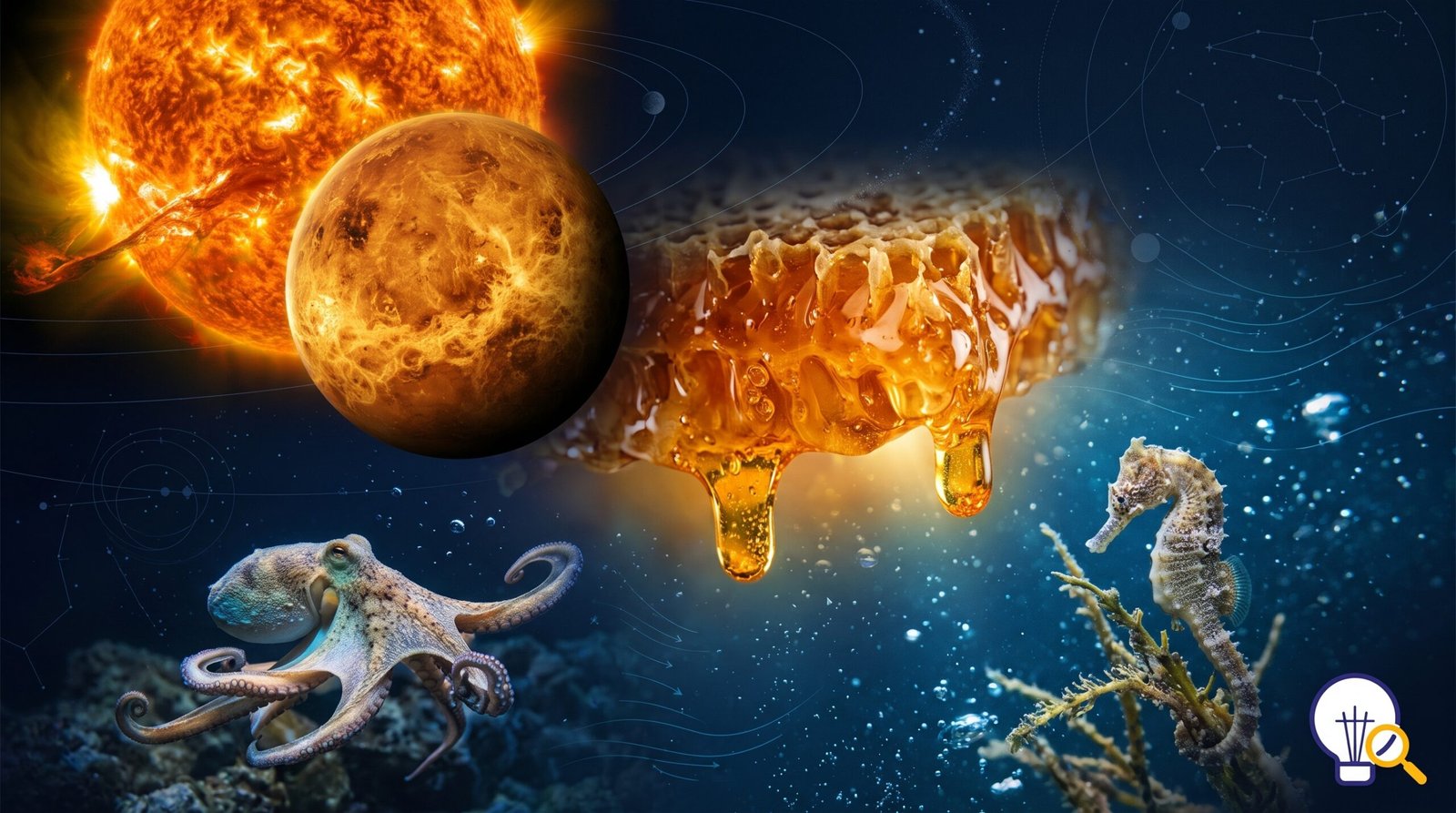
Some scientific facts sound impossible because they challenge everyday experience. A planet can take longer to spin once than to travel around the Sun, while an animal can use copper rather than iron to carry oxygen. These examples become easier to understand when you look at the physical or biological process behind them.
A Day on Venus Is Longer Than Its Entire Year
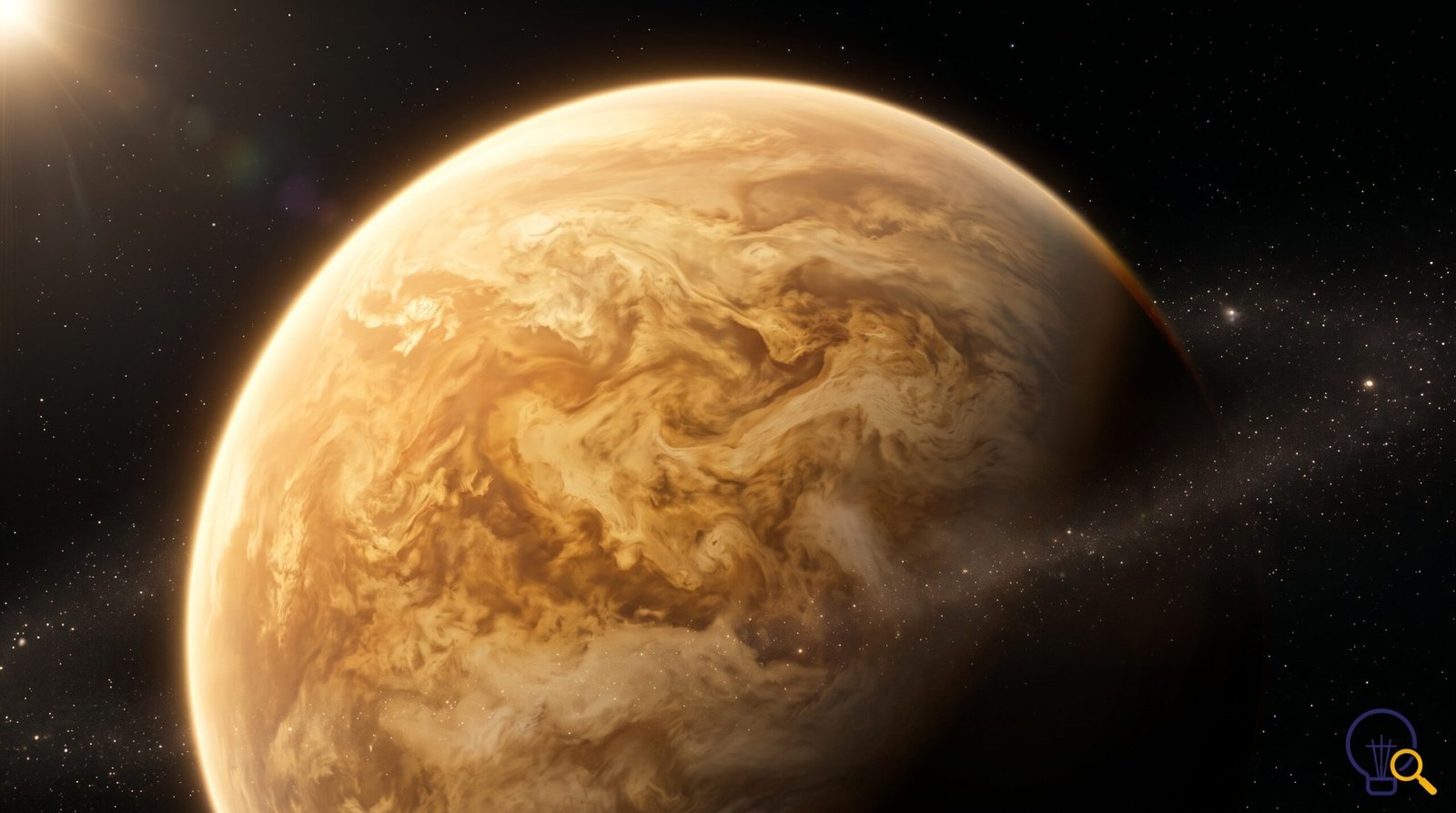
A single rotation of Venus takes longer than one complete trip around the Sun.
On Earth, a day lasts about 24 hours, while a year takes approximately 365 days. Venus follows a very different schedule. It takes about 243 Earth days to rotate once on its axis, but only about 225 Earth days to orbit the Sun.
In other words, Venus completes a year before it finishes one full rotation. This happens because the planet spins extremely slowly and in the opposite direction to most planets in our solar system. This unusual motion is known as retrograde rotation.
There is another interesting detail: because Venus rotates backward, the Sun would appear to rise in the west and set in the east. Its sunrise-to-sunset day is about 117 Earth days long.
The Sun Can Fit Around 1.3 Million Earths Inside It
The Sun may look like a small bright circle in the sky, but its actual size is difficult to imagine. It is so enormous that approximately 1.3 million Earths could fit inside its volume.
This comparison is about volume, not width. The Sun is roughly 109 times wider than Earth, but volume increases in three dimensions, which is why the estimate reaches about 1.3 million Earths. The figure describes how much space the Sun occupies; it does not mean Earth-sized planets could be neatly packed inside without gaps.
The Sun contains more than 99% of the solar system’s total mass. Its gravity keeps planets, dwarf planets, asteroids, and other objects in orbit. It also releases energy through nuclear fusion in its core, where hydrogen nuclei combine to form helium. That energy eventually reaches Earth as light and heat, helping make life here possible.
Honey Can Remain Edible for Thousands of Years
Honey is more than a natural sweetener. Its chemical properties make it unusually resistant to spoilage when it is properly processed and stored.
Most bacteria and other microorganisms need available water to grow. Honey contains very little water, has a naturally acidic environment, and contains compounds that help limit microbial growth. These conditions make it difficult for many microbes to survive.
However, this does not mean every jar of honey will remain perfect forever. Moisture can enter if honey is stored improperly, and quality can change over time. Keep it in a clean, tightly closed container and follow food-storage guidance. The famous discoveries of ancient honey in archaeological sites are interesting, but they should not be taken as a guarantee that every old jar is safe to eat.
Male Seahorses Are the Ones That Give Birth
Seahorses have one of the most unusual reproductive systems in the animal kingdom. During reproduction, the female transfers her eggs into a special pouch on the male’s abdomen.
The male carries the developing embryos inside this brood pouch. The pouch helps regulate conditions around the embryos, including the exchange of oxygen and waste, before the male releases the young into the water.
This is often described as male pregnancy. The female still produces the eggs, but the male carries them during development and gives birth to the young. The arrangement is unusual among animals and shows that parental roles can evolve in very different ways.
Octopuses Have Three Hearts and Blue Blood

An octopus has three hearts, and its blood is blue rather than red. Two of its hearts move blood toward the gills, where oxygen is absorbed from the water. The third heart pumps oxygen-rich blood to the rest of the body.
Its blue blood contains a copper-based protein called hemocyanin. In humans, hemoglobin uses iron to carry oxygen and gives blood its familiar red color. Hemocyanin uses copper instead, which gives oxygenated octopus blood a blue appearance.
Hemocyanin is dissolved in the blood rather than being enclosed in red blood cells as human hemoglobin is. The copper-containing protein binds oxygen and changes color when oxygenated, producing the blue appearance. This system works well for many mollusks in cool, low-oxygen environments. An octopus’s third heart temporarily slows when it swims, which is one reason swimming can be energetically demanding for these animals.
Amazing Human Body Science Facts
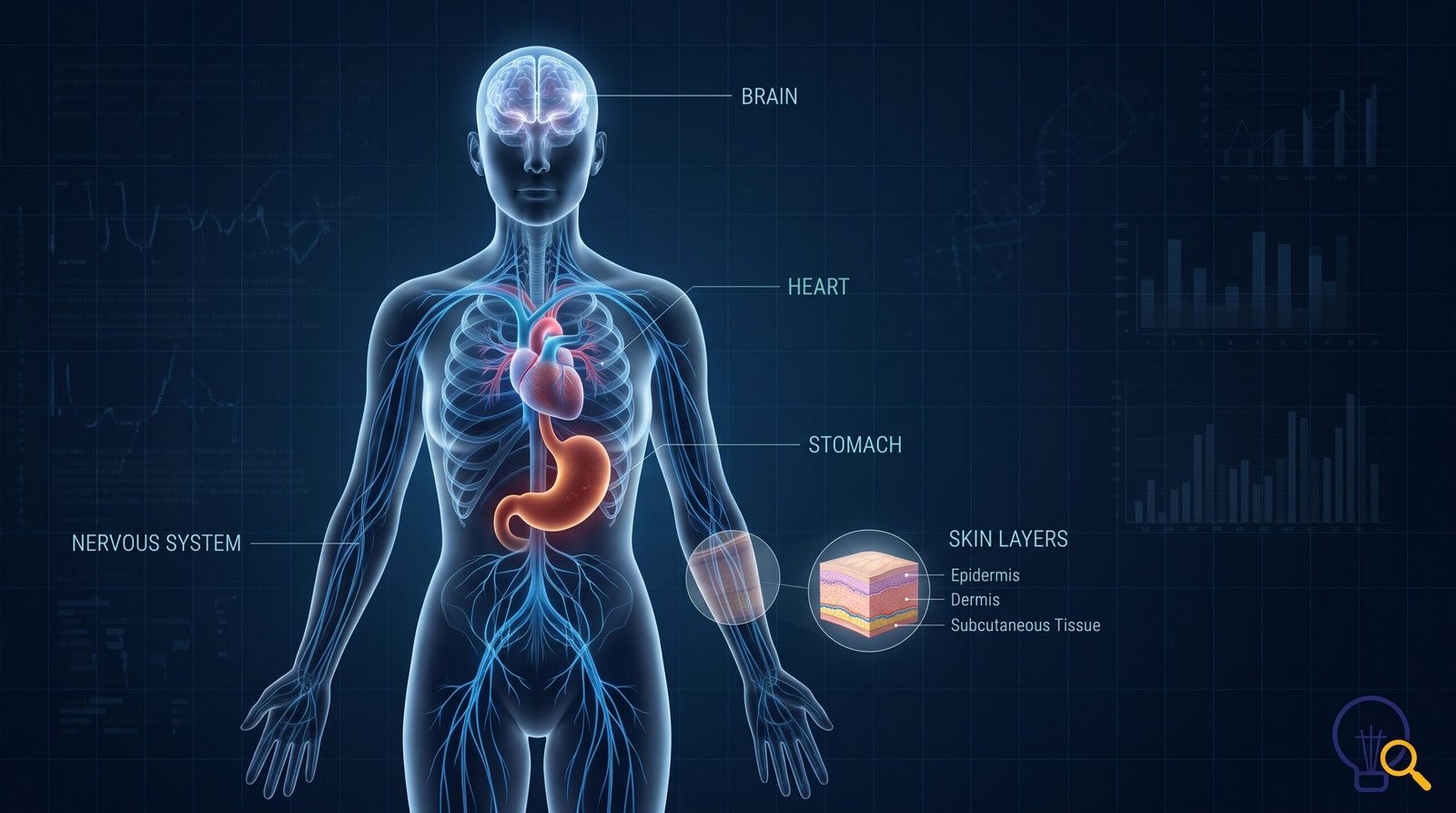
Your body performs thousands of complex tasks without you having to think about them. Your brain processes information, your skin protects you, and your cells constantly carry out chemical reactions that keep you alive.
These human body facts reveal some of the surprising biology happening beneath the surface.
Your Brain Ignores Your Nose Even Though You Can Always See It
Look straight ahead for a moment. Your nose is probably visible at the bottom of your field of vision, but you rarely notice it. That is because your brain does not give equal attention to every piece of information your eyes receive.
Your brain constantly processes visual signals and prioritizes information that seems important. Familiar, unchanging details often receive less attention, allowing you to focus on movement, objects, faces, and other relevant things. Your nose is also close to your eyes, so its image occupies a relatively stable area near the edge of your visual field.
This is related to selective attention and the brain’s ability to filter sensory information. Your nose has not disappeared; your brain simply gives it little attention unless you deliberately look for it. This is an example of how perception is an active process, not a perfect recording of everything your eyes detect.
Your Skin Constantly Replaces Its Outer Cells
Your skin is not a permanent covering. It is a living organ that continually renews its outer layer.
New skin cells form in the deeper part of the epidermis, then gradually move toward the surface. As they move, they change, flatten, and eventually become part of the protective outer layer. Old cells are naturally shed and replaced by newer ones.
This renewal process helps your skin maintain a protective barrier against friction, water loss, and microorganisms. The outermost layer contains flattened cells filled with keratin, a tough protein that helps resist damage. The rate of renewal varies with age, body area, and health, so there is no single schedule on which everyone’s entire skin is replaced.
The Human Body Contains Trillions of Cells
Your body is made up of an enormous number of tiny living units called cells. Scientists commonly estimate that an average adult human body contains around 30 trillion human cells, although the exact number varies with body size and other factors.
Cells are the basic building blocks of life. Different types perform different jobs:
- Red blood cells carry oxygen around the body.
- Nerve cells transmit electrical and chemical signals.
- Muscle cells help produce movement.
- Skin cells form a protective barrier.
- White blood cells help defend the body against infections.
Cells also contain DNA, which carries much of the genetic information needed for growth, development, and normal cell activity. Although cells are tiny, their coordinated work allows the body to function as a whole.
Your Stomach Has a Protective Layer Against Its Own Acid
Your stomach contains hydrochloric acid, which helps break down food and creates conditions that support digestion. This acid is strong enough to damage many types of biological material, so why doesn’t it normally digest the stomach itself?
The answer is its protective lining. The stomach wall produces mucus containing bicarbonate, which helps create a less acidic layer close to the stomach’s surface. Cells in the lining also renew themselves to help maintain protection.
This defense system is important because the stomach needs to break down food without damaging its own tissues. When the protective barrier becomes weakened, irritation and ulcers can develop.
Your Brain Uses Around 20% of Your Body’s Energy
Although the adult brain makes up only a small percentage of total body weight, it uses a surprisingly large share of the body’s energy.
In a typical resting adult, the brain consumes roughly 20% of the body’s energy. It needs a continuous supply of oxygen and glucose to support communication between nerve cells, maintain electrical signals, and manage essential functions such as movement, memory, and breathing.
Even when you are resting, your brain remains active. It continues processing information, regulating body systems, and maintaining the networks that allow you to think and respond to the world.
Mind-Blowing Space Science Facts
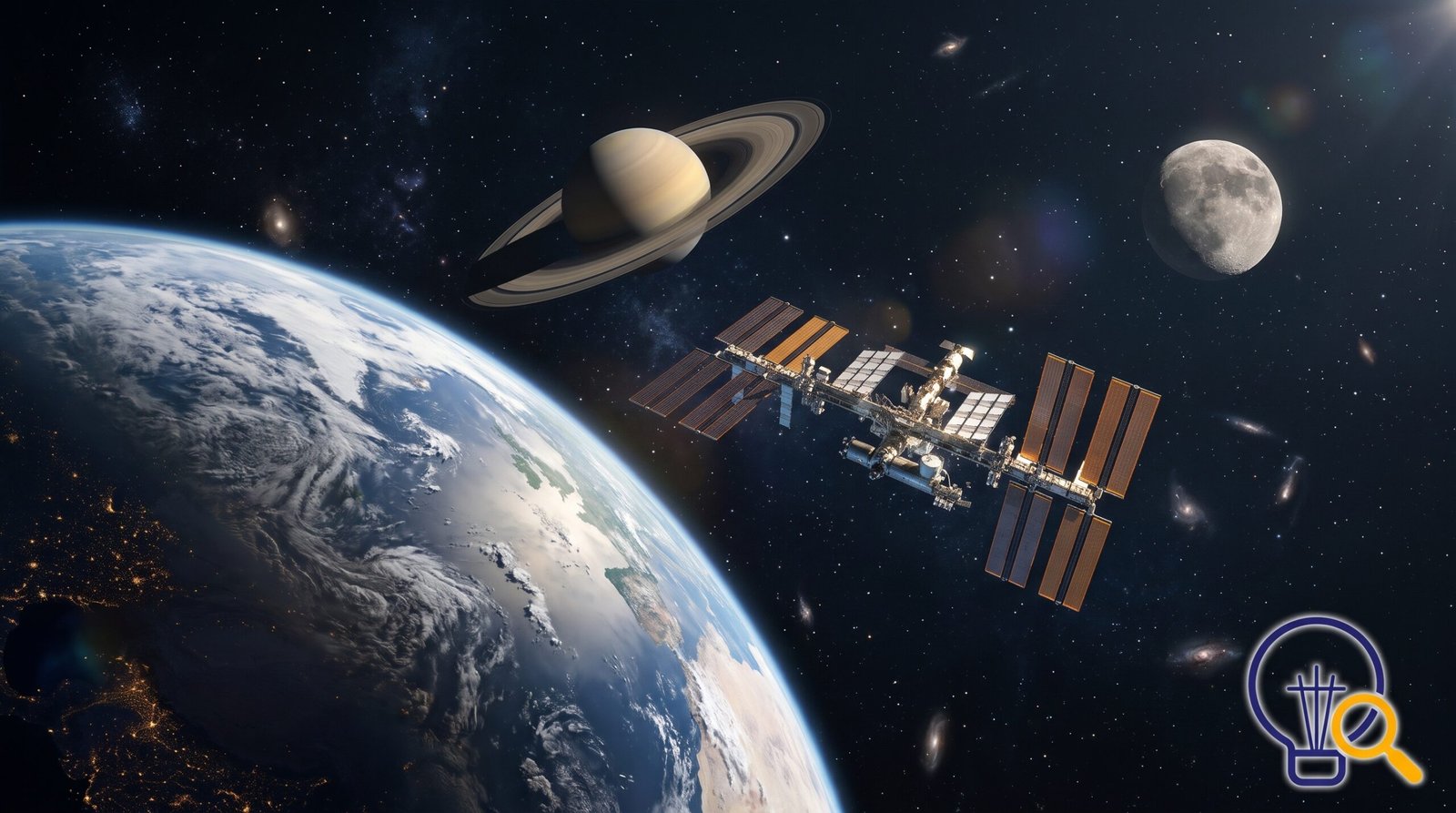
Space is so vast that even familiar measurements become difficult to imagine. Planets, stars, moons, and spacecraft all follow physical laws, but some of the results are stranger than fiction.
Light From the Sun Takes About 8 Minutes to Reach Earth
Sunlight does not reach Earth instantly. It travels through space at approximately 186,000 miles per second (300,000 kilometers per second). Even at that incredible speed, light takes about 8 minutes and 20 seconds to travel from the Sun to Earth.
This means that when you look at the Sun, you are not seeing it exactly as it is at that moment. You are seeing the light it released a little over eight minutes earlier.
The same idea applies to distant stars and galaxies. If a galaxy is 100 million light-years away, the light reaching a telescope today began its journey about 100 million years ago. Astronomers therefore observe distant objects as they existed in the past. A light-year is a measure of distance—the distance light travels in one year—not a measure of time.
Footprints on the Moon Can Last for Millions of Years
The footprints left by Apollo astronauts are still preserved on the Moon. Unlike Earth, the Moon has virtually no atmosphere, so there is no wind or rain to wash away tracks.
On Earth, wind, water, and changing weather gradually reshape the ground. The Moon does not have these familiar weather processes, which allows marks in its dusty surface to remain for an extremely long time.
Images from NASA’s Lunar Reconnaissance Orbiter show Apollo landing-site features, including astronaut tracks and equipment trails. The marks can persist because the Moon has no weather system like Earth’s wind and rain. They will still change slowly: tiny space rocks continually strike the surface, gradually disturbing the lunar soil. So the tracks may survive for a very long time, but they are not permanent.
Saturn Could Float in a Large Enough Body of Water
Saturn is famous for its beautiful rings, but it has another unusual feature: its average density is lower than the density of water.
Density describes how much mass is packed into a particular volume. Saturn is a giant planet made mostly of hydrogen and helium, so its average density is lower than water’s.
This leads to the popular statement that Saturn could float in a sufficiently large ocean. It is a theoretical comparison, not something that could realistically happen. No ordinary container could hold a planet, and Saturn’s atmosphere, pressure, and conditions make the idea very different from placing a small object in a bathtub.
The International Space Station Orbits Earth Every 90 Minutes
The International Space Station (ISS) travels around Earth at roughly 17,500 miles per hour (28,000 kilometers per hour). At that speed, it completes an orbit in approximately 90 minutes.
Because astronauts live aboard the station, they experience repeated cycles of daylight and darkness. They can see around 16 sunrises and sunsets during a typical 24-hour period.
The ISS does not stay in one place above Earth. It continuously moves along its orbital path while Earth’s gravity keeps it in orbit. Its speed is necessary to keep it moving around the planet rather than falling directly toward the surface.
There May Be More Stars in the Universe Than Grains of Sand on Earth
The number of stars in the observable universe is so enormous that scientists cannot count them individually. Instead, astronomers estimate how many galaxies exist and how many stars each galaxy may contain.
Our own Milky Way contains billions of stars, including the Sun. And the Milky Way is only one galaxy among an immense number of galaxies in the observable universe.
Comparing stars with grains of sand is a popular way to communicate the scale of the cosmos. However, the exact comparison depends on estimates of both stars and sand grains. The important point is that the observable universe contains an almost unimaginable number of stars.
Incredible Animal Science Facts

From unusual senses to extraordinary movement, animals have evolved abilities that are difficult to imagine.
Butterflies Taste With Their Feet
Butterflies do not rely only on their mouths to detect food. They have taste receptors on their feet, which help them identify suitable plants when they land.
For a female butterfly, this ability is especially useful when choosing where to lay eggs. By touching a leaf, she can detect chemical signals that help her determine whether it is a suitable food source for her future caterpillars.
Butterflies also use their antennae to detect smells. Their senses help them find nectar, recognize plants, and respond to their surroundings.
Hummingbirds Can Fly Backward
Most birds are adapted to fly forward, but hummingbirds can also move backward. Their unusual flight ability comes from the way they move their wings.
A hummingbird can rotate its wings in a figure-eight pattern, generating lift during both the forward and backward parts of the movement. This allows it to hover in one place, move sideways, and reverse direction.
Hovering is particularly useful when a hummingbird feeds from flowers. It can remain in front of a flower while using its long bill and tongue to collect nectar.
Snails Can Have Thousands of Tiny Teeth
A snail may look harmless, but its feeding structure contains a remarkable number of tiny tooth-like structures.
Many snails have an organ called a radula, a flexible ribbon covered with rows of microscopic teeth. The snail uses it to scrape, cut, or collect food from surfaces.
The number of teeth varies greatly between species. Some have thousands, while others have fewer. These tiny structures are continually replaced in many species, helping the animal maintain an effective feeding surface.
Sloths Can Turn Their Heads Almost 270 Degrees
Some sloths have an unusually flexible neck compared with many other mammals. Certain species have extra cervical vertebrae, allowing them to rotate their heads much farther than humans can.
This flexibility helps sloths look around while keeping much of their body still. Since they spend much of their lives hanging from branches, being able to observe their surroundings without making large movements can be useful.
However, the exact range of movement depends on the species. It is better to think of this as a special adaptation in some sloths rather than a feature shared equally by every species.
Only Female Mosquitoes Drink Blood
Not every mosquito bites people. In fact, male mosquitoes do not feed on blood. Both male and female mosquitoes normally obtain energy from sources such as plant nectar.
Female mosquitoes of many species also take blood meals because they need the nutrients, especially proteins, to develop their eggs. This is why female mosquitoes are the ones responsible for biting humans and other animals.
It is worth remembering that not every mosquito species feeds on humans, and the details of their feeding habits can vary. Their ability to transmit certain diseases makes understanding mosquito biology important for public health.
Amazing Earth and Nature Facts
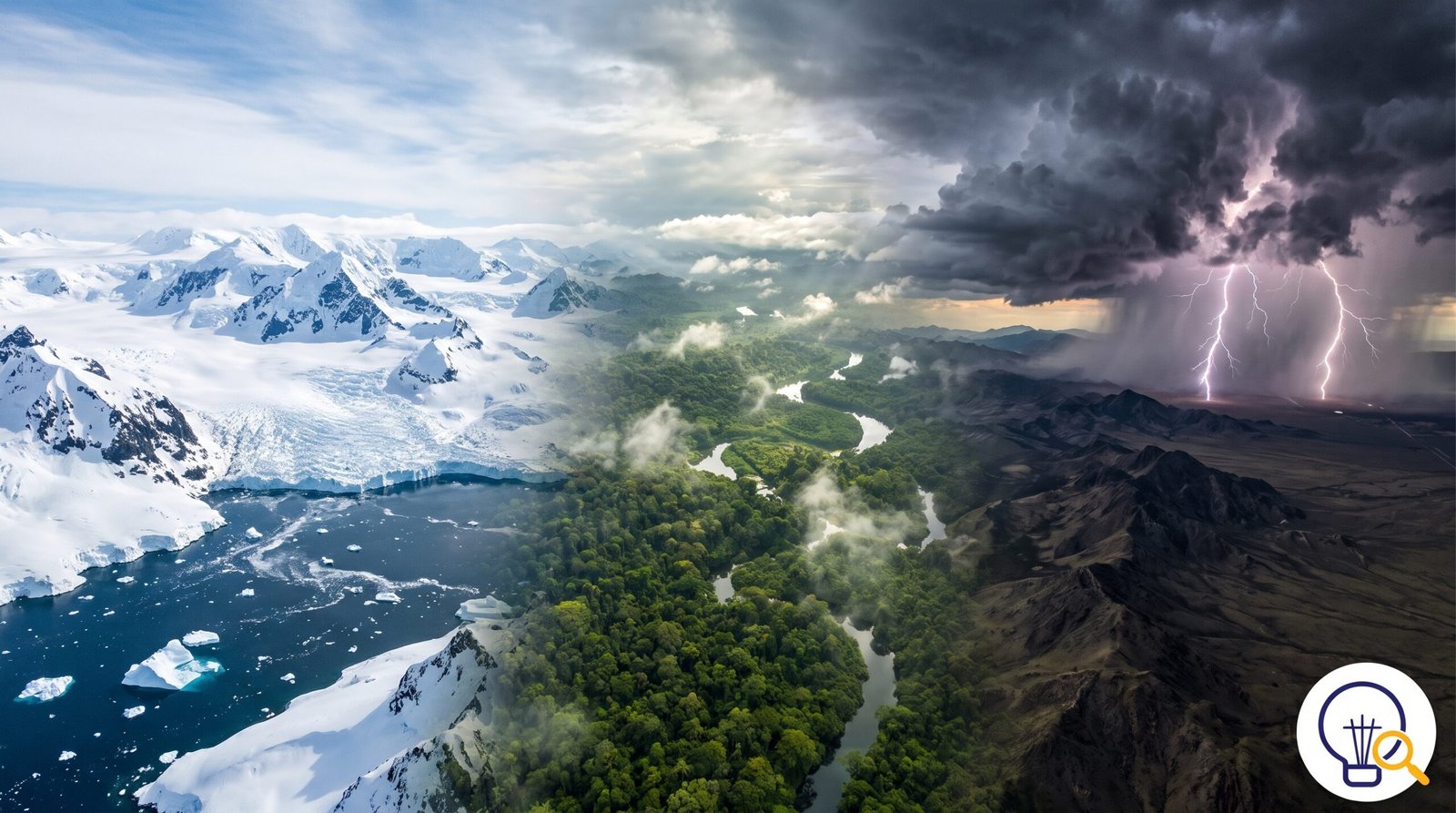
Earth is full of natural surprises, from unusual weather patterns to extreme environments that challenge our understanding of nature.
Lightning Is Much Hotter Than the Surface of the Sun
A lightning flash can heat the surrounding air to approximately 50,000°F (around 28,000°C). That is several times hotter than the Sun’s visible surface, which is about 10,000°F (5,500°C).
Lightning is an enormous electrical discharge. When it passes through the atmosphere, it heats the surrounding air very rapidly. The air expands suddenly, producing the sound wave we hear as thunder.
The comparison is specifically with the Sun’s visible surface, not its core. The Sun’s core is vastly hotter.
Antarctica Is the World’s Largest Desert
When people imagine a desert, they often picture hot sand and very little shade. However, temperature does not determine whether a place is a desert. The key factor is precipitation, or how little rain and snow an area receives.
Antarctica is the largest desert on Earth because much of the continent receives very little precipitation. Its extremely cold conditions also mean that much of its water is stored as ice.
This makes Antarctica a polar desert. The Sahara is the world’s largest hot desert, but Antarctica is larger overall.
Some Rainforests Receive Rain Almost Every Day
Tropical rainforests often experience frequent rainfall because of their warm temperatures, moisture, and active water cycle.
Sunlight warms water on the ground and in plants, causing it to enter the atmosphere as water vapor. As moist air rises and cools, water vapor condenses into clouds. Eventually, droplets become heavy enough to fall as rain.
In some tropical regions, this process happens regularly throughout the year. However, rainfall patterns vary: not every rainforest receives rain every day, and many have distinct wet and dry seasons.
The North Pole Experiences One Sunrise Each Year
At the geographic North Pole, the Sun rises approximately once a year and sets approximately once a year.
This unusual pattern happens because Earth’s axis is tilted. As Earth travels around the Sun, the North Pole remains tilted toward the Sun for part of the year and away from it for the other part.
During the period when the North Pole faces the Sun, it experiences continuous daylight, known as the polar day or midnight sun. When it faces away, it experiences continuous darkness, known as the polar night.
The transition is gradual, so sunrise and sunset at the pole are very different from the daily cycle most people experience.
A Single Cloud Can Weigh Hundreds of Tons
A fluffy white cloud may look light, but it can contain a huge amount of water spread across a large volume of air.
A typical fair-weather cumulus cloud can contain hundreds of tons of water droplets. The droplets are extremely small and spread out, which is why a cloud can remain suspended rather than falling like a giant mass of water.
Clouds stay aloft because tiny droplets and ice crystals are supported by rising air currents and are affected by air resistance. When droplets combine and become large enough, they can fall as rain.
The important distinction is that a cloud’s water is distributed through a vast space. It is not a solid block of water hanging in the sky.
Surprising Physics and Chemistry Facts

Physics and chemistry explain how matter, energy, light, sound, and chemical reactions behave. Many of their most interesting discoveries are connected to things you experience every day.
Everything You See Is From the Past
Light takes time to travel from one place to another. Even though it moves incredibly fast, it is not instantaneous.
When you look at a person standing across a room, the light reaching your eyes left that person a tiny fraction of a second earlier. When you look at the Moon, you see it as it was about 1.3 seconds ago. When you look at the Sun, you see it as it was about eight minutes earlier.
The farther away an object is, the older the light reaching you may be. This is why astronomers can study the history of the universe by observing distant galaxies.
Water Can Exist as a Solid, Liquid, and Gas
Water is unusual because it can naturally exist in three common states of matter:
- Solid: Ice, such as the ice in a freezer or a glacier.
- Liquid: Water in rivers, lakes, oceans, and drinking glasses.
- Gas: Water vapor in the atmosphere.
The state depends mainly on temperature and pressure. When water gains enough energy, it can evaporate into vapor. When it loses energy, it can freeze into ice.
Water can also change directly between solid and gas through a process called sublimation. This is one reason ice can gradually disappear in very cold, dry conditions without first becoming liquid.
Sound Cannot Travel Through Empty Space
Sound is a vibration that travels through a material medium, such as air, water, or metal. It moves when particles in that material pass vibrations from one another.
Outer space is nearly a vacuum, meaning it contains far too few particles to carry ordinary sound waves. That is why explosions in space do not make the loud noises often shown in science-fiction movies.
Spacecraft can still detect events using instruments that measure electromagnetic signals, vibrations, or other data. Scientists can then convert some of those measurements into sounds that humans can hear, but those are not ordinary sound waves traveling through empty space.
Diamonds Can Form Naturally Deep Inside Earth
Diamonds are made of carbon, the same chemical element found in graphite, which is used in many pencils. The difference is how the carbon atoms are arranged.
Natural diamonds form under extremely high pressure and temperature conditions deep within Earth’s mantle. Over long periods, carbon atoms form a strong crystal structure.
Some diamonds reach the surface through volcanic rocks called kimberlites, which can carry material upward from deep underground. This is one reason diamonds are found in particular geological regions rather than everywhere.
Hot Water Can Sometimes Freeze Faster Than Cold Water
This unusual observation is known as the Mpemba effect. Under certain conditions, warmer water has been observed to freeze before cooler water.
Scientists have suggested several possible factors, including evaporation, convection, dissolved gases, and differences in how water cools. The result depends on the conditions, such as the container, starting temperature, water composition, and surrounding environment.
It is not a universal rule that hot water always freezes faster. In many ordinary situations, colder water freezes first. The Mpemba effect remains an interesting example of how a seemingly simple process can involve several interacting physical factors.
Fascinating Ocean Science Facts
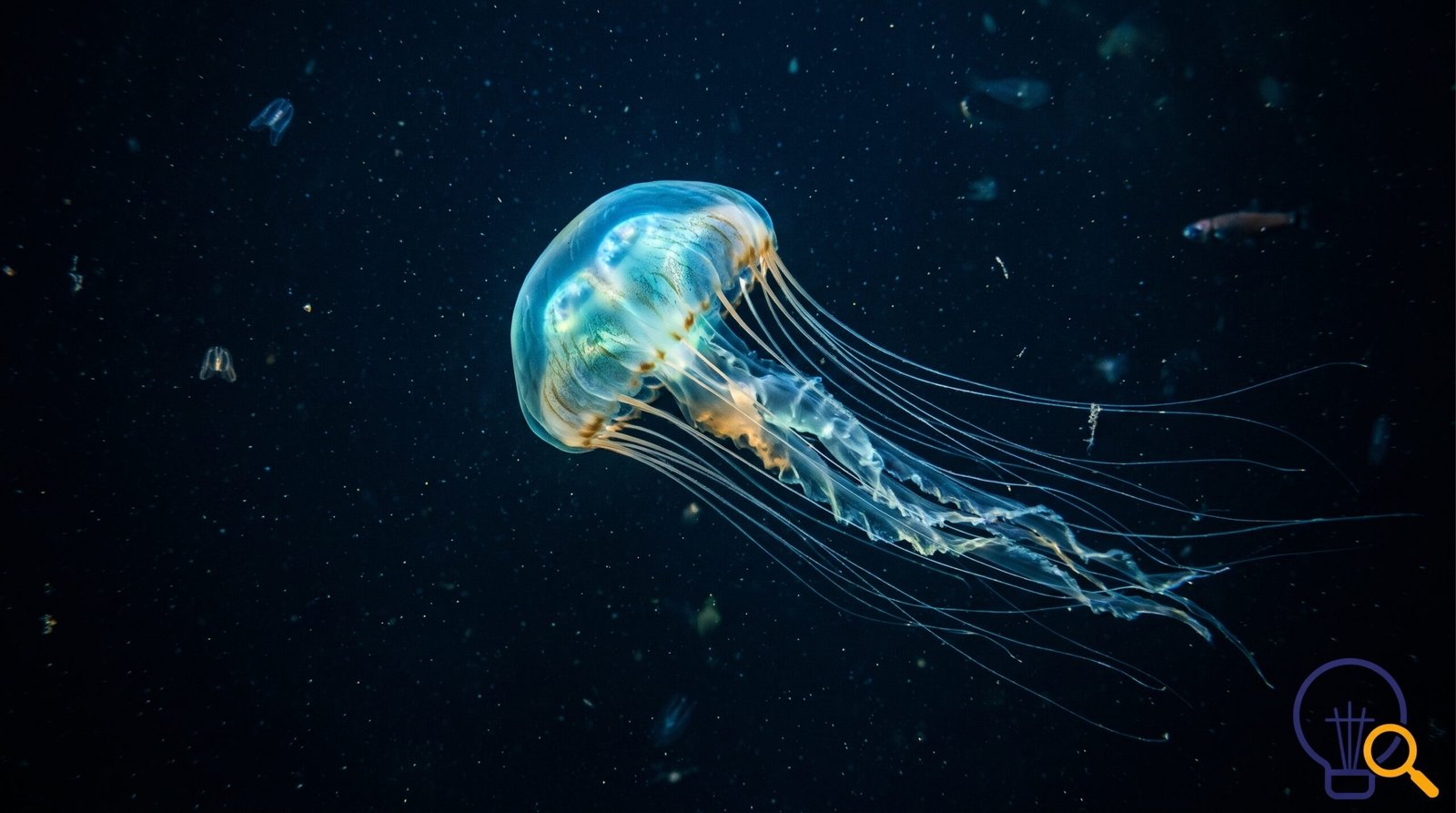
The ocean covers most of Earth’s surface and supports an enormous variety of life. Yet many of its environments remain difficult to study, especially the deep sea.
Most of the Ocean Remains Unexplored
Scientists have mapped large areas of the ocean floor, but mapping is not the same as exploring every location in detail.
The deep ocean is difficult to study because it is dark, cold, and under enormous pressure. Research vessels, remotely operated vehicles, and autonomous underwater vehicles help scientists investigate these environments, but expeditions are expensive and technically challenging.
As a result, many deep-sea habitats and species remain poorly understood. New expeditions continue to discover organisms and geological features that add to our knowledge of Earth’s oceans.
The Ocean Produces Much of Earth’s Oxygen
A large share of Earth’s oxygen production comes from microscopic organisms living in the ocean. These include phytoplankton, algae, and photosynthetic bacteria.
Through photosynthesis, these organisms use sunlight to convert carbon dioxide and water into energy-rich compounds, releasing oxygen as a by-product. Some of them are so small that you cannot see them individually without a microscope.
Scientists commonly estimate that marine photosynthesis accounts for roughly half of the oxygen produced globally each year. That estimate describes gross oxygen production, not a simple net addition to the atmosphere. Marine organisms also use oxygen for respiration, and decomposition consumes oxygen as organic matter breaks down. Tiny organisms such as cyanobacteria and phytoplankton are therefore important to the global oxygen cycle, even though most individual organisms are invisible to the naked eye.
The Deep Ocean Contains Creatures That Produce Their Own Light
Some deep-sea animals can create light through a process called bioluminescence. This natural light is produced by chemical reactions inside an organism or through partnerships with light-producing microorganisms.
Bioluminescence can help animals attract prey, communicate, find mates, or confuse predators. Different species produce different colors, although blue light is especially common in the ocean because it travels relatively well through seawater.
Bioluminescence is especially common among animals in the ocean’s open water, where sunlight becomes scarce with depth. For example, some fish use light-producing organs to attract prey, while certain squid release glowing material that may distract predators. The exact role of the light depends on the species and its environment.
The Pacific Ocean Is Larger Than All Land Areas Combined
The Pacific Ocean is the largest ocean on Earth. Its surface area is roughly 63.8 million square miles (165 million square kilometers), making it larger than all of Earth’s land areas combined.
It stretches between Asia and Australia on one side and the Americas on the other. It also contains thousands of islands, deep ocean trenches, underwater mountains, and a wide range of marine ecosystems.
Its enormous size helps explain why the Pacific plays such an important role in Earth’s climate, ocean circulation, and marine biodiversity.
Amazing Plant and Food Science Facts
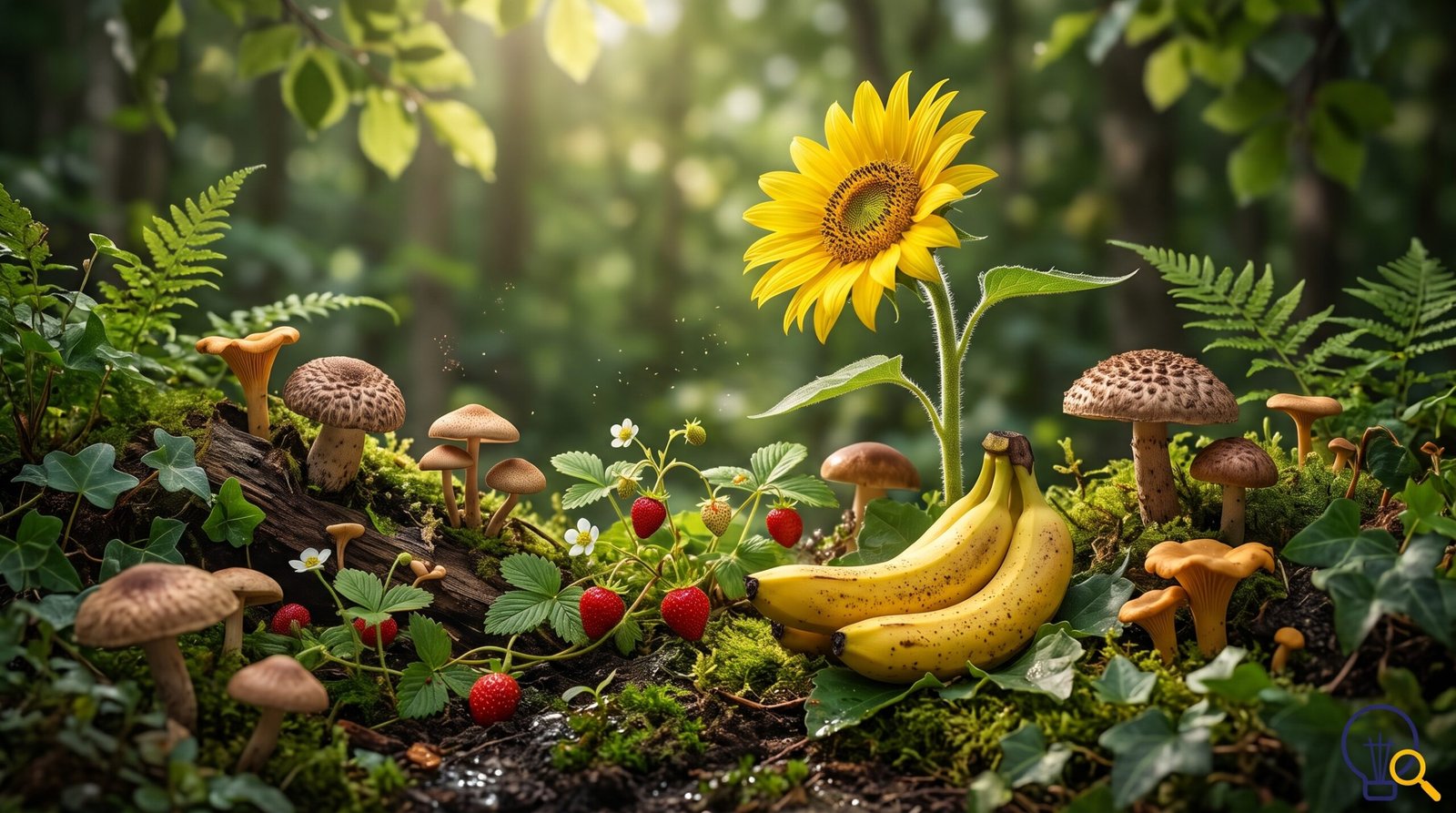
Plants and fungi may seem less active than animals, but they carry out complex biological processes. Even familiar foods can reveal surprising details about genetics, evolution, and plant structure.
Bananas Are Botanically Classified as Berries
In everyday language, people use the word berry for small, juicy fruits such as strawberries, blueberries, and raspberries. Botanical definitions are more specific.
A botanical berry develops from a single flower’s ovary and usually has seeds embedded within its fleshy interior. Under this definition, bananas qualify as berries.
This is why botanical classification can seem confusing: the scientific meaning of a word does not always match how people use it in everyday conversation.
Strawberries Are Not True Botanical Berries
Despite their name, strawberries are not classified as true berries in botanical terms.
The red, fleshy part of a strawberry is an enlarged flower base called the receptacle. The tiny structures on its outer surface are individual fruits, each containing a seed.
This makes the strawberry an aggregate accessory fruit, rather than a botanical berry. So, while bananas are true berries, strawberries are not.
Some Plants Can Communicate Through Chemical Signals
Plants do not communicate with words or thoughts, but they can release and detect chemical signals. When some plants are attacked by insects, for example, they release airborne compounds. Nearby plants of the same or other species may detect those chemicals and activate defenses, such as producing substances that make their leaves less appealing to herbivores.
Roots also release chemicals into the soil, where they interact with microbes and neighboring plants. Fungi that form partnerships with plant roots can connect underground networks through which resources and signals may move. Scientists are still studying how important these exchanges are in different ecosystems, so it is best to describe them as chemical and ecological interactions rather than human-like conversations.
Sunflowers Follow the Sun During Their Early Growth
Young sunflower plants can show a movement called heliotropism, in which their developing flower heads track the Sun across the sky.
This movement is linked to differences in growth on opposite sides of the stem. As the plant matures, the movement usually slows, and mature sunflower heads commonly face east.
Facing east can help flowers warm up earlier in the morning, which may benefit pollinating insects. So the familiar image of sunflowers following the Sun is real, but it mainly describes their growing stage rather than every mature flower.
Mushrooms Are More Closely Related to Animals Than Plants
Mushrooms belong to the kingdom Fungi, not the plant kingdom. In evolutionary terms, fungi share a more recent common ancestor with animals than either group shares with plants.
One important difference is how they obtain nutrients. Plants generally make their own food through photosynthesis, while fungi absorb nutrients from organic material in their surroundings.
Fungi also have cell walls, but these are mainly made of chitin rather than the cellulose found in plant cell walls. Chitin is also found in the outer skeletons of insects and other arthropods.
This relationship is a useful reminder that organisms that look very different can still share important evolutionary history.
Everyday Science Facts That Will Surprise You

Science is part of everyday life, even when we don’t notice it. From kitchen appliances to simple household objects, many familiar things work because of fascinating scientific principles.
Microwaves Heat Food Using Electromagnetic Waves
A microwave oven uses a form of electromagnetic radiation called microwaves to heat food.
These waves interact with molecules in food, especially water molecules. The resulting energy transfer increases the motion of molecules and produces heat throughout the food.
Microwaves do not simply heat food from the inside out. The waves penetrate only a limited distance, and heat then spreads through the food by conduction. Heating also depends on moisture, shape, thickness, and the way energy is distributed inside the oven. This is why a thick dish may have hot edges and a cooler center, and why stirring or letting food stand can improve temperature consistency.
Ice Is Less Dense Than Liquid Water
Most substances become denser when they freeze, but water behaves differently. When water freezes, its molecules form a crystal structure that takes up more space than the same amount of liquid water.
As a result, ice is less dense than liquid water and floats on top.
This property is important for life in lakes and ponds. In cold weather, ice forms at the surface and can create an insulating layer, helping the water underneath remain liquid and providing a more stable environment for aquatic organisms.
A Rainbow Is Actually a Full Circle
A rainbow is not naturally a half-circle. It forms when sunlight enters water droplets, bends, reflects inside them, and exits in a way that separates the light into different colors.
From the ground, the horizon usually blocks the lower part of the circle, so you see an arc. From an airplane or a high viewpoint with the right conditions, it may be possible to see a much more complete circular rainbow.
The familiar rainbow shape is therefore partly a result of where the observer is standing.
Soap Helps Remove Germs and Dirt From Your Hands
Soap does more than make your hands smell fresh. Its molecules have two different ends: one interacts with water, while the other interacts with oils and grease.
This allows soap to loosen oily dirt and help lift microorganisms from the skin. When you rinse your hands, water carries much of that material away.
Proper handwashing matters because germs can move from contaminated hands to the eyes, nose, mouth, food, or other people. Scrubbing with soap and water for at least 20 seconds helps loosen dirt and microbes from the skin; rinsing then carries them away. Soap does not make hands sterile, but careful washing lowers the number of germs and helps reduce the spread of infection.
A Mirror Doesn’t Actually Reverse Left and Right
When you look into a mirror, it may seem as if your left and right sides have switched. However, a flat mirror does not literally reverse left and right.
A mirror reverses the direction from front to back. Your reflection appears to face you, and your brain interprets the image as though another person were standing in front of you.
The apparent left-right reversal comes from how you imagine turning yourself around to match the reflection. The mirror itself is reflecting light, not deciding which side should be left or right.
Strange but True Science Facts
Some scientific discoveries are especially strange because they involve unusual body structures, unexpected life cycles, or organisms that survive in extreme environments.
Wombats Produce Cube-Shaped Droppings
Wombats are Australian marsupials known for producing cube-shaped droppings. This unusual shape is not created by a square-shaped opening.
Research suggests that differences in the elasticity and stiffness of sections of the wombat’s intestine help shape the material into separate cubes as it moves through the digestive system.
Scientists believe the shape may help the droppings stay in place when wombats use them to mark territory. It is a surprising example of how the structure of an animal’s body can influence even its waste.
Some Jellyfish Can Reverse Their Life Cycle
A species known as Turritopsis dohrnii has an unusual ability: under certain conditions, it can return from its adult stage to an earlier life stage.
Instead of following the usual one-way path of development, its cells can undergo a transformation that allows the organism to return to a polyp-like stage. This process is called transdifferentiation.
The jellyfish is sometimes described as biologically immortal, but that phrase can be misleading. It can still be eaten, become ill, or die from environmental conditions. Its unusual life cycle does not make it impossible to kill.
A Group of Flamingos Is Called a Flamboyance
A group of flamingos is sometimes called a flamboyance. The name suits their bright feathers and distinctive appearance.
Flamingos are also fascinating from a biological perspective. Their pink and reddish colors come largely from carotenoid pigments in their food, including algae and tiny crustaceans.
Young flamingos are not born bright pink. Their feathers become more colorful as they grow and consume foods containing these pigments.
Some Turtles Can Absorb Oxygen Through Their Cloaca
Certain freshwater turtles can absorb oxygen from water through specialized tissues around the cloaca, a shared opening used for several body functions.
This process is often called cloacal respiration. It can help some species remain underwater for extended periods, especially during cold conditions when their metabolism slows down.
However, this ability is not shared by all turtles, and it does not mean they can live underwater indefinitely. They still need suitable environmental conditions and must obtain oxygen in ways appropriate to their species.
Certain Bacteria Can Survive in Extremely Harsh Environments
Some microorganisms can survive conditions that would be difficult or impossible for most forms of life. These organisms are known as extremophiles.
Different extremophiles tolerate different conditions. Some live in extremely hot environments, others survive in highly acidic water, and some thrive in places with intense salt concentrations.
Their survival does not mean bacteria can live anywhere. Each species has limits, but studying these organisms helps scientists understand how life adapts and where it might exist beyond Earth.
Amazing History and Technology Science Facts
Science is not only about natural phenomena. It is also a history of human curiosity, experiments, and inventions that changed the world.
The First Computer Programmers Worked in the 1800s
Ada Lovelace, a mathematician who worked with inventor Charles Babbage, is widely recognized as an early computer programmer.
In the 1840s, she wrote notes describing how Babbage’s proposed Analytical Engine could carry out a sequence of operations. One of her examples explained how the machine could calculate Bernoulli numbers.
The Analytical Engine was never completed during her lifetime, and it was a mechanical design rather than a modern electronic computer. Still, Lovelace’s work showed that a computing machine could potentially do more than simple arithmetic.
The First Airplane Flight Happened Only 66 Years Before the Moon Landing
The Wright brothers achieved the first powered, sustained, and controlled flight of a heavier-than-air aircraft in 1903. Just 66 years later, in 1969, Apollo 11 carried astronauts to the Moon.
The difference between these events is remarkable. The first successful Wright brothers flight lasted only 12 seconds and covered about 120 feet. The Apollo 11 mission took humans hundreds of thousands of miles from Earth.
This comparison shows how quickly aviation, engineering, physics, and space technology advanced during the twentieth century.
The First Photograph Took Several Hours to Capture
Early photography was very different from taking a picture with a phone today. Some of the earliest photographic processes required long exposure times because the materials used were not very sensitive to light.
The earliest surviving permanent camera photograph is commonly credited to Nicéphore Niépce and dates to the 1820s. It required a very long exposure—often described as several hours—because the light-sensitive material was far less efficient than modern photographic sensors and film. The exact exposure time is uncertain, so it is more accurate to say it took hours rather than give a precise number.
Early photography was a major scientific and technological achievement because it allowed images of the real world to be recorded and preserved.
The Modern Internet Began as a Research Network
The internet did not begin as the global system of websites and apps we use today. One important early foundation was ARPANET, a U.S. research network that connected computers at universities and research institutions. It helped demonstrate packet switching, a method of breaking information into smaller units that can travel across a network and be reassembled at the destination.
The internet and the World Wide Web are not the same thing. The internet is the network infrastructure that connects devices around the world. The Web is a service that uses that infrastructure to access linked pages and other resources. The Web became widely used later, after the underlying network technologies had already developed.
Incredible Mathematics and Numbers Facts
Mathematics is more than calculations on paper. It helps scientists describe patterns, understand nature, build technology, and make predictions about the world.
Zero Is an Essential Number in Modern Mathematics
Zero may look like an ordinary number, but it plays two important roles in mathematics.
First, it represents the absence of a quantity. Second, it works as a placeholder in our place-value number system. For example, zero helps distinguish 5, 50, and 500.
Zero also makes many mathematical operations possible and is essential to algebra, calculus, computing, and modern science. Its development was a major milestone in the history of mathematics.
There Are Infinitely Many Prime Numbers
A prime number is a whole number greater than 1 that has exactly two positive factors: 1 and itself.
Examples include 2, 3, 5, 7, 11, and 13. The number 2 is the only even prime because every other even number can be divided by 2.
One of the most famous mathematical results is that there are infinitely many prime numbers. Euclid’s classic argument starts by imagining that you have listed every prime. By constructing a number from that list, he showed that the list must be incomplete: there is always a prime missing from it or a new prime factor to consider.
Prime numbers also appear in modern cryptography. Some encryption systems rely on mathematical problems involving very large numbers, although real-world security depends on carefully designed algorithms and more than simply choosing large primes.
A Circle Has No Corners or Straight Edges
A circle is a shape made up of all points in a plane that are the same distance from a central point. That fixed distance is called the radius.
Unlike a square or triangle, a perfect circle has no corners and no straight sides. Every point along its boundary curves smoothly around the center.
This simple geometric shape appears in many areas of science and engineering, including wheels, lenses, planetary orbits, and the design of machines.
Mathematics Is Used to Explain Patterns Throughout Nature
Mathematical patterns appear in many natural systems. For example, the arrangement of leaves around some plant stems can follow patterns related to Fibonacci numbers.
The Fibonacci sequence begins with 0 and 1, with each following number formed by adding the previous two numbers: 0, 1, 1, 2, 3, 5, 8, and so on.
Some plants show arrangements that resemble these patterns because they can help leaves or seeds fit efficiently into available space. Not every natural spiral follows the Fibonacci sequence, but mathematics gives scientists useful tools for describing and studying these structures.
Science Facts About Weather and Natural Disasters
Weather is shaped by the movement of air, water, heat, and energy around Earth. Some of its most dramatic events reveal how powerful natural processes can become.
There Can Be Thousands of Thunderstorms Around the World at Once
Thunderstorms are common across the planet, particularly in warm regions where moist air rises and forms tall clouds.
A thunderstorm develops when warm, moist air rises, cools, and condenses into a cumulonimbus cloud. Strong upward and downward air movements can develop inside the cloud, sometimes producing heavy rain, lightning, hail, and strong winds.
Thousands of thunderstorms can occur around the world over the course of a day. The number active at any exact moment changes with weather conditions and the time of year.
Snowflakes Usually Have Six-Sided Structures
Snowflakes form when water vapor freezes into ice crystals in the atmosphere. The arrangement of water molecules in ordinary ice naturally creates a six-sided crystal structure.
As a snowflake travels through a cloud, temperature and humidity influence how it grows. This is why snowflakes can develop different shapes, including plates, columns, and branching patterns.
The familiar six-sided symmetry comes from the way water molecules bond in ordinary ice. The detailed branches depend on the temperature and humidity a crystal experiences as it moves through a cloud. Two snowflakes can develop similar patterns, but their paths through the cloud are rarely identical. The popular claim that no two snowflakes can ever be alike is stronger than scientists can prove.
Volcanic Lightning Can Occur During Eruptions
Some powerful volcanic eruptions produce lightning inside or near their ash clouds. This phenomenon is called volcanic lightning.
During an explosive eruption, ash particles, rock fragments, and ice particles can collide and separate electrical charges. When the difference in charge becomes large enough, electrical discharges can occur.
Volcanic lightning is not present in every eruption. It is most often associated with explosive events that send large amounts of ash and particles into the atmosphere.
Tornadoes Can Form Over Water
A tornado-like rotating column of air can develop over water. It is known as a waterspout.
Some waterspouts form in connection with thunderstorms, while others develop in less severe weather conditions. They can vary in strength and may move across the water’s surface.
Waterspouts are a reminder that rotating storms are not limited to land. However, they can still be dangerous to boats and people nearby, so they should be treated as serious weather events.
Some Places on Earth Have Experienced Snowfall in Summer
Summer does not mean every location on Earth must be warm. Snow can fall during summer in high mountain areas, polar regions, and places where temperatures remain low enough.
For example, mountain elevations can be cold even when nearby valleys are experiencing warm weather. The atmosphere becomes cooler with increasing altitude, which is why some high peaks retain snow throughout the year.
The timing of seasons also differs between the Northern and Southern Hemispheres. When it is summer in the United States, it is winter in much of the Southern Hemisphere.
Science Facts That Sound Fake but Are Real
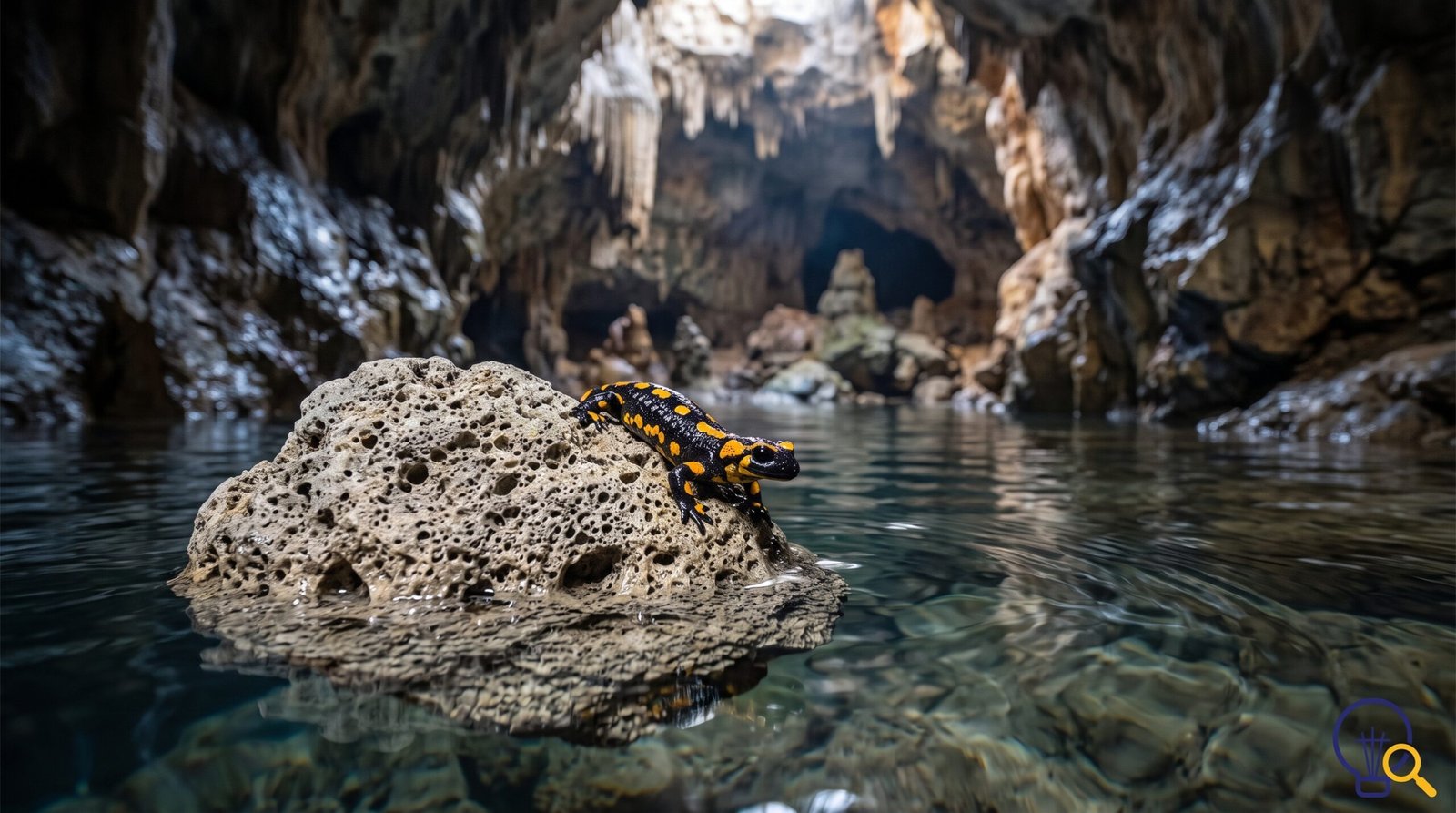
Some scientific discoveries sound too strange to be true. The best way to understand them is to look beyond the headline and examine the process behind each one.
Some Metals Can React Very Strongly With Water
Certain metals, including sodium and potassium, react strongly with water. These elements belong to a group called the alkali metals.
Their outer electrons are held relatively loosely, making them highly reactive. When they come into contact with water, chemical reactions can release heat and produce hydrogen gas and metal hydroxides.
The intensity of the reaction depends on the metal and the conditions. These substances require professional handling and should never be used for casual experiments.
There Are Lakes Beneath Earth’s Surface
When people think of lakes, they usually imagine open water surrounded by land. However, underground lakes and large water-filled cave systems also exist.
These bodies of water can form when groundwater collects in natural underground spaces, including caves and limestone formations. Some are connected to rivers or larger groundwater systems.
They are different from the vast oceans hidden beneath Earth’s crust in science-fiction stories. Real underground lakes are geological features shaped by water movement, rock structure, and the local environment.
Certain Animals Can Regrow Lost Body Parts
Regeneration is the ability to replace damaged or lost body parts. Some animals have remarkable regenerative abilities.
For example, axolotls can regrow limbs and repair certain tissues, including parts of their spinal cord and heart. Some sea stars can regrow lost arms, although the ability to regenerate an entire animal depends on the species and how much of the body remains.
Scientists study regeneration to better understand how cells grow, specialize, and repair tissues. This research may help improve knowledge of healing and tissue repair in humans.
Some Rocks Can Actually Float on Water
Pumice is a volcanic rock that can float on water. It forms when gas-rich magma cools quickly, leaving behind many tiny holes called vesicles.
These holes reduce the rock’s average density. If the pumice is light enough and has enough trapped air, it can float rather than sink.
Large floating accumulations of pumice can sometimes form after volcanic eruptions. The rock may eventually become waterlogged and sink.
The Human Body Naturally Produces Tiny Amounts of Light
The human body produces extremely weak light as a result of chemical reactions taking place inside cells. This phenomenon is known as ultraweak photon emission.
The light is far too faint for human eyes to see under normal conditions. It is associated with processes involving molecules and oxidative reactions in living tissues.
This is not the same as glowing skin in science-fiction stories. It is a very weak scientific signal that researchers can detect using sensitive instruments.
Final Thoughts on These Amazing Science Facts
These discoveries show that science is not limited to laboratories or textbooks. It explains why ice floats, how animals use unusual adaptations, why distant stars appear as they did long ago, and how tiny organisms influence Earth’s atmosphere.
The most useful part of a surprising fact is the explanation behind it. A headline may catch your attention, but understanding the process—and the limits of what scientists know—turns trivia into real learning. Keep asking questions, compare claims with reliable scientific evidence, and look for the mechanism behind the surprise.
Frequently Asked Questions About Interesting Science Facts
What is the most unbelievable science fact?
A striking example is Venus’s slow rotation: it takes about 243 Earth days to rotate once, while its orbit around the Sun takes about 225 Earth days. The comparison is unusual because a planet completes an orbit before completing one rotation.
What are some interesting facts about the human body?
The human body contains around 30 trillion human cells, and the brain uses roughly 20% of the body’s energy while at rest. The stomach also protects itself from its own acid with a mucus-based lining.
What is the strangest fact about space?
One of the strangest space facts is that Saturn is less dense than water on average. If a body of water large enough existed, Saturn would theoretically float in it.
What are some amazing facts about animals?
Octopuses have three hearts and blue blood, butterflies taste with their feet, and wombats produce cube-shaped droppings. These unusual traits help show how varied animal biology can be.
Why are science facts important to learn?
Science facts help us understand the human body, nature, animals, space, and how the world around us works. They also encourage curiosity and help us evaluate surprising claims using evidence.
