
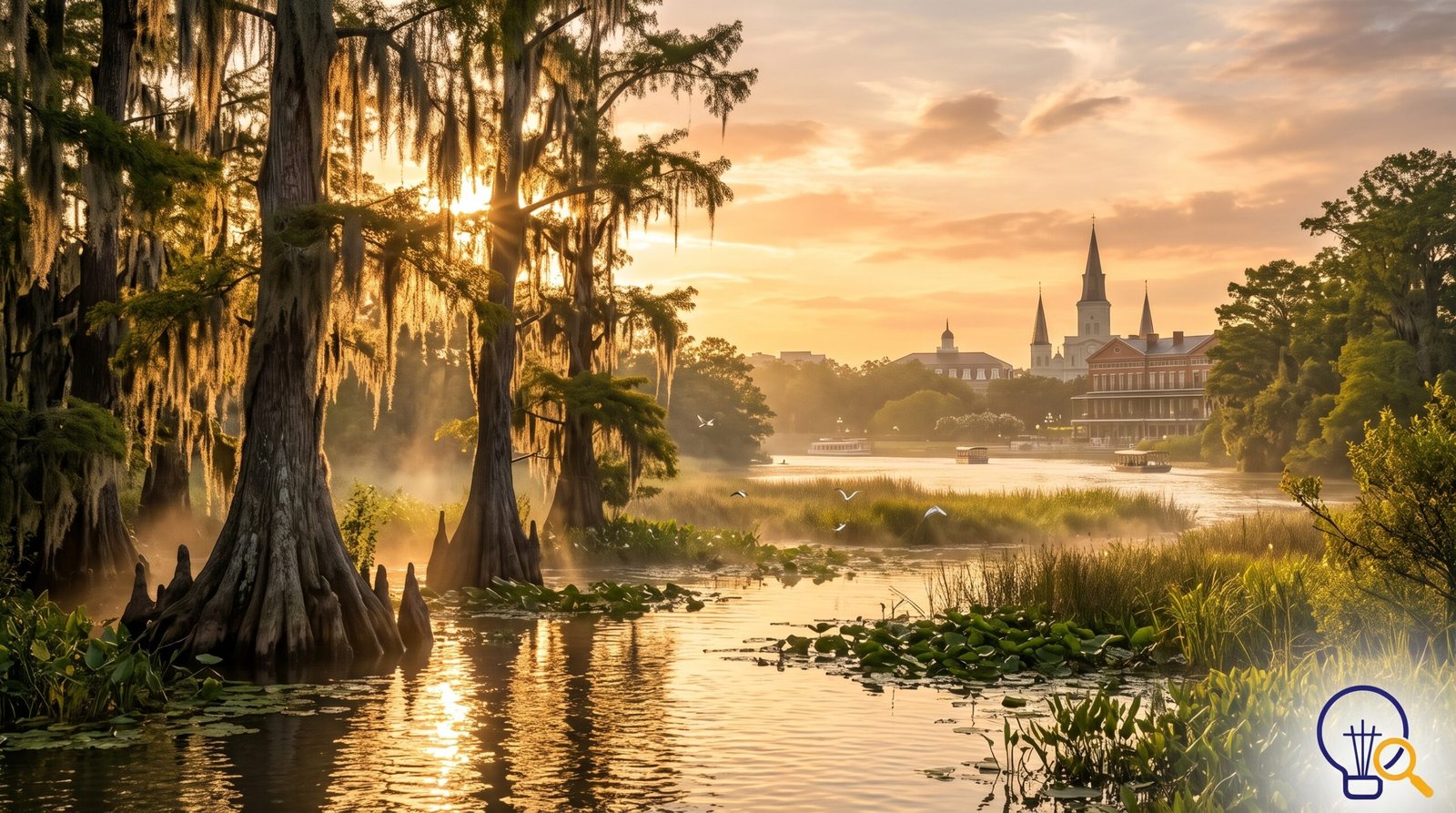

Did you know Louisiana is the only U.S. state with parishes instead of counties? That’s just one of many facts about Louisiana that surprise most people. From the swamps of the Atchafalaya Basin to the jazz clubs of New Orleans, the Pelican State is unlike anywhere else in the country. Its law, language, food, and coastline all have stories most people never hear.
This guide explores Louisiana’s history, geography, food, wildlife, and culture. You’ll learn how the state got its name, why its coastline is changing, what separates Cajun from Creole traditions, and which places are worth exploring. Start with a few surprises, then discover the stories behind them.
Interesting Louisiana Facts Most People Don’t Know
You probably already know about Mardi Gras and gumbo. Here are eight lesser-known facts that reveal what makes the state different:
- No official language. Louisiana has never named one, even though French and Creole shaped it. For a state this proud of its heritage, that’s a surprisingly hands-off choice.
- Older than the pyramids. The earthworks at Poverty Point are roughly 3,400 years old, built by people who hadn’t yet taken up farming.
- A bridge that disappears into the horizon. The Lake Pontchartrain Causeway runs about 24 miles over water. For long stretches, you can’t see land in either direction.
- A skyscraper for a statehouse. The capitol in Baton Rouge has 34 stories and stands about 450 feet tall, the tallest state capitol in the country.
- Crawfish central. Louisiana is the leading U.S. crawfish-producing state, and crawfish farming is closely connected with the state’s rice-growing industry.
- Natchitoches beat New Orleans. Natchitoches, founded in 1714, is older than New Orleans, which dates to 1718. Most people assume the famous city came first.
- A strong Native American presence. Louisiana is home to four federally recognized tribes, along with state-recognized tribal communities. Indigenous peoples have shaped the region’s history and remain part of the state today.
- Living below sea level. Parts of New Orleans sit about 8 feet below sea level, which is why the city relies on levees and pumps.
The sections below explain the history and context behind these facts.
Louisiana at a Glance
Need the basics fast? This quick-reference table covers important Louisiana state facts for students, visitors, and trivia fans.
| Category | Detail |
| Nicknames | Pelican State (official), Bayou State, Creole State, Sportsman’s Paradise |
| Statehood | April 30, 1812, the 18th state |
| Capital | Baton Rouge |
| Largest city | New Orleans |
| Population | 4,618,189 (2025 Census Bureau estimate) |
| Area rank | 31st |
| State bird | Brown pelican |
| State flower | Magnolia |
| State tree | Bald cypress |
| State reptile | American alligator |
| State dog | Catahoula Leopard Dog |
| State songs | “You Are My Sunshine” and “Give Me Louisiana” |
| Motto | “Union, Justice, Confidence” |
| Highest point | Driskill Mountain, 535 feet |
| Neighbors | Texas, Arkansas, Mississippi, and the Gulf of Mexico |
Louisiana counts as part of the Deep South, yet it feels different from its neighbors. It has a large Catholic population in the south, a civil law tradition, French-language roots, and a culture that blends Caribbean, African, Spanish, and Native influences.
Why Is It Called Louisiana?
The name is a piece of French royal flattery, and it has stayed on the map for more than 340 years.
In 1682, the French explorer René-Robert Cavelier, Sieur de La Salle, claimed the whole Mississippi River drainage for France. He called it La Louisiane in honor of King Louis XIV. The name honors King Louis XIV of France. The French form La Louisiane referred to the vast territory claimed in his name.
That original territory was enormous. It stretched from the Gulf of Mexico up to what is now the Canadian border, including small slices of modern Alberta and Saskatchewan. Today’s state is a tiny fraction of it.
The Pelican State nickname comes from the brown pelican, the state bird. The other nicknames are easy to decode: “Bayou State” for the waterways, “Creole State” for the culture, and “Sportsman’s Paradise” for the hunting and fishing.
Louisiana History Timeline
The most interesting details about Louisiana’s past make more sense in order, so start with the turning points, then dig into the details.
| Year | What happened |
| 1682 | La Salle claims the territory for France |
| 1718 | New Orleans is founded |
| 1762 | France secretly hands the region west of the Mississippi to Spain |
| 1803 | The United States buys the Louisiana Territory |
| 1812 | Louisiana becomes the 18th state |
| 1861 | Louisiana secedes from the Union |
| 2005 | Hurricane Katrina floods New Orleans |
Over the centuries, the region came under French, Spanish, and American control, leaving a layered cultural legacy.
Native Peoples and Poverty Point
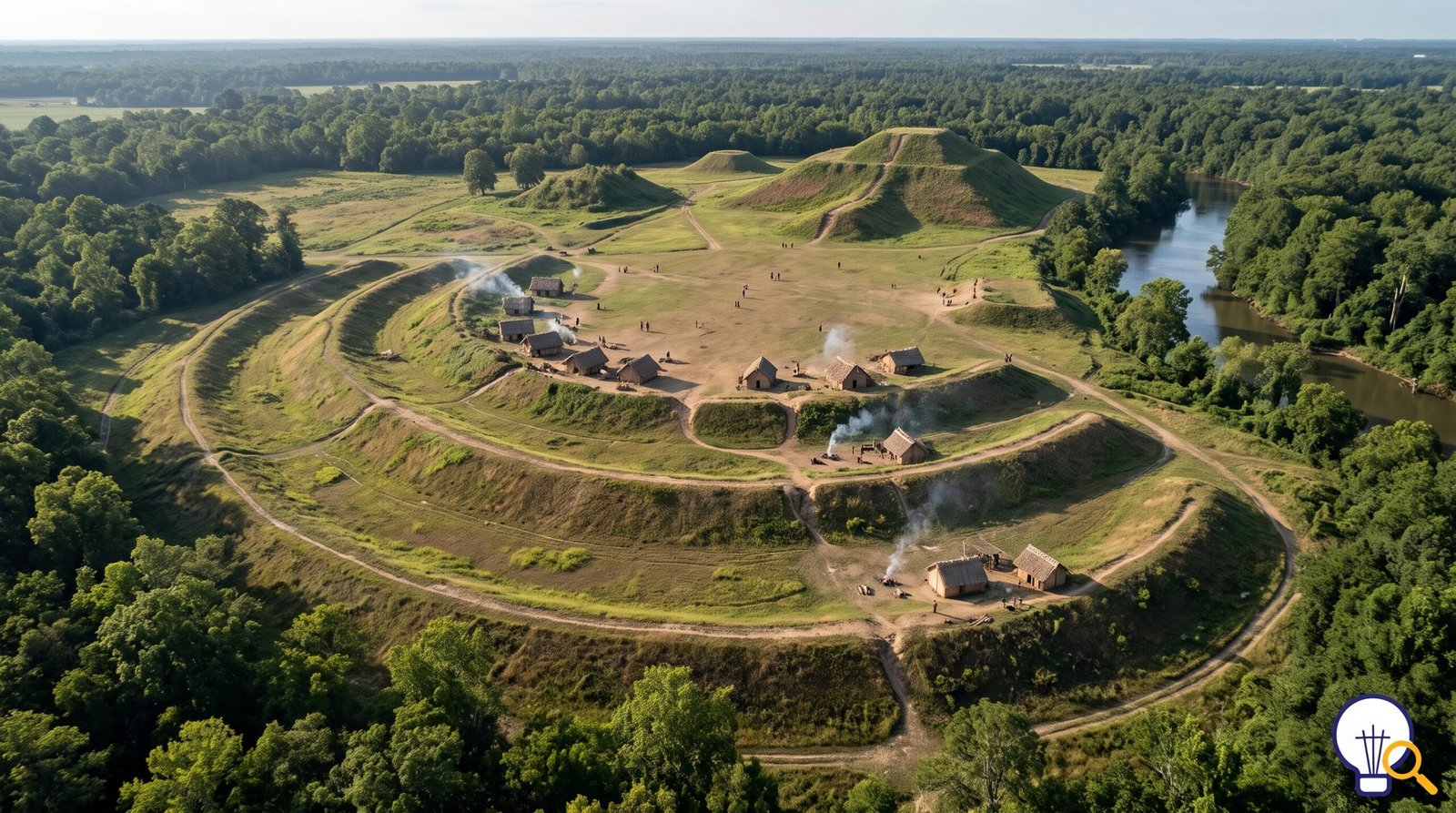
People lived here thousands of years before Europeans arrived. The Watson Brake site near Monroe holds eleven connected mounds built around 5,400 years ago. That surprised archaeologists, because the builders were hunter-gatherers. Experts had long assumed such large earthworks required farming communities.
Later came Poverty Point, a set of huge earthen ridges and mounds arranged in a precise pattern and built without metal tools or wheels. The National Park Service manages it as a national monument, and UNESCO lists it as a World Heritage Site. Standing on the ridges today, you’re walking on one of the most ambitious construction projects in ancient North America.
Native peoples are still here. The Chitimacha, Coushatta, Jena Band of Choctaw, and Tunica-Biloxi are among the Indigenous communities with deep ties to Louisiana. Indigenous languages and histories have also influenced regional place names, including Atchafalaya, Houma, and Tangipahoa.
French and Spanish Rule
Hernando de Soto’s expedition passed through in the early 1540s, but France was the first to settle. The French colonial heritage you see today began with trading posts and river forts. Natchitoches, for instance, was built to reach Spanish Texas and block Spanish expansion. New Orleans started as a planned river port, and by 1722 it had replaced Biloxi as the colonial capital.
Spain received the west bank in 1762, though Spanish colonial rule didn’t begin in practice until 1769. Two groups who still define Louisiana arrived during this period: Acadians in 1765 and Canary Islanders (Isleños) between 1778 and 1783.
This era also has a painful side. The French issued the Code Noir in 1724, which governed enslaved people, and slavery drove the colonial economy. By the end of 1721, about half of New Orleans’s 1,256 residents were enslaved. After 1791, refugees from Saint-Domingue (now Haiti) arrived by the thousands and reshaped the city’s language, music, and religion.
The Louisiana Purchase and Statehood
Napoleon Bonaparte wanted a Caribbean empire built on sugar. When his army failed to retake Saint-Domingue, Louisiana lost its value to him, so he offered it for sale.
President Jefferson had only wanted New Orleans and had authorized up to $10 million for it. Instead, his envoys, Robert Livingston and James Monroe, bought the entire territory of roughly 828,000 square miles for about $15 million. That works out to less than three cents an acre, and it doubled the size of the country.
The southern portion became the Territory of Orleans in 1804, and it was admitted to the Union as the state of Louisiana in 1812. One odd wrinkle: the Florida Parishes, the area east of the Mississippi, didn’t become part of the state until the legislature approved them in August of that year.
Civil War and Reconstruction
By 1860, enslaved people made up nearly 47 percent of the state’s population (331,726 of 708,002). Louisiana seceded on January 26, 1861, and Union forces captured New Orleans in April 1862.
Reconstruction brought real change. Oscar Dunn became one of the first Black lieutenant governors in the United States, and P.B.S. Pinchback later became the first Black governor of a U.S. state. Black lawmakers also played an important role in Louisiana’s Reconstruction-era legislature.
The backlash was severe. The 1898 constitution used poll taxes, residency rules, and literacy tests to push Black voters off the rolls. In 1896, there were 130,334 registered Black voters. By 1900, there were 5,320.
20th Century to Today
Governor Huey Long dominated the Depression era with huge public-works projects and an iron grip on state government. He was assassinated in 1935, inside the capitol he had built. In 1920, the state didn’t have a single continuous paved road crossing it from end to end.
Many Black Louisianans left in the Great Migration, heading north and west for jobs and to escape Jim Crow. One detail stands out: Louisiana didn’t ratify the Nineteenth Amendment, which gave women the vote, until 1970.
Hurricane Katrina struck on August 29, 2005. Levee failures flooded roughly 80 percent of New Orleans. In August 2016, a historic rainstorm damaged an estimated 110,000 homes across south Louisiana. The state’s population was 4,657,757 in the 2020 Census and an estimated 4,618,189 on July 1, 2025.
Geography, Landforms, and Climate
Much of the state’s character comes down to geography: the land is young, low, and always changing.
Louisiana touches Texas to the west, Arkansas to the north, Mississippi to the east, and the Gulf of Mexico to the south. Its postal abbreviation is LA, and the state observes Central Time. The Mississippi River runs about 600 miles through the state before emptying into the Gulf.
Locals think in regions rather than parishes. North Louisiana is known for upland hills and pine forests, while Central Louisiana includes pine country and the Kisatchie Hills. Acadiana is the heart of Cajun country around Lafayette. The Florida Parishes sit north of Lake Pontchartrain, and Greater New Orleans covers the river city and its surrounding parishes.
The high and low extremes are small. Even Driskill Mountain, the state’s highest natural point, is barely a big hill by Western standards.
The Mississippi Delta and Coastal Wetlands
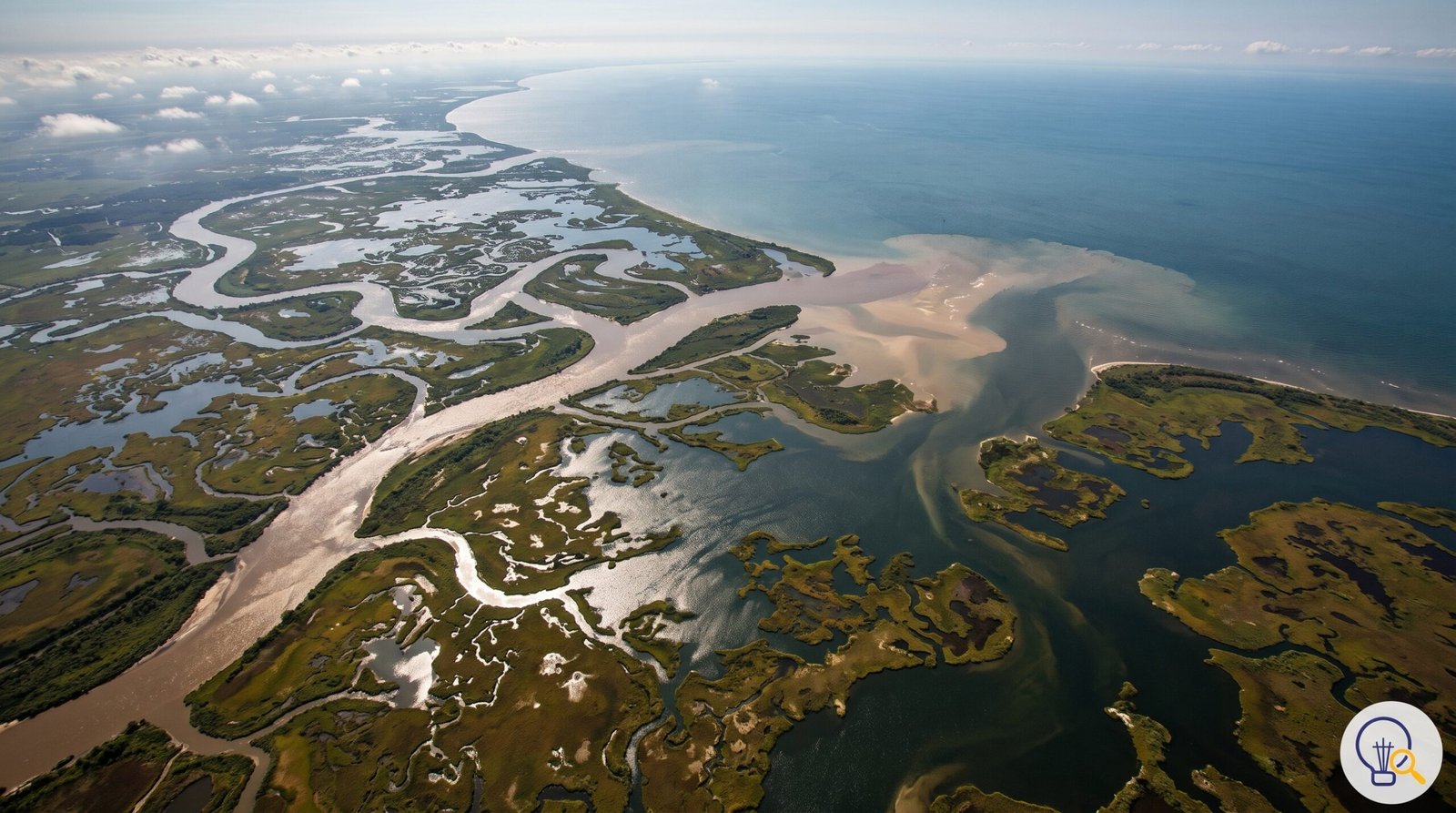
Much of south Louisiana was built from sediment the river carried down over the last 12,000 years. A series of delta lobes, from the old Maringouin and Teche to the modern Mississippi and the growing Atchafalaya, stacked up the land.
That process has stopped working. The levee system keeps spring floods from spreading fresh water and mud across the marshes. Canals cut for oil and gas let salt water creep in, and rising seas add to the coastal erosion. According to a major state and federal assessment, Louisiana lost approximately 1,883 square miles of coastal land between 1932 and 2010. This loss reflects several connected processes, including subsidence, erosion, altered river flows, canals, and rising sea levels.
Louisiana’s Coastal Protection and Restoration Authority coordinates a long-term program of levee improvements, marsh creation, barrier-island restoration, and other coastal projects. Offshore, an oxygen-poor area known as the Gulf “dead zone” forms in many summers. Nutrient pollution carried by the Mississippi River watershed contributes to the problem. Its measured size changes each year; one unusually large estimate reached 8,776 square miles in 2017.
Weather and Hurricane Season
Louisiana has a humid subtropical climate. Summer highs in the south average above 90°F, and when humidity is high, the heat index can top 120°F. Winters are mild, with northern lows occasionally dipping near 20°F.
Thunderstorms are common, especially during the warm months, and tornadoes can occur in different parts of the state. Severe weather is possible in every season, so local forecasts matter when planning outdoor activities.
Because the coast is so hurricane-prone, the official Atlantic hurricane season, June 1 to November 30, matters here more than almost anywhere. Tropical cyclones can push storm surge far inland through the bayous and marshes. Louisiana has recorded both extreme summer heat and occasional winter freezes, despite its generally humid subtropical climate.
Major Cities
| City | Region | Known for |
| New Orleans | Southeast | The state’s largest city (about 363,000 people), a major port, and its cultural capital |
| Baton Rouge | South-central | The state capital and second-largest city, home to Louisiana State University |
| Lafayette | Acadiana | The center of Cajun and zydeco culture |
| Shreveport | Northwest | North Louisiana’s largest city, paired with Bossier City |
| Lake Charles | Southwest | An industrial and port hub near the Texas border |
Because the regions differ so much, exploring more than one city gives visitors a broader picture of Louisiana.
Wildlife, Swamps, and Nature
Louisiana’s wild side is one of its biggest draws, and these facts about Louisiana wildlife are easy to picture once you’ve seen a cypress swamp at dawn.
The state holds one of the largest wetland systems in North America, and the terms get confusing. Here’s the simple version. A swamp is a forested wetland, often filled with cypress and tupelo trees. A marsh is dominated by grasses, with few or no trees. A bayou is a slow-moving creek or waterway winding through flat, low land.
The Atchafalaya Basin is the largest river swamp in the United States, according to the U.S. Geological Survey. It covers more than a million acres of forested wetlands and marsh. The basin also provides habitat for bald eagles and many other bird species.
Alligators, Birds, and Other Animals
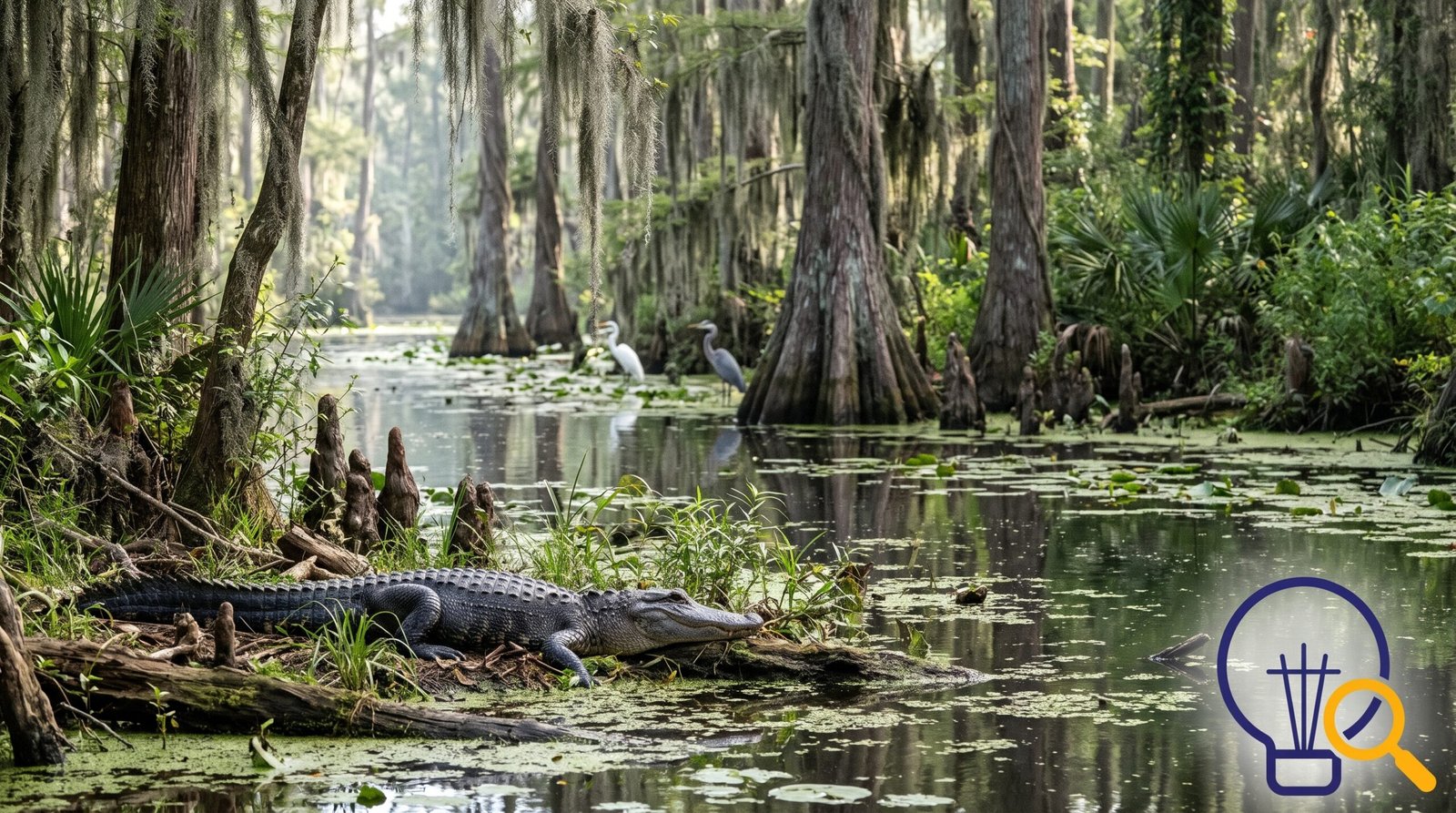
The American alligator is the icon, and the state manages it through a regulated harvest and farming program. USDA figures from 2013 attributed 57 percent of U.S. alligator sales to Louisiana. Because this is an older statistic, keep the year attached rather than presenting it as a current market share.
Birdwatchers will find brown pelicans, roseate spoonbills, egrets, ibises, and purple gallinules. Less famous residents include the alligator snapping turtle, the rare Louisiana pine snake, and the swamp rabbit, a good swimmer that takes to the water when threatened.
Look for bald cypress trees too. Their “knees,” woody growths that rise above the waterline, are one of the swamp’s most recognizable sights.
National and State Parks
Jean Lafitte National Historical Park and Preserve has units in New Orleans, St. Bernard Parish, Barataria, and the Acadiana area. Cane River Creole National Historical Park near Natchitoches preserves plantation history, and Poverty Point National Monument sits in Delhi, in the northeast.
Kisatchie National Forest, about 600,000 acres, is the state’s only national forest. It protects longleaf pine habitat and rare species like the red-cockaded woodpecker. The state also maintains a network of state parks and historic sites that protect natural areas and preserve local history.
For wildlife viewing, choose a smaller boat tour over a big one. Smaller boats can slip into narrower channels and tend to be quieter, which helps. Ask whether the tour runs year-round, since alligators are less active in cold weather.
Why Louisiana Has Parishes, Not Counties
This is the “only in Louisiana” question people ask most, and the answer starts in colonial church records.
Louisiana has 64 parishes, and no other state uses the term. The units trace back to Catholic church districts from French and Spanish rule, which later became civil divisions in the early 1800s.
Alaska is the only other state without counties, but it uses boroughs and census areas instead. A few Louisiana places go further and merge city and parish government into one unit.
For official records and local government services, residents use parish offices rather than county offices.
Civil Law vs. Common Law
Louisiana is the only state whose private law is built on a civil code, not English common law.
| Feature | Louisiana (civil law) | Other 49 states (common law) |
| Main source of law | Written codes and statutes | Court decisions and precedent |
| Roots | French and Spanish law | English legal tradition |
| Judges’ role | Start with the code; court decisions also matter | Precedent carries heavy weight |
A few differences show up in daily life. Louisiana has “forced heirship” rules that protect certain children, such as those 23 or younger or permanently unable to care for themselves, from being fully disinherited. Louisiana law also uses concepts like usufruct, which gives one person the right to use property owned by another. And spouses generally share ownership of property acquired during marriage.
You’ll often hear this called the “Napoleonic Code.” That’s partly right but oversimplified. The state’s early codes, including the 1808 Digest and the 1825 Civil Code, drew on both French and Spanish law and have been revised many times since.
Government and Elections
State government has the same basic pieces as elsewhere: a governor, a two-chamber legislature (Senate and House of Representatives), and the Louisiana Supreme Court.
Elections have been unusual. For decades Louisiana used a majority-vote system, often called the “jungle primary,” where all candidates run on one ballot and the top two go to a runoff unless someone wins more than 50 percent.
Louisiana has changed its election system in recent years, and the rules can differ by office and election cycle. Do not describe every congressional or statewide contest as using the same primary system. Before publishing specific 2026 election details, verify the rules for the particular office with the Louisiana Secretary of State.
People and Demographics
About 4.6 million people live in Louisiana. Most are in the south, around Greater New Orleans, the Florida Parishes, and Acadiana, while Central and North Louisiana have been stagnating.
According to the Census Bureau’s current QuickFacts estimates, about 61 percent of Louisiana residents are White alone, 32 percent are Black alone, 8.5 percent are Hispanic or Latino, and 2.1 percent are Asian alone. Hispanic or Latino is an ethnicity, so people in that category may be of any race. Vietnamese communities are especially visible along parts of the Gulf Coast. Saint Malo, founded by free Filipino sailors known as “Manilamen,” is often described as the oldest Asian settlement in the United States.
Louisiana’s population reflects generations of French, African, Spanish, German, Filipino, and Vietnamese influence. These communities have helped shape the state’s food, music, language, neighborhoods, and traditions.
Education is part of the picture, too. The state has more than 40 public and private colleges and universities. Louisiana State University in Baton Rouge is the largest, Tulane in New Orleans is a major private research university, and Southern University and Grambling State are the state’s two largest historically Black universities.
Languages Spoken in Louisiana
Louisiana is a multilingual state, though less than its reputation suggests. The Census Bureau’s 2020–2024 estimates show that 8.5 percent of Louisiana residents age 5 and older speak a language other than English at home.
Spanish is the most common language other than English spoken at home. French, including Cajun varieties, and Vietnamese are also part of the state’s linguistic heritage. Louisiana French, Cajun French, and Louisiana Creole are related to the state’s history but are not interchangeable terms.
The state constitution protects residents’ right to preserve their historic, linguistic, and cultural origins. English was the only language of instruction in schools in 1921, but multilingualism returned in 1974.
Three varieties matter most in the heritage story. Louisiana French is the regional form of French. Cajun French is spoken in Acadiana. Louisiana Creole, sometimes called Kouri-Vini, is a separate language blending French, African, Spanish, and Native influences, and it is now endangered. CODOFIL, the state’s French-language council, works to keep French alive through schools and cultural programs.
Religion and Traditions
Louisiana splits religiously. The south is heavily Catholic because of its French and Spanish heritage, while the north is mostly Protestant, a pattern more typical of the South. In the Public Religion Research Institute’s 2020 survey, about 53 percent of adults were Protestant and about 22 percent Catholic, a notably large Catholic population for a southern state.
Smaller communities add to the mix. New Orleans has long had an influential Jewish community, and the state is home to roughly 25,000 Muslims. Louisiana Voodoo and Haitian Vodou arrived with Caribbean and African influences and are still practiced today, often misunderstood by outsiders.
Cajun, Creole, and Isleño Culture
Three communities are especially important to understanding Louisiana’s cultural identity: Creoles, Cajuns, and Isleños.
Creole is a term with a complex history in Louisiana. It was used for people born in the colony and, over time, came to describe communities with varied French, Spanish, African, Indigenous, and Caribbean backgrounds. Free people of color (gens de couleur libres) formed influential Creole communities, especially in New Orleans. The meaning of the term has varied by place and period.
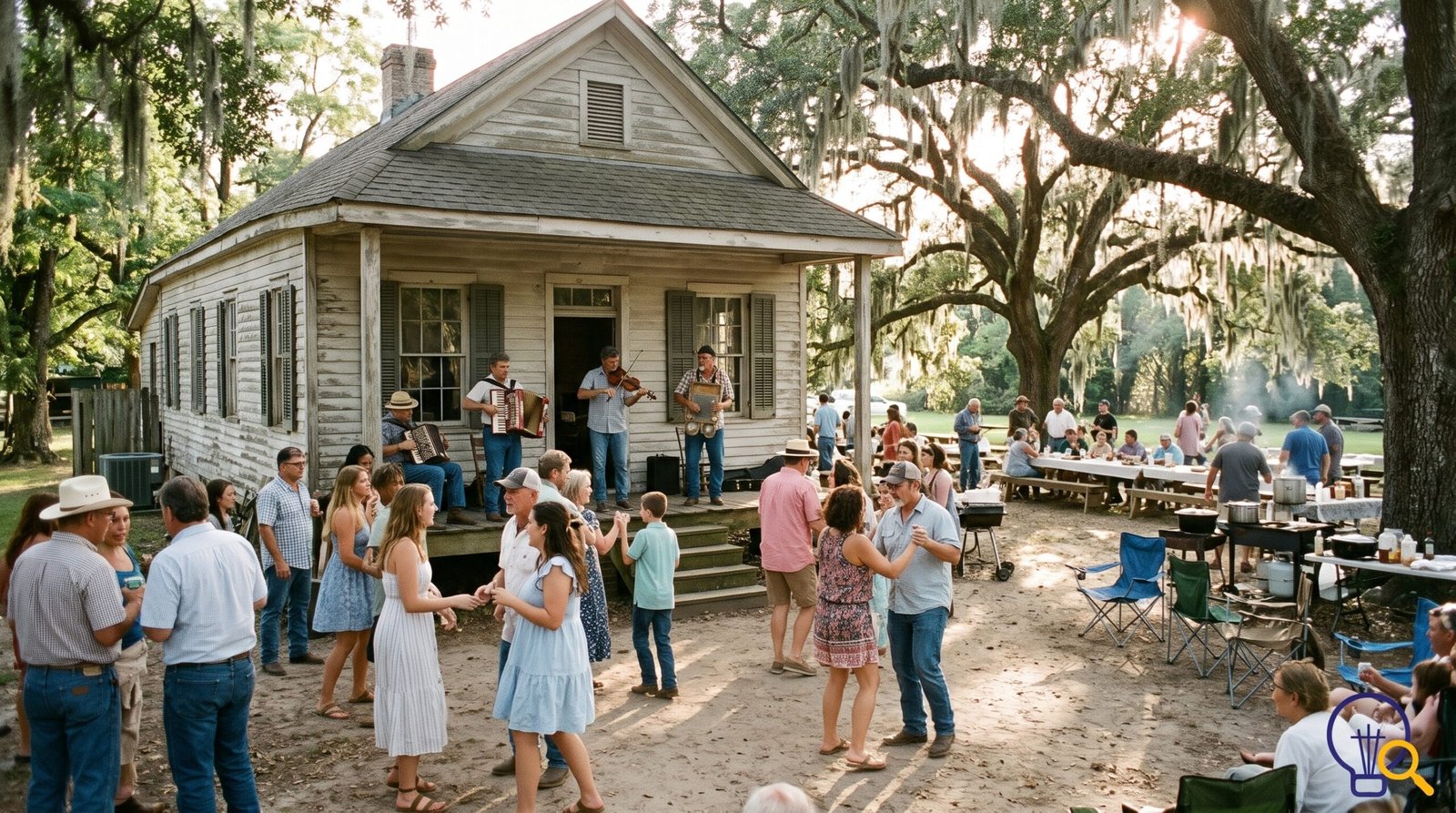
Cajuns descend from Acadians from eastern Canada who were expelled by the British. Many settled in southwest Louisiana, where they developed a rural culture distinct from New Orleans.
Isleños descend from Canary Islanders who came under Spanish rule. The community in St. Bernard Parish kept its traditions longest, and it still holds the annual Fiesta de los Isleños.
Cajun vs. Creole: What’s the Difference?
| Cajun | Creole | |
| Origin | Acadians exiled from Canada | Colonial French, African, Spanish, and Native mix |
| Typical region | Rural Acadiana (prairies and bayous) | New Orleans, river parishes, Cane River |
| Food style | Rustic, one-pot cooking, dark roux | Often richer, with tomatoes and more European technique |
| Music | Fiddle- and accordion-led dance music | Zydeco is strongly associated with Black Creole communities; New Orleans also shaped jazz |
| Language | Cajun French | Louisiana Creole and Creole French |
Cajun and Creole communities have influenced one another for generations. Many families share connections to both, and the table is a broad introduction rather than a strict set of rules.
Louisiana Food Facts
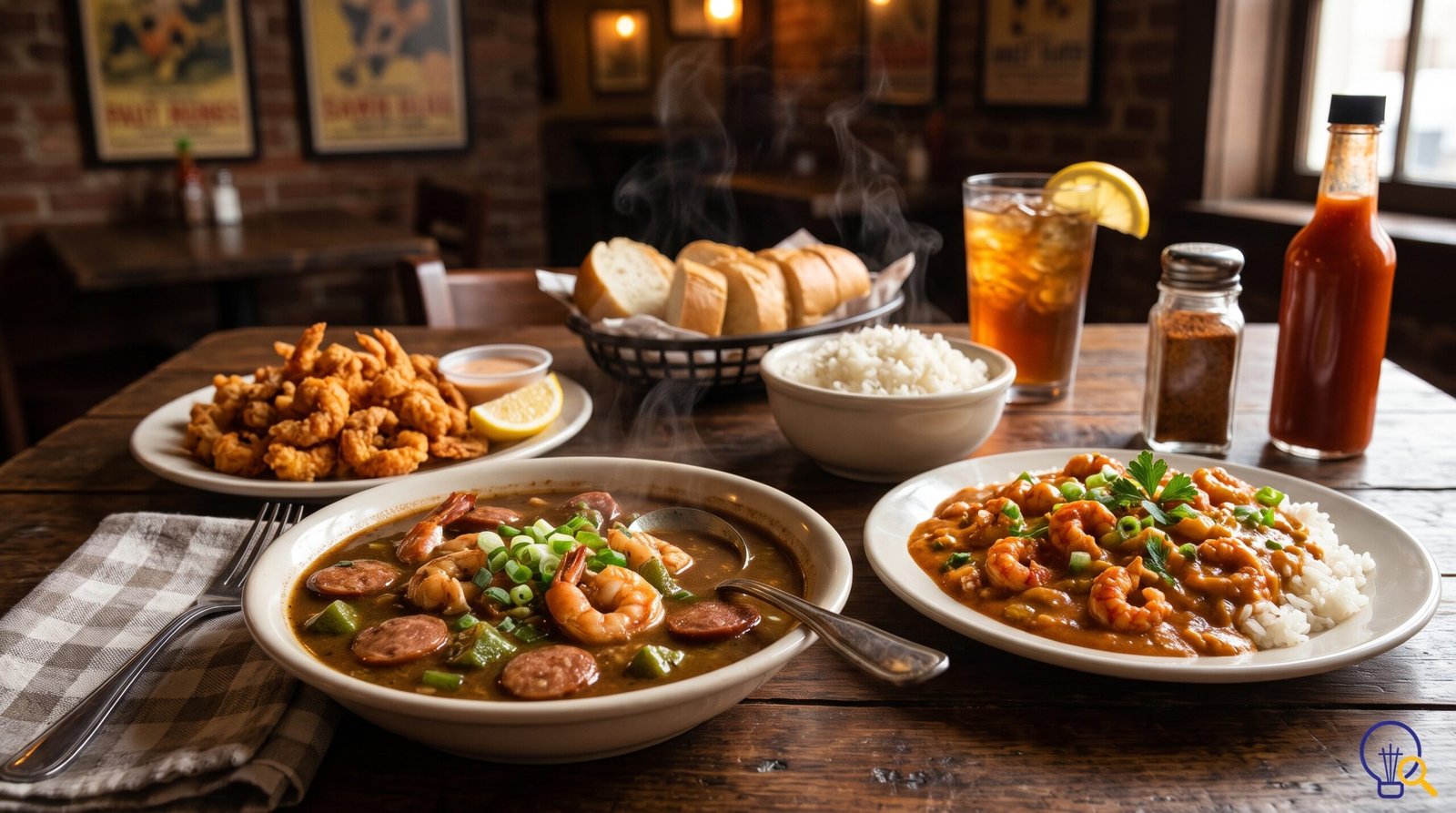
The state’s culinary heritage is the easiest part of its culture to taste, and it comes from the same mix of French, Spanish, African, and Native traditions covered above.
Start with gumbo, a stew thickened with roux, okra, or filé and served over rice. Jambalaya looks similar but works differently: the rice cooks right in the pot with the meat, seafood, and seasonings. Étouffée smothers shellfish in a rich sauce (the word means “smothered”), and boudin is a pork-and-rice sausage you’ll find at gas stations across Cajun country. Po’boys, crusty French-bread sandwiches, and beignets, the square, powdered-sugar doughnuts, round out the classics. At Mardi Gras, you’ll also meet the king cake, a ring-shaped pastry with a hidden plastic baby.
A roux deserves a closer look, because it explains half the cooking. It’s flour cooked in fat until it changes color. The darker it gets, the deeper the flavor, though it also thickens less.
Louisiana is the leading U.S. crawfish-producing state, and spring is the peak harvest season. Many crawfish ponds are integrated with rice farming, allowing producers to use the same fields for both crops.
Tabasco sauce was first made on Avery Island, one of the state’s salt domes, and the McIlhenny Company still makes it there.
One important detail about Cajun and Creole cooking is that flavor comes from carefully layered ingredients and seasoning, not simply from heat.
Music, Festivals, and Mardi Gras
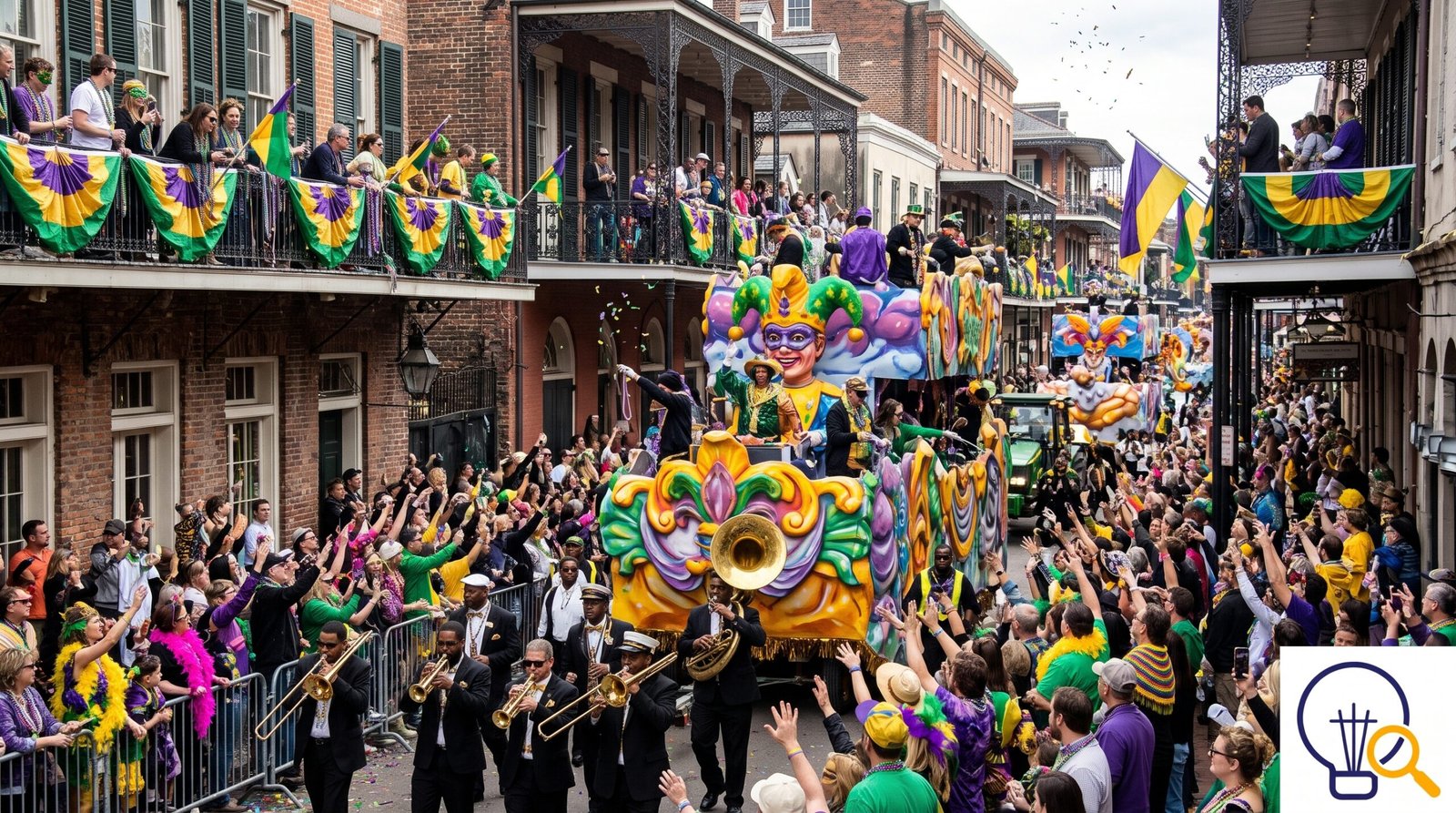
Louisiana’s musical heritage is so deep that the sound of the state shaped American music. It’s also one of the best-loved parts of the state, because it’s part of daily life here, not just concert fare.
New Orleans is widely regarded as one of the key birthplaces of jazz. The city’s early jazz scene helped launch icons like Louis Armstrong and Jelly Roll Morton. Fats Domino brought a rolling New Orleans piano style into early rock and roll. Beyond jazz, Louisiana gave the world blues, gospel, Cajun music, and zydeco, the accordion-driven dance music rooted in Creole communities of southwest Louisiana.
Mardi Gras is a season, not a single day. Carnival begins on January 6 and builds to Fat Tuesday, the day before Ash Wednesday. In 2027, that’s February 9. Krewes organize parades, throw beads and trinkets, and ride floats, and the king cake tradition keeps the party going.
Louisiana’s festival culture runs year-round, from the New Orleans Jazz & Heritage Festival to Festival International de Louisiane in Lafayette. Rural Cajun communities even hold a Mardi Gras “run” on horseback, called a Courir de Mardi Gras. In St. James and St. John the Baptist parishes, locals light bonfires along the Mississippi levees on Christmas Eve.
If you’re going for Mardi Gras, book your hotel months ahead, arrive early at the parade route, and expect road closures near the route in New Orleans.
Economy and Major Industries
Oil and gas are important to Louisiana’s economy, but they are only part of the picture.
Louisiana’s economy is shaped by energy, petrochemicals, agriculture, seafood, shipping, tourism, and film production. The importance of each sector varies over time with markets, weather, and investment.
| Industry | Standout fact |
| Oil and natural gas | Salt domes serve as natural traps for oil and gas |
| Petrochemicals | The petrochemical industry is a major contributor to state output, especially along the river |
| Agriculture | Louisiana ranked third in U.S. rice production in the 2017 Census of Agriculture and also grows sugarcane, soybeans, and cotton |
| Seafood | Commercial fishing and aquaculture support coastal jobs and food businesses |
| Tourism and gaming | The tourism economy is strongest in Greater New Orleans |
| Film | State incentives since 2002 earned it the nickname “Hollywood South” |
The Mississippi River connects these industries to national and international markets.
Ports, Waterways, and Transportation
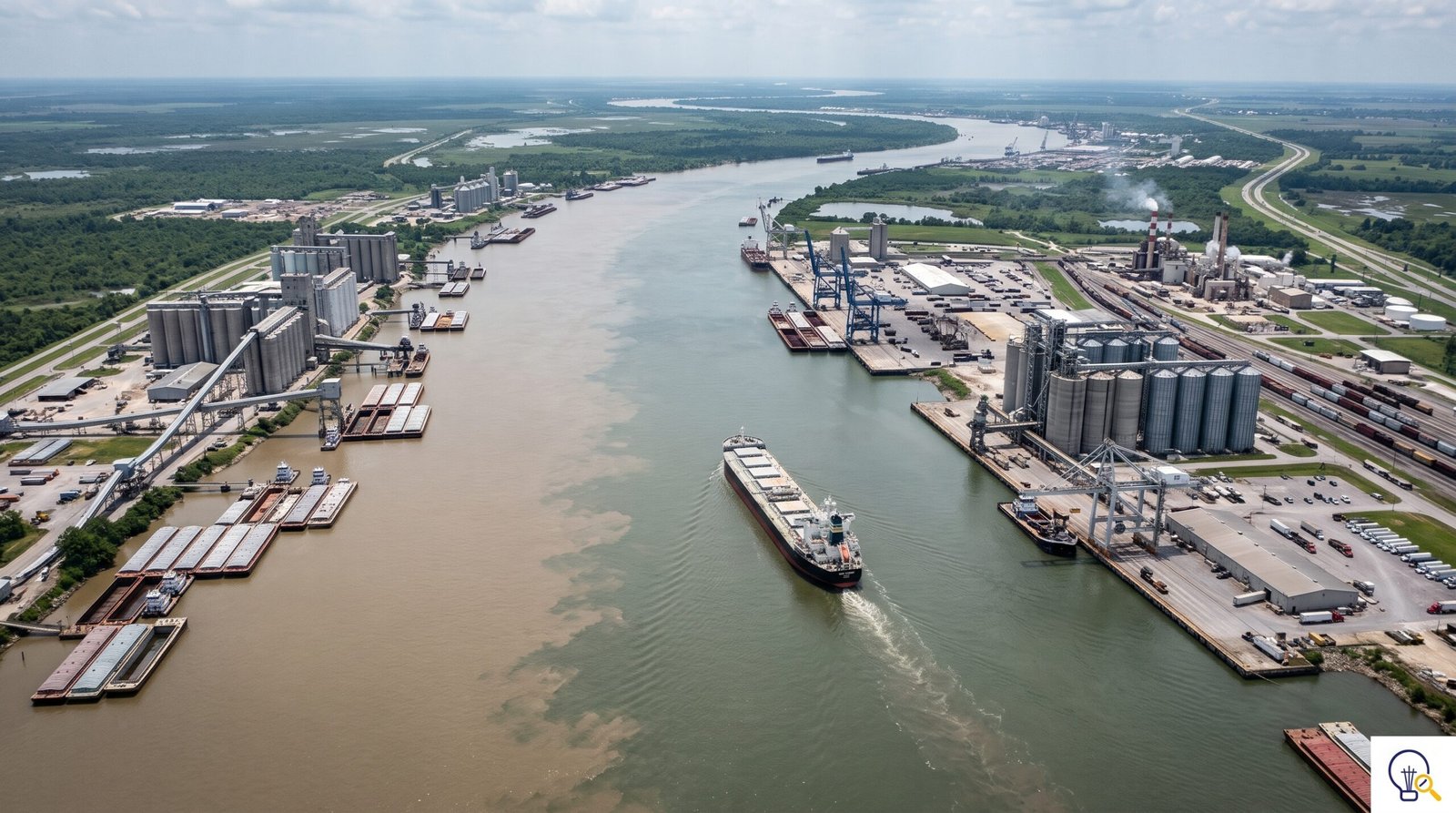
The Port of South Louisiana stretches 54 miles along the Mississippi between New Orleans and Baton Rouge. It is a major hub for bulk cargo, grain, energy products, and other goods moving through the Mississippi River system. Port traffic changes from year to year, so avoid describing its ranking without a dated comparison.
More than 4,000 miles of navigable waterways crisscross the state. Long bridges are a necessity here, such as the 18-mile Atchafalaya Basin Bridge.
On land, six major freight railroads operate in the state. Amtrak runs three long-distance routes out of New Orleans: the Crescent, the City of New Orleans, and the Sunset Limited.
Famous People and Sports
Louisiana has produced notable figures in music, business, entertainment, and public life. Wynton Marsalis became one of the best-known jazz trumpeters and composers of his generation. Harry Connick Jr. built a career as a pianist, singer, and actor. Madam C.J. Walker, born in Delta, became a pioneering entrepreneur and philanthropist, and Ellen DeGeneres, born in Metairie, became one of America’s best-known TV hosts.
Sports culture is just as strong. The New Orleans Saints play in the Superdome, and the LSU Tigers are the pride of Baton Rouge. Each Thanksgiving weekend, Southern University and Grambling State meet in the Bayou Classic, one of the biggest games in historically Black college football, also held in the Superdome.
In many Louisiana communities, game day brings together local pride, food, music, and family traditions.
Best Places to Visit in Louisiana
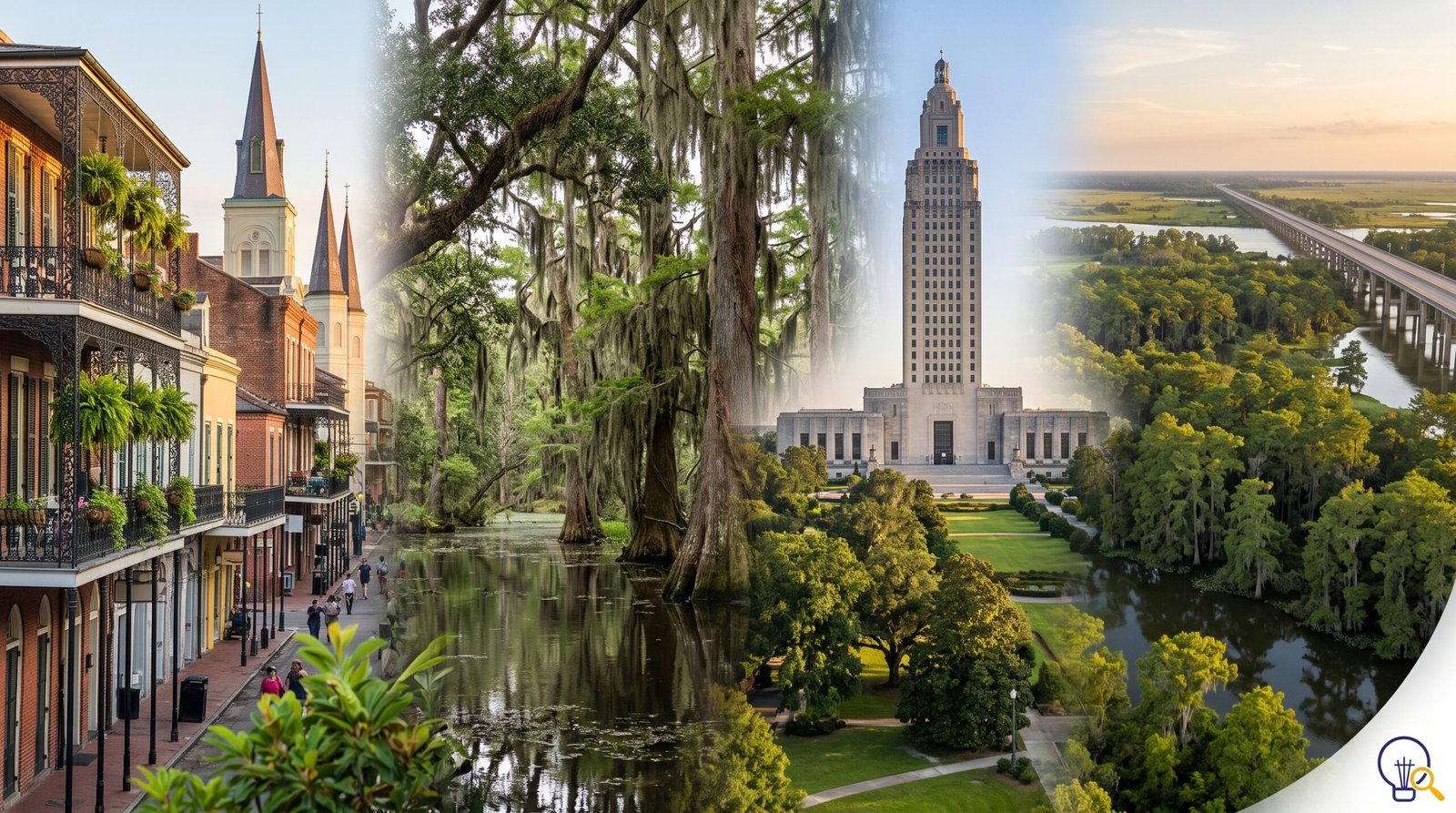
To turn these Louisiana facts into a trip, start with a mix of city, swamp, and small town.
In New Orleans, the French Quarter is the oldest neighborhood, with iron balconies and live music on almost every block. Jackson Square and St. Louis Cathedral anchor the historic heart, and the Garden District is best explored on foot or by streetcar.
Louisiana also has natural landmarks worth exploring. Lake Pontchartrain is a defining feature of the southeast, Toledo Bend Reservoir lies along the Texas border, and Catahoula Lake is known for its seasonal wetlands and birdlife. In central Louisiana, Kisatchie National Forest offers longleaf pine landscapes and hiking areas.
For museums, visitors can explore the National WWII Museum and the Louisiana State Museum in New Orleans, or the Capitol Park Museum in Baton Rouge. Check opening days and admission details before making a trip.
Outside the city, swamp tours run in the Atchafalaya and Manchac areas. Avery Island, home of Tabasco, lets you stand on an actual salt dome. Lafayette and the surrounding Cajun country offer live music, dance halls, and boudin stops. In the north, Natchitoches is a historic river town, and Poverty Point is a quiet, powerful stop for anyone interested in the ancient earthworks.
A simple 3-day route:
- Day 1: New Orleans. Walk the French Quarter and eat beignets.
- Day 2: Drive west across the Atchafalaya Basin to Lafayette, with a stop at Avery Island.
- Day 3: Head back through Baton Rouge to see the capitol and the river.
The northern sites, Natchitoches and Poverty Point, deserve a separate trip.
If you travel between June and November, book refundable lodging and check the forecast before you go. Summer heat is real, so plan outdoor stops for mornings.
Best Time to Visit by Season
Use this seasonal guide to choose travel dates:
| Time of year | Weather | What’s happening |
| January to February | Mild and often damp | Carnival season and Mardi Gras (February 9 in 2027) |
| March to May | Warm and pleasant | Peak crawfish harvest, Festival International in Lafayette, and Jazz Fest season |
| June to September | Hot, humid, storm-prone | Peak hurricane risk, fewer crowds, lower hotel prices |
| October to November | Milder, drier | Fall festivals, the end of hurricane season, and the Bayou Classic at Thanksgiving |
| December | Cool and mild | Holiday lights and Christmas Eve levee bonfires |
Louisiana Words You’ll Hear
A few local words can save you some confusion:
- Lagniappe: a little something extra, like a free bonus with your purchase
- Krewe: a Mardi Gras parade organization
- Neutral ground: the grassy median in the middle of a street in New Orleans
- Making groceries: a local way of saying you’re grocery shopping
- Laissez les bons temps rouler: Cajun French for “let the good times roll”
- Parish: what everyone else calls a county
Common Myths About Louisiana
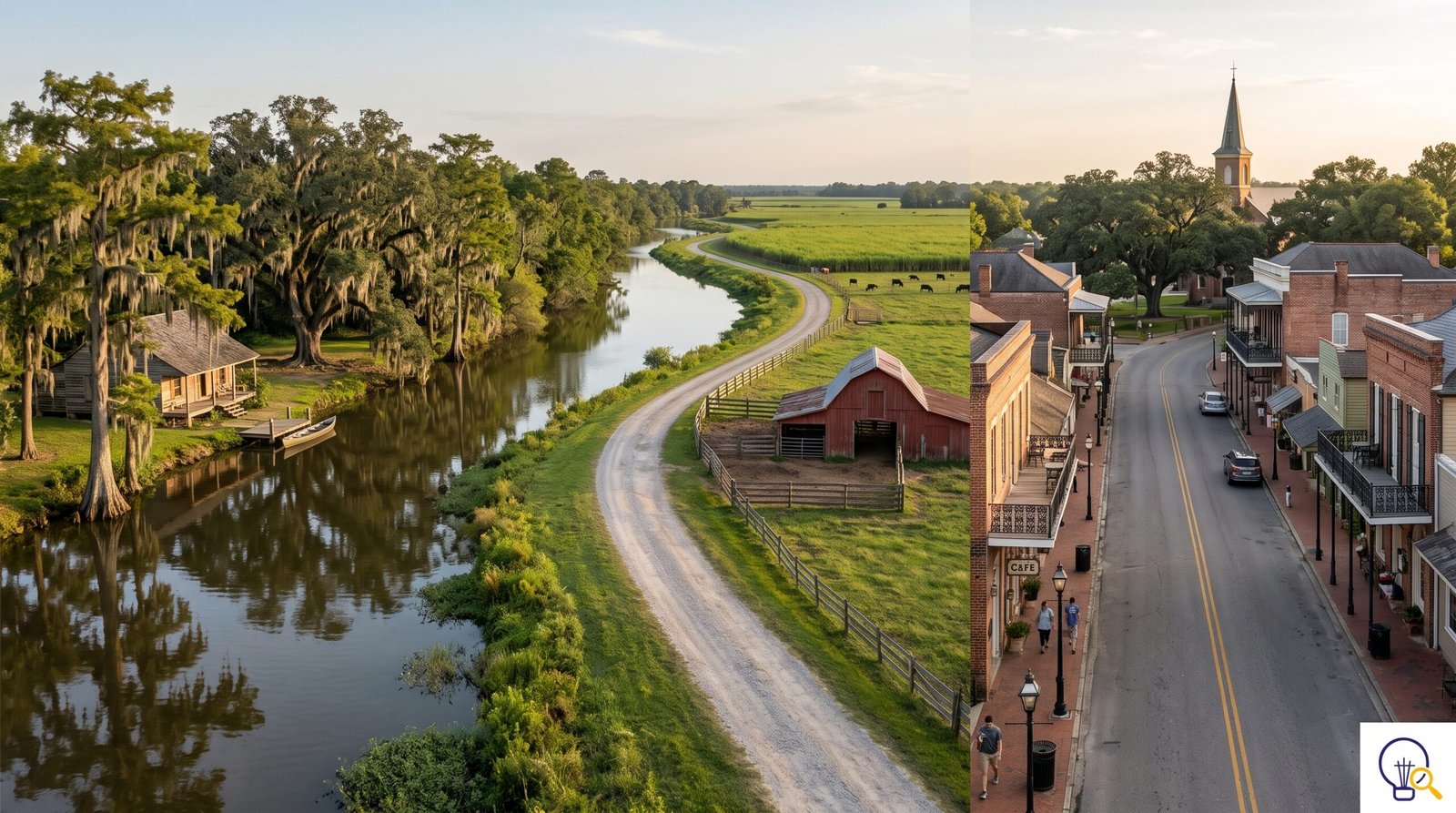
Even familiar details about Louisiana are often misunderstood. Here are five common myths, explained.
Myth: Cajun and Creole mean the same thing.
Reality: They’re related but distinct cultures with different origins, even though they overlap.
Myth: Louisiana has counties like everywhere else.
Reality: It uses parishes, a leftover of church districts from colonial times.
Myth: Everything in Louisiana is spicy.
Reality: Traditional Cajun and Creole cooking focuses on layered seasoning. Hot sauce usually sits on the table for you to add.
Myth: Louisiana is just New Orleans and swamps.
Reality: You’ll also find tallgrass prairie, longleaf pine forests, rice fields, and a quiet, Protestant-leaning north.
Myth: Mardi Gras is one day in the French Quarter.
Reality: It’s a weeks-long season, and communities across the state celebrate it in their own ways, including rural horseback runs.
15 Fun Louisiana Facts for Kids and Students
Here are 15 easy-to-remember facts about Louisiana’s history, geography, culture, and official state symbols:
- Louisiana became the 18th U.S. state on April 30, 1812.
- Baton Rouge is the state capital.
- New Orleans is Louisiana’s largest city.
- Louisiana has 64 parishes instead of counties.
- The brown pelican is the state bird.
- The magnolia is the state flower.
- The bald cypress is the state tree.
- The American alligator is the state reptile.
- The Catahoula Leopard Dog is Louisiana’s official state dog.
- Milk is the official state drink.
- The crawfish is the official state crustacean.
- The honeybee is the official state insect.
- Petrified palmwood is the state fossil.
- The Cajun accordion is the official state musical instrument.
- Gumbo is the official state cuisine.
Final Thoughts
Louisiana stands apart for four big reasons: its law, its language, its land, and its culture. Parishes, a civil code, a coastline that keeps shifting, and a mix of French, Spanish, African, Native, and Caribbean traditions all make it unlike any other state.
The best way to appreciate these Louisiana facts is to experience them. Pick a parish you’ve never heard of, plan a festival weekend, or take a swamp tour and see the Atchafalaya for yourself. Which fact surprised you most? Share it with a friend, or with the next person who says Louisiana is “just New Orleans.”
Frequently Asked Questions
Here are quick answers to common questions about Louisiana’s history, culture, geography, and traditions.
What are three unique things about Louisiana?
Louisiana has parishes instead of counties, follows a civil-law tradition for much of its private law, and has a distinctive mix of Cajun, Creole, French, African, Spanish, and Indigenous cultural influences.
What is Louisiana famous for besides New Orleans?
The state is also known for Cajun and Creole food, the Atchafalaya Basin, crawfish farming, zydeco music, historic Natchitoches, and coastal wetlands.
Why does Louisiana have a different legal system?
Louisiana’s legal tradition developed under French and Spanish rule. Its civil-law system relies heavily on written codes, unlike the English common-law tradition used in the other states.
Why is Louisiana called the Pelican State?
The brown pelican is Louisiana’s official state bird and a prominent symbol of the state. The nickname stuck because the pelican is a symbol of the Gulf Coast. Louisiana also uses other nicknames, including the Bayou State and Sportsman’s Paradise.
How many parishes are in Louisiana?
Louisiana has 64 parishes. The word comes from Catholic church districts used under French and Spanish rule. Today parishes work like counties elsewhere, though Louisiana is the only state that uses the term for its main local divisions.
When did Louisiana become a state?
Louisiana became the 18th state on April 30, 1812. It had been the Territory of Orleans after the United States bought the Louisiana Territory from France in 1803. The Florida Parishes joined later that year.
How old is Louisiana?
As a state, Louisiana is 214 years old as of 2026. French claims to the region date back to 1682, and people lived in the area for thousands of years before that. Poverty Point alone is roughly 3,400 years old.
What is the capital of Louisiana?
The capital is Baton Rouge, which is also the state’s second-largest city. New Orleans is the largest city but not the capital. The capitol building in Baton Rouge has 34 stories and is the tallest state capitol in the country.
What is the largest city in Louisiana?
New Orleans is the state’s largest city. Population figures depend on the census year and whether city-proper or metropolitan populations are being compared. Most of the state’s population lives in the southern half, around Greater New Orleans and Acadiana.
Is Louisiana in the Deep South?
Yes. Louisiana is part of the Deep South, along with Mississippi, Alabama, Georgia, and South Carolina. It stands out within the region because of its French and Spanish roots, its Catholic population in the south, and its civil law system.
What language do they speak in Louisiana?
Most residents speak English. Spanish is the most common other language at home, followed by French, including Cajun, and Vietnamese. Louisiana has never named an official language, and Louisiana Creole survives as an endangered heritage language.
Does Louisiana have an official language?
No. The state has never named one, though French and Creole remain important parts of its heritage. The constitution instead protects residents’ right to preserve their historic, linguistic, and cultural origins.
Is Louisiana sinking?
Parts of the coast are losing land. Subsidence, erosion, levees that limit sediment deposits, canals, and rising seas all contribute. A major assessment estimated a net loss of about 1,883 square miles of coastal land between 1932 and 2010.
What is the highest point in Louisiana?
Driskill Mountain, in the north, is the highest natural point at 535 feet above sea level. The lowest areas are in New Orleans, where some neighborhoods sit below sea level.
What is Louisiana best known for?
Mardi Gras, jazz, Cajun and Creole food, and its swamps. Lesser-known Louisiana facts, like its civil law system, are part of what makes the state stand out from every other.
What is Louisiana #1 in?
Louisiana is the leading U.S. crawfish-producing state. The Port of South Louisiana is also a major grain-shipping hub, although rankings and export shares vary by year.
What are 5 fun facts about Louisiana?
It has parishes instead of counties, has never had an official language, and is home to the 24-mile Lake Pontchartrain Causeway. Its state dog is the only breed native to Louisiana, and its state drink is milk.
Is Louisiana more Black than white?
No. Census Bureau QuickFacts estimates show about 61 percent of residents are White alone and about 32 percent are Black alone. The state’s Black population share is among the highest in the country.
What is the difference between Cajun and Creole?
Cajuns descend from Acadians exiled from Canada and settled mostly in rural Acadiana. Creoles trace to colonial French, African, and Spanish roots, often in New Orleans. Cajun food is rustic and one-pot, while Creole cooking is often richer. Many families share both heritages.
When is the best time to visit Louisiana?
Spring and fall offer the most comfortable weather. Winter is mild, and Mardi Gras season draws big crowds. Summer is hot and humid, and hurricane season runs June 1 to November 30.
